Once you have chosen the car you need to do some paperwork…
First the car dealership takes a photocopy of your Japanese driver’s license and, in my case, my gaikokujin toroku shomeisho (certificate of alien registration – a.k.a gaijin card).
You then need to get an inkan (personal seal) made, register it at the city office, then bring the inkan and the inkan toroku shomeisho (certificate of name stamp registration) to the car dealership.
Also bring your gaikokujin toroku genpyo kisai jiko shomeisho (certified copy of registration) which shows your official address.
Fill out the parking application paper, drawing a diagram of your local streets and the exact dimensions of the parking area at your house or apartment. If you are not the owner of the house you must also produce a piece of paper from the housing office with their official stamp to show you have parking permission. Parking applications must be taken to the local police station for processing although your car dealer may do this for you. This is all done to get a shako shoumei (parking space certificate).
Then fill out the ininjo (letter of guarantee) and you are almost done…
unless you are dumping your old car with them, and then you will also need a second ininjo, a second inkan toroku shomeisho and the cars shakensho (vehicle inspection certificate), the jibai seki hoken (compulsory third-party automobile liability insurance certificate) the road tax certificate, and the recycle fee certificate.
Finally give them a wad of cash to hold the vehicle. The balance will be due when you pick up the car. Now all you have to do is wait for the paperwork to be processed. I am told this can take around a week or longer.
While you wait for your new (or newer) car you may still need to get around, and in my case my previous car no longer has a valid shakensho. I was lent a Suzuki Kei, so for the next few days I will be pootling around the island in this little 660cc car.
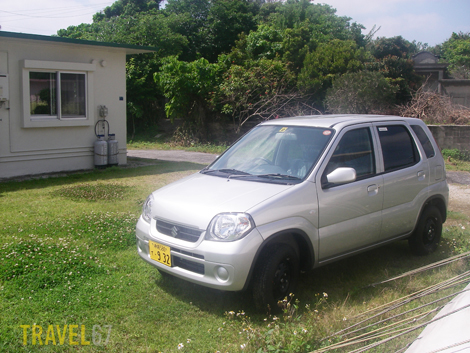
The loaner a Suzuki Kei 660cc
After only driving through town and back up the expressway to my home I have discovered some interesting things about these 660cc kei jidosha.
The steering is really light. They are a great city car, able to squeeze through tight spaces. With only a driver there is plenty of power, I imagine it would struggle if there were an extra 3 large passengers but I had no problem accelerating or cruising along the expressway.
However, kei jidosha are limited not only in their engine size but also in their width and length. K-cars must be less than 3.4 metres long and 1.48 metres wide. There is no regulation for height. The narrow width makes them great when parking or escaping from the police down narrow alleyways, but there is a reason why sports cars are wide and low. At the extreme end of the spectrum you have 4×4 off-roader K-cars such as the Suzuki Jimny and the Mitsubish Pajero Mini, these look like they are going to roll-over at any moment, and at least one of Seiko’s friends had to extricate herself and her 4×4 k-car from a ditch in Hokkaido. Driving back on the expressway, and with a bit of a sidewind, the Suzuki Kei felt decidedly wobbly. Overtaking trucks caused a sudden change in the wind, making the car skittish. Things are not helped by the fact that the tyres are not much wider than you would find on a mountain bike.
As I do both a lot of expressway driving, and because I don’t ride the bicycle during wind and rain, and as Okinawa is hit by several typhoons each year, I am now sure I made the right decision of the Swift over the Cervo.
 TRAVEL 67 : Chris Willson Photography