I was out snorkeling a week ago and found this camera in amongst the coral. It’s a nice camera. As I’ve mentioned in previous blogs, I’m a big fan of these waterproof shockproof point and shoots that can take a licking and keep on clicking. The problem is that this camera had been underwater for days if not weeks or even months. Water head leaked inside the body so that the camera no longer worked and the 8GB micro SD card inside was unreadable.
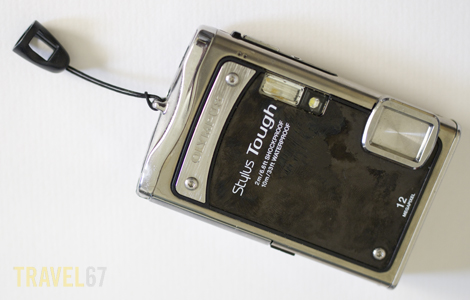
Waterlogged Olympus Stylus Tough
As is probably clear from the photo (or the title of the blog) the culprit here is the ever so convenient quick release strap connector. The owner lost their camera and quite possibly all their photos from their holiday / honeymoon / deployment in Okinawa. (If this is your camera please get in touch. I’ll hold onto the micro SD card so that if the owner does get in touch and wants to send the card to a data recovery specialist they can give it ago.)
Which leads me to the fact that many aftermarket camera straps have quick release systems at both ends of the strap. These clips are said to be very secure, but it would only take one of them to come loose for the camera to drop unceremoniously from your neck to the ground.
I understand the desire to be able to remove your camera strap quickly and easily from the camera body, but I needed a better balance of risk versus convenience. For my 645D, I now use the original strap plus two small locking carabineers to attach it to the camera.
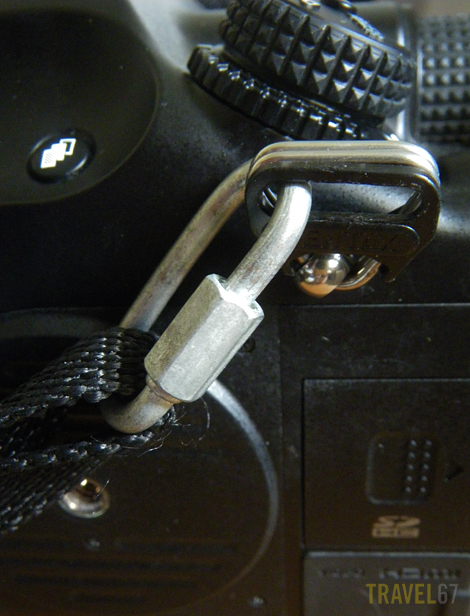
Custom Quick Release Camera Strap for Pentax 645D
So today’s question is… What camera strap are you using?
 TRAVEL 67 : Chris Willson Photography
If I were you I’d add a couple of those small leather flaps so you don’t scratch the body with your improvised lugs.
Good idea Jan, maybe I’ll create a thin neoprene sleeve that slides over the carabiner.
I’m a fan of the lug and triangle connectors that all cameras used to have, and that Pentax seems to have gone back to on the K-7, K-5 and 645D.
With my film KX from 1975 I replaced the original strap with a wide Hakuba strap with metal quick release clips on the end. This let me take the strap off when I did not need it. Very useful when mounting a camera on a tripod and you do not want the risk catching the strap on something and pulling the whole setup over.
I’m much less keen on the straps that Pentax moved to where you thread the strap through a metal slot projecting from the camera. On my Pentax DS I removed the normal strap and fixed to small key chain rings into the slot. This then let me attach my Hakuba strap to the rings and allowed for easy removal of the strap when necessary.
The other advantage is if I’m wearing my backpack and I want my hands free I use a pair of ThinkTank Camera Support Straps V2.0. One end has a metal quick release clip and the other clips to the slide webbing on the straps of my backpack. This lets the camera hang free from the front straps of the backpack while keeping it instantly available. You could even hang one camera on the left strap and one form the right strap. I don’t nee to worry about slinging a camera over my shoulder and I can let the camera go and be hands free if I to.
I’ve also bought a set of the triangular rings as shown in your photo above and fixed then to my Pentax D, so that both my D and DS can be used like this.
Last point. I have a pair of PackSafe straps for when I might need to be paranoid about someone trying to cut my camera straps of run off with my camera. These PackSafe straps feature the same metal quick release clips, but they also have a tab that you have to move aside to release the clips. Their final protection measure is that the have a pair of steel wires running the length of the strap. So no one is going to be able to cut the strap with a knife.
Regards
Chris Stone
I’ve heard PackSafe gear is meant to be good. I definitely think a camera strap you can’t slice through would be very useful in certain parts of the world.
I make my own straps, with no quick-release possible! I prefer to hold my cameras in my hand, with safety strap around the wrist – if the camera didn’t come with one I modify its neck strap, or make one from old straps. Usually a bit of Kevlar rope through the ring on the camera, then some soft ribbon, sewn together with the help of various sail-maker’s tools and waxed sail thread, and often some crimp tube over. No way this will break, unless the attachemnt point in the camera breaks!
Tord,
Using Kevlar for the camera strap sounds perfect. I’ve considered using some of my old climbing gear to fashion something similar.
Indeed, it is a thin rappelling line-type of line I use!
A note about other cameras that can be used under-water: Quite a few seem to have had problems with their Pentax W90, which quite often seem to leak, even after a brief snorkel tour :-)!
It has been replaced by a new, outwardly similar, model (WG-1) already, so the manufacturer seems to be aware of its problems!