Wind Rider
Kiteboarding instructor Mike Davison can usually be found speeding across the ocean surface, using the waves to launch himself into the air.
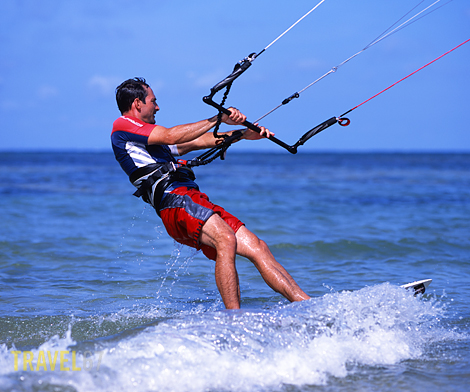
Kiteboarding Instructor Mike Davison
Mike grew up in Chicago, but moved to Okinawa in 1990. In 2001, a friend introduced him to kiteboarding, and he was immediately hooked. He bought his own kite and board, and then quickly realized he wanted to share his new found passion for the sport with others. He earned his first instructor’s certification 18 months later and began teaching his friends how to ride the waves. In 2003, he set up his own shop Patriot Kites, and today he continues to share his love for the sport with more and more people.
What is kiteboarding?
“Kiteboarding is a new sport that came into the limelight about 15 years ago. Kiteboarding uses the power of the wind to pull you along. It can be done on the sand, snow, lakes or the sea – anywhere the wind blows.”
How does a kiteboarding kite differ from a regular toy kite?
“The kites we use are much larger than toy ones so that they can generate enough force to pull the rider along. Also, they’re inflatable so that when they hit the water, they float. We can then relaunch them from the surface of the water and continue riding.”
Do you need any other equipment?
“Riders wear a harness around their waist with a clip that attaches to a loop on the control bar of the kite. The harness means that the rider can use their own body weight to control the kite rather than just arm strength.
Helmets can prevent head injury, but usually, only riders who are taking part in wake-style riding competitions wear them, as there is a danger of colliding with the artificial jumps and ramps.”
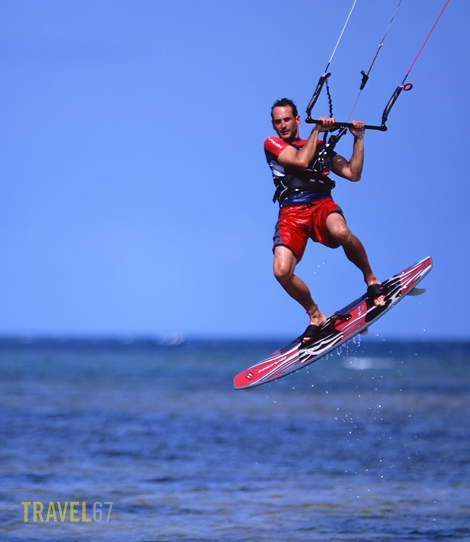
Kiteboarding Instructor Mike Davison
Do you wear a wetsuit?
“It depends on the air temperature and the water temperature. In summer many riders wear just shorts and a rash guard top; others wear a ‘shortie’ wetsuit. In winter most riders wear a full length wetsuit and some even use a drysuit. A drysuit has seals at the wrists and neck, so no water can get inside. You could even kiteboard while it was snowing, but that would be pretty hardcore.”
Is kiteboarding expensive?
“It depends what sports you are comparing it to. A set of kiteboarding equipment ranges from $500 to $2,000. It‘s of course cheaper if you buy last years model rather than the latest version. However, when you start to learn, you can use equipment provided by the kiteboarding instructor so you only need to pay for the lessons.”
How important is an understanding of the weather?
“I think it’s the most important part of the sport. You need to know the wind’s direction, speed, and quality. You also need to be aware of the waves, the tides, and even the cloud types. If you didn’t understand the wind, the kite could pull you out to sea or even lift you up into the air.”
Does the kiteboarder always travel with the direction of the wind?
“No, you travel at roughly right angles to the wind. Experienced riders are able to position the kite and the board so they can move upwind or downwind, just like a sailboat.”
What are the popular tricks?
“The basic tricks are similar to skateboarding and skateboarding: jumps, board grabs, 360s and 720s. More advanced tricks include the handle pass where you pass the control bar around your back while flying through the air.”
What do you see as the future for kiteboarding?
I expect to see further improvements in kiteboarding equipment design making it safer, more efficient, and useable in a wider range of wind conditions. I think we’ll see kite boarding become an event in the summer X-games, and maybe one day an Olympic sport.
Would you describe yourself as an adrenaline junkie?
I suppose so. I ski, snowboard, ride motocross, play ice hockey and I used to crew on a racing yacht. I guess I like speed and power. You can get that same buzz from driving a big American muscle car or racing across the ocean controlling a giant kite.

Kiteboarding Instructor Mike Davison
Interview first published in Okinawa Living Magazine, July 2007





 on the Amazon website. Our small patch of jungle had arguably the greatest diversity of bird and butterfly species in the world. I ordered a copy of the guide and have spent the last few days flicking through the book reminiscing about Hoatzins, Harpy Eagles, Potoos, and Macaws. It’s amazing to think that I once used to use the calls of Howler Monkeys as an alarm clock.

 and
and  . I’m a fan of Oprah but for me (and probably a large proportion of the British public) Attenborough is a broadcasting icon beyond compare, so I know which version I’ll order.


 . Just ordered my copy, hopefully Ben will sign it next time we meet. 🙂

 TRAVEL 67 : Chris Willson Photography