Latest Posts

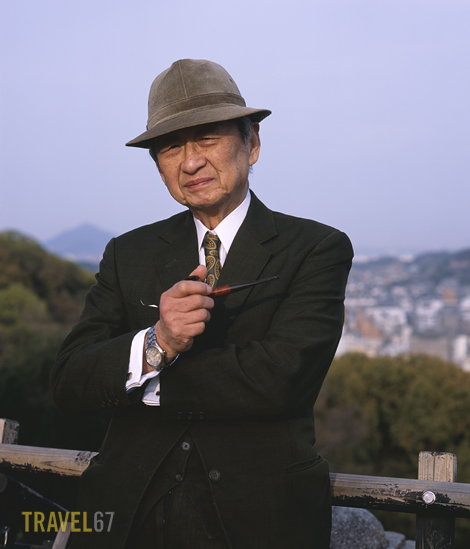
Japanese Gentleman

It’s interesting how I (and perhaps many other people) have completely different reactions toward cigarette smokers and pipe smokers. The reality is that they are both inhaling tobacco, the only difference is the delivery system.

Japanese Gentleman

Japanese Gentleman

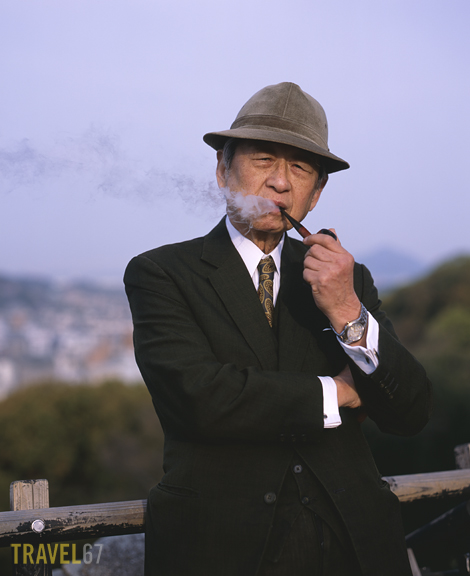
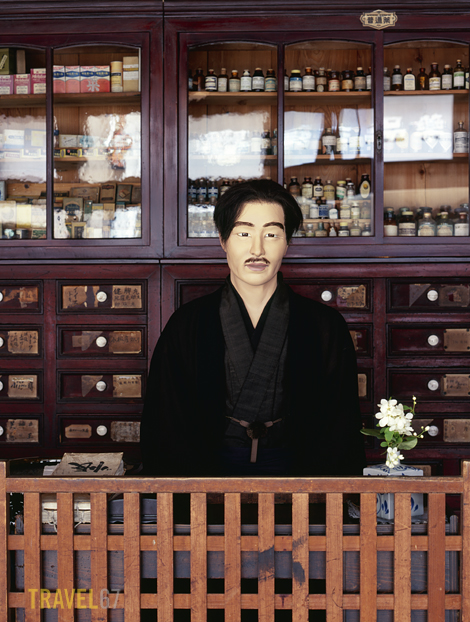
I saw this smartly dressed, Japanese man at Matsuyama castle. If he’d been smoking a cigarette I probably wouldn’t have approached him, but he was carefully packing tobacco into the bowl of his pipe. I went over and we talked as he smoked his pipe. The scene was very similar to the one with Gandalf and Frodo at the start of the Fellowship of the Rings.

After our conversation, I asked if I could take a couple of photographs. He was more than happy to pose for a couple of shots, and then with his pipe extinguished he continued on his way. A lovely encounter with a charming man.

Japanese Gentleman

Japanese Gentleman

Matsuyama Castle, Ehime

Matsuyama Castle, Ehime

Matsuyama Castle, Ehime

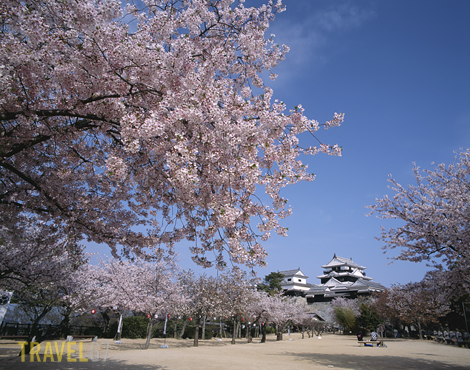
Matsuyama Castle is one of the other main attractions in Matsuyama City. From the city center, it is a short walk uphill to the castle. For those who believe only horses should sweat, there is a ropeway and chairlifts. Cherry blossom was in full bloom during my visit, and when the clouds cleared I managed to get some nice shots. (If you walk up to the castle before the chairlift opens you can even take photographs free from the crowds.)

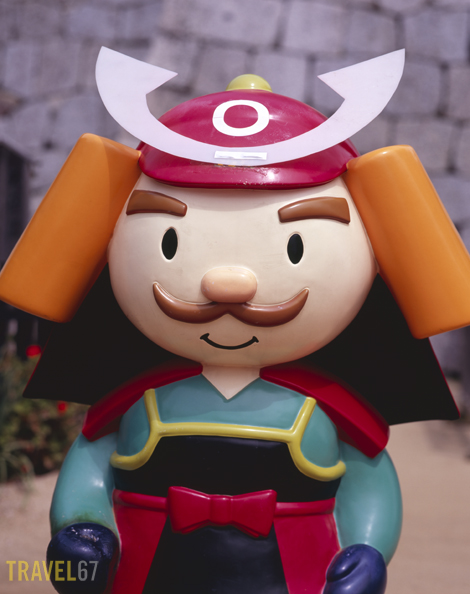
Samurai, Matsuyama Castle, Ehime

Happy Samurai, Matsuyama Castle, Ehime

Matsuyama Castle, Ehime

Matsuyama Castle, Ehime

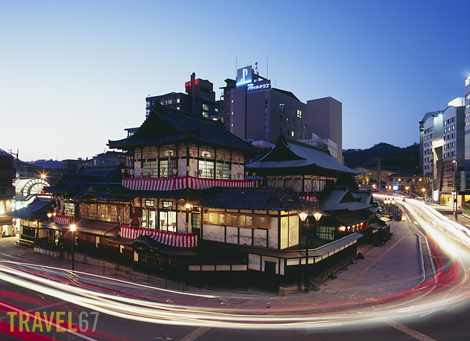
Dogo Onsen, Matsuyama City

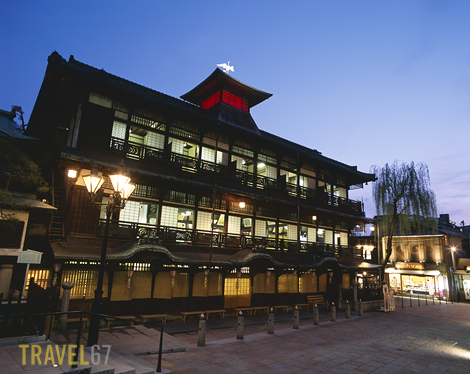
Dogo Onsen is the oldest hot spring in Japan, and a special bath for the royal family. According to legend, a white heron once dipped its injured leg into the spring’s warm waters and was miraculously healed. White herons can be seen on the pillars around Dogo Onsen, on yukata worn by guests, and most famously on the roof. The onsen building is delightful, an island of ornate wood and tile  in a sea of concrete and asphalt.

Dogo Onsen, Matsuyama City

Dogo Onsen was the inspiration for the bathhouse in Hayao Miyazaki’s Spirited Away. Just as in the movie, it is an enchanting place to visit. (If you haven’t seen the film, rent, borrow, or buy a copy. It’s very good.)

Dogo Onsen, Matsuyama City

Dogo Onsen, Matsuyama City

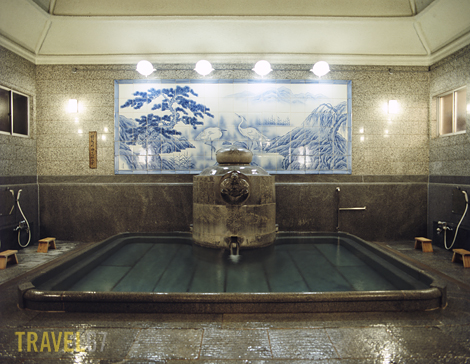
For ¥250 you can go for a guided tour of the onsen, but unless you are very shy or have tattoos, there are far better options. For just ¥400 you can bathe in the Kami-no-Yu bath. For ¥800 you can bathe in the Kami-no-Yu bath and follow this with tea and senbei. The best option is for ¥1200 yen, where you can bathe in the special Tama-no -Yu bath (and then the Kami-no-Yu bath) before enjoying your tea and senbei.

Dogo Onsen, Matsuyama City

Kami-no-Yu Men's Bath (east) Dogo Onsen, Matsuyama City

Uchiko, Ehime Prefecture

From Beppu, I took the ferry across to Yawatahama on the island of Shikoku. I then headed north to the historic town of Uchiko.

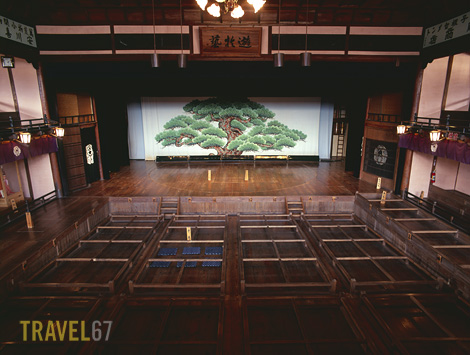
Uchiko-za Kabuki Theater, Uchiko, Ehime Prefecture

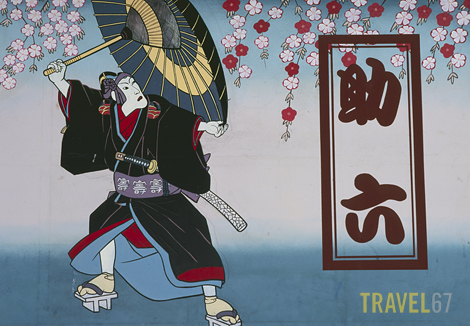
Sign outside Uchiko-za Theater, Uchiko, Ehime Prefecture

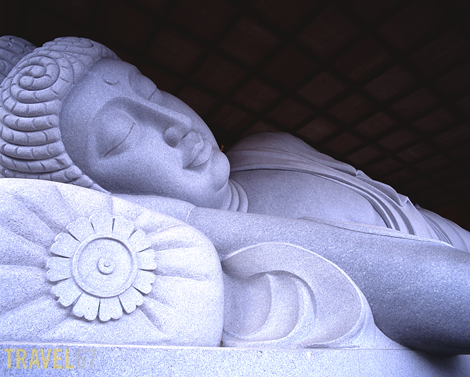
Uchiko is famous for its vegetable wax candles and Uchiko-za a Kabuki and Bunraku theater. It was an interesting place to walk around for a few hours. Kosyo-ji Temple at the top of the hill had an impressive giant reclining buddha statue that I hadn’t expected.

Reclining Buddha, Kosyo-ji Temple, Uchiko, Ehime Prefecture

And finally, I almost asked this guy for directions, but he wasn’t very talkative.

Uchiko History & Folklore Museum, Uchiko, Ehime Prefecture

Korakuen Garden, Okayama

I’m pretty sure that saying Korakuen Garden is a tautology as -en means garden. But, for the sake of clarity, I’ve titled this post Korakuen Garden, Okayama. Here’s a bit of info from The Best of Okayama.

Okayama’s mild climate and fertile soils mean that the prefecture is known for its quality rice, grapes and peaches. One of Japan’s most popular children’s stories is about Momotaro, the boy who was born from a peach, and a statue of Momotaro greets visitors at the city’s main train station.

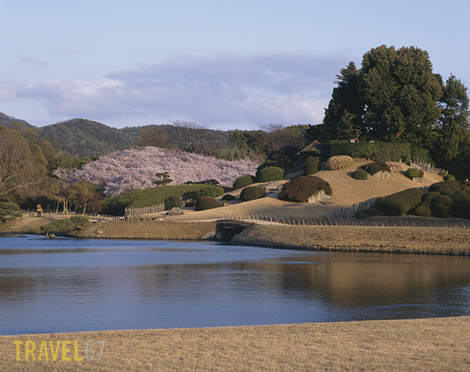
The area’s fertile soil also contributed to Okayama’s Koraku-en becoming one of the country’s top three gardens. Constructed between1687 and 1700, Koraku-en was designed with an expansive lawn for leisurely walks, a tea plantation, paddy field, and the Yatsu-hashi zig-zag bridge. Another classic feature of the garden is its use of borrowed landscape. Okayama Castle, although outside the boundary of the garden, is “borrowed” so that its presence on the skyline makes it appear as an integral part of the scenic landscape.

Before this trip, I didn’t have any photos of the garden as my last visit to Okayama was in February when the garden doesn’t look at its best. This time I got a few good images using a combination of nice light, ingenuity, and sheer luck.

Light.

Korakuen Garden, Okayama

Ingenuity.

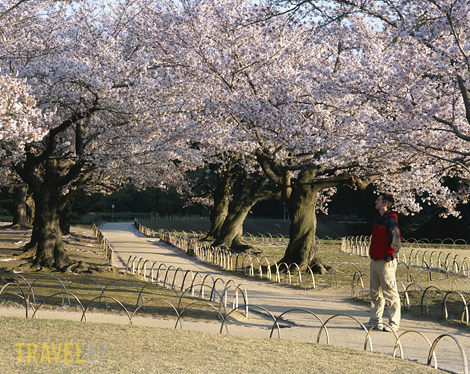
If you want a little human interest in a shot, but there’s nobody else around…

Tripod, self-timer, run.

Some strange bloke, Korakuen Garden, Okayama

Luck.

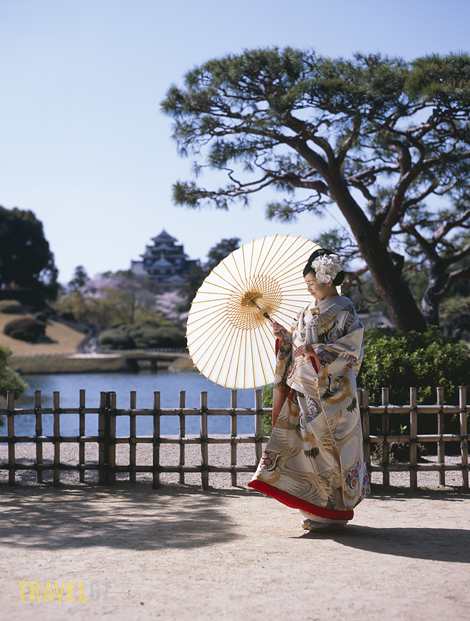
Returning to the garden early the next morning, I was initially disappointed as the light was nowhere near as nice as the evening before. However while strolling around the lake I came across a group having wedding photos taken. Bride, groom and parents were all wearing traditional costumes. For a brief moment, the bride stood to one side,  and dropped her gaze . Her light colored parasol worked as a perfect diffuser for the strong sunlight and I knew this was going to be a good shot. I don’t know how the wedding photographer’s photos came out, but I’m delighted with this one.

Japanese bride, Korakuen Garden, Okayama

Okayama Castle

I visited Okayama Castle several years ago when writing The Best of Okayama. It was good to drop by again on my latest trip, especially as the sky was postcard blue. (These shots are good examples of images where I have left room for text. Doing this hopefully makes things easier for the photo editor and the graphic designer laying out the page.)

Here’s the description of the castle from The Best of Okayama.

Modern Japan may be dominated by giant corporations, but for centuries it was feudal lords or shoguns who ruled the land. A lord’s castle served as both a military stronghold and as a sign of his power and status.

Nearly all Japanese castles were painted white, the most famous example of which is Himeji-jo. With its elegant towers and iridescent walls, Himeji-jo is thought to be Japan’s most beautiful castle, and became known as The White Egret Castle. Eastern philosophy says that everything has its opposite: Yin and Yang, good and evil, life and death. The White Egret Castle in Himeji has it opposite in Okayama – The Crow Castle.

While Himeji-jo, could be described as elegant or fairy-tale, The Crow Castle is far more imposing. The black walls and towers may be trimmed with gold, but they still give the appearance of brute strength and invulnerability. When the castle was built, the country’s finest weapons were samurai swords. The castle’s downfall would come centuries later from something far more devastating. On June 29, 1945, allied bombing raids hit Okayama City, leaving all but one turret of the castle destroyed.

In 1966, Okayama Castle was carefully reconstructed, and has once again become a commanding sight on the city skyline. The crow, like the phoenix, can rise from the ashes of disaster.

Okayama Castle

Okayama Castle

Island Icon: Mike Davison

Wind Rider

Kiteboarding instructor Mike Davison can usually be found speeding across the ocean surface, using the waves to launch himself into the air.
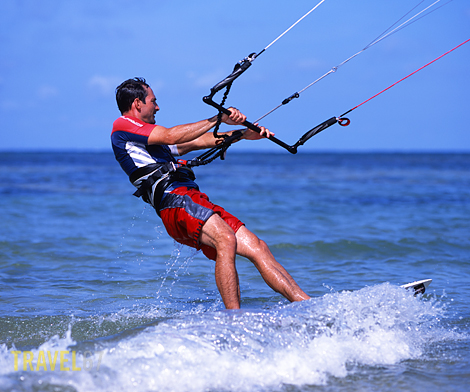
Kiteboarding Instructor Mike Davison

Mike grew up in Chicago, but moved to Okinawa in 1990. In 2001, a friend introduced him to kiteboarding, and he was immediately hooked. He bought his own kite and board, and then quickly realized he wanted to share his new found passion for the sport with others. He earned his first instructor’s certification 18 months later and began teaching his friends how to ride the waves. In 2003, he set up his own shop Patriot Kites, and today he continues to share his love for the sport with more and more people.

What is kiteboarding?

“Kiteboarding is a new sport that came into the limelight about 15 years ago. Kiteboarding uses the power of the wind to pull you along. It can be done on the sand, snow, lakes or the sea – anywhere the wind blows.”

How does a kiteboarding kite differ from a regular toy kite?

“The kites we use are much larger than toy ones so that they can generate enough force to pull the rider along. Also, they’re inflatable so that when they hit the water, they float. We can then relaunch them from the surface of the water and continue riding.”

Do you need any other equipment?

“Riders wear a harness around their waist with a clip that attaches to a loop on the control bar of the kite. The harness means that the rider can use their own body weight to control the kite rather than just arm strength.

Helmets can prevent head injury, but usually, only riders who are taking part in wake-style riding competitions wear them, as there is a danger of colliding with the artificial jumps and ramps.”
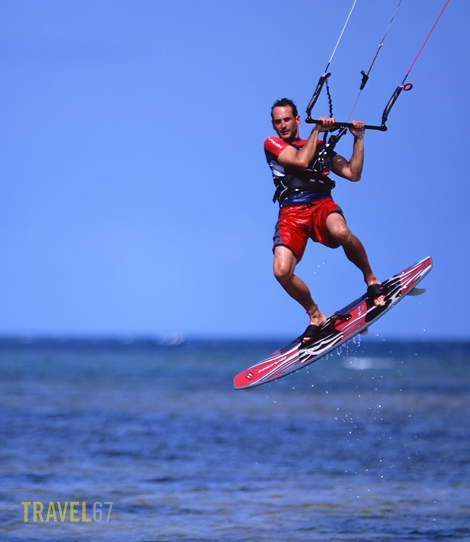
Kiteboarding Instructor Mike Davison

Do you wear a wetsuit?

“It depends on the air temperature and the water temperature. In summer many riders wear just shorts and a rash guard top; others wear a ‘shortie’ wetsuit. In winter most riders wear a full length wetsuit and some even use a drysuit. A drysuit has seals at the wrists and neck, so no water can get inside. You could even kiteboard while it was snowing, but that would be pretty hardcore.”

Is kiteboarding expensive?

“It depends what sports you are comparing it to. A set of kiteboarding equipment ranges from $500 to $2,000. It‘s of course cheaper if you buy last years model rather than the latest version. However, when you start to learn, you can use equipment provided by the kiteboarding instructor so you only need to pay for the lessons.”

How important is an understanding of the weather?

“I think it’s the most important part of the sport. You need to know the wind’s direction, speed, and quality. You also need to be aware of the waves, the tides, and even the cloud types. If you didn’t understand the wind, the kite could pull you out to sea or even lift you up into the air.”

Does the kiteboarder always travel with the direction of the wind?

“No, you travel at roughly right angles to the wind. Experienced riders are able to position the kite and the board so they can move upwind or downwind, just like a sailboat.”

What are the popular tricks?

“The basic tricks are similar to skateboarding and skateboarding: jumps, board grabs, 360s and 720s. More advanced tricks include the handle pass where you pass the control bar around your back while flying through the air.”

What do you see as the future for kiteboarding?

I expect to see further improvements in kiteboarding equipment design making it safer, more efficient, and useable in a wider range of wind conditions. I think we’ll see kite boarding become an event in the summer X-games, and maybe one day an Olympic sport.

Would you describe yourself as an adrenaline junkie?

I suppose so. I ski, snowboard, ride motocross, play ice hockey and I used to crew on a racing yacht. I guess I like speed and power. You can get that same buzz from driving a big American muscle car or racing across the ocean controlling a giant kite.

Kiteboarding Instructor Mike Davison

Interview first published in Okinawa Living Magazine, July 2007
Model Shoot: Daniela Pagan (Space)

Studio Shoot with Daniela Pagan

Studio Shoot with Daniela Pagan

Studio Shoot with Daniela Pagan

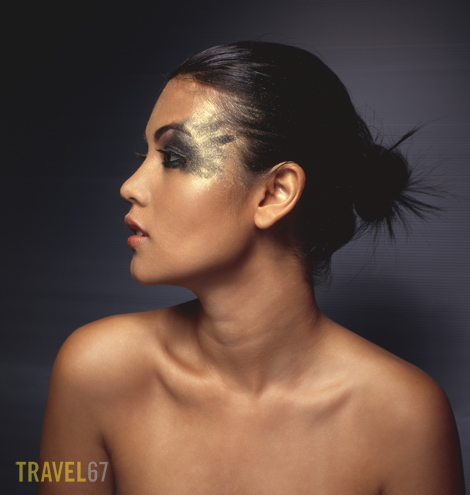
These are images from a recent shoot with model Daniela Pagan. I’m really pleased with the photos. Dani looked great, and  Eboh’s ideas for lighting worked brilliantly. Kim and Wendy did a fantastic job with make-up and hair. As for me, I merely rocked up and tried to make the most of working with a group of talented people. Big thanks to them all.

Model: Daniela Pagan

Make-up: Kim Clay

Hair: Wendy Richardson

Lighting: Eboh Ajeroh

Wardrobe: Eboh Ajeroh & Ursula Ajeroh

Birds of Peru

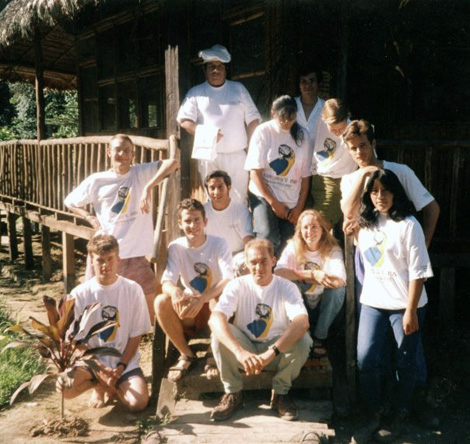
Explorer's Inn, Tambopata, Peru 1998

Back in 1998 not long after graduating from university I spent a year in South America. For six months I worked as a resident naturalist guide at a jungle lodge in the Peruvian Amazon. I guided tourists on forest walks, canoed on the lake looking for giant otters and spent evenings out in the peki peki motorized river boats searching for caiman. The memories all came flooding back when I saw a field guide to the Birds of Peru on the  Amazon website.  Our small patch of jungle had arguably the greatest diversity of bird and butterfly species in the world. I ordered a copy of the guide and have spent the last few days flicking through the book reminiscing about Hoatzins,  Harpy Eagles, Potoos, and Macaws. It’s amazing to think that I once used to use the calls of Howler Monkeys as an alarm clock.

Princeton Field Guides: Birds of Peru