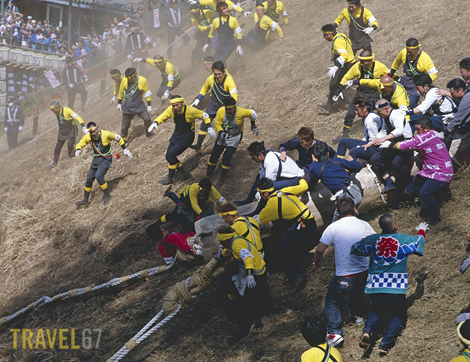
Yamadashi at Onbashira Festival, Nagano
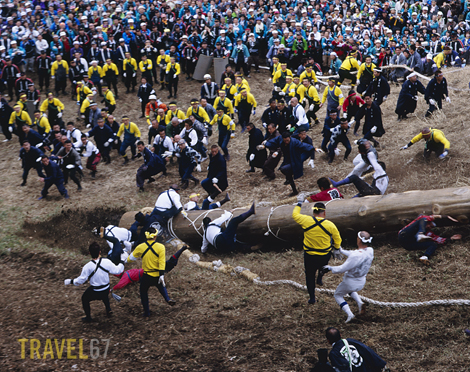
Dangerous Stuff - The log rams into the earth.
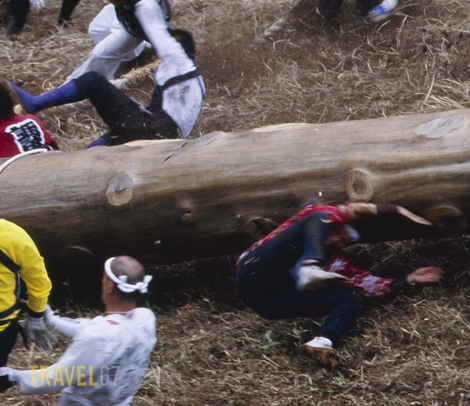
Crop of the above image. This guy was lucky to have walked away unharmed.
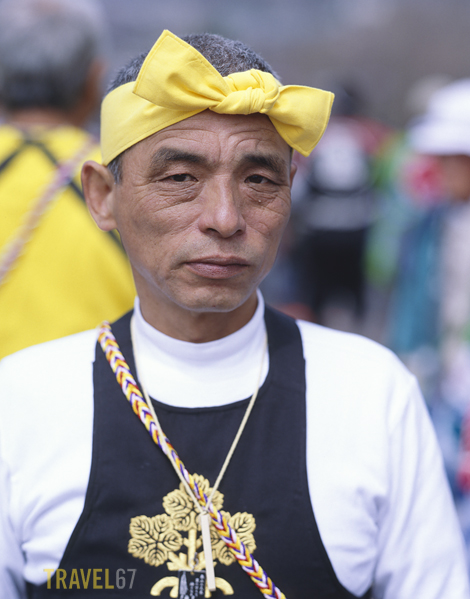
Onbashira - serious stuff, but I think I've seen the same bow on Hello Kitty.
Yamadashi at Onbashira Festival, Nagano
Dangerous Stuff - The log rams into the earth.
Crop of the above image. This guy was lucky to have walked away unharmed.
Onbashira - serious stuff, but I think I've seen the same bow on Hello Kitty.
 I now have my own page Chris Willson Photography on Facebook.
Stay up-to-date with my latest images, news, photo tips and exhibitions by simply clicking Like.
Here’s an email I received today from a friend based on Ishigaki (one of Okinawa’s southern islands).
I’ve just discovered the power of Ishigaki’s mould. I left my favorite macro lens out on the desk for about 2 weeks….every day I told myself that I should pack it away before it gets mouldy. I finally got around it to and guess what – inner element completely smeared with mould which looks like it might have cut into the glass. How stupid. Lesson learned. I really need to get some dry-storage, especially as I’m about to buy a nice Tokina 11-16mm wide lens which I really don’t want to suffer the same fate.
Mould is a serious problem in Okinawa, especially during rainy season. Lenses and film are particularly vulnerable. A mouldy lens can be sent to a specialist for cleaning but more than likely the mould will have etched itself into the coatings and a repair will be more than the cost of the lens. I imagine mould could easily create havoc on a digital sensor.

The cheap solution is to store your gear in an airtight container
A far better option if you are living in (rather than just traveling through) a humid area is to purchase a dehumidifier cabinet. These work similar to a refrigerator except they keep the interior at a constant humidity. I have three large cabinets, two filled with transparencies and one filled with camera equipment.
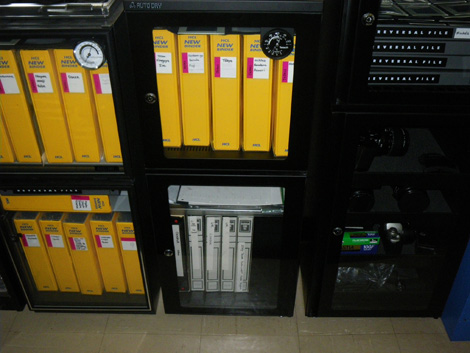
Dry cabinets are available at most camera stores in Okinawa, however, they’re cheaper and there’s a better selection at Amazon.co.jp
A final tip is that you should get out in the sun and use your gear. A good dose of sunshine will help combat the growth of mould, and there’s no point having a camera if you don’t get out there are take some pictures.
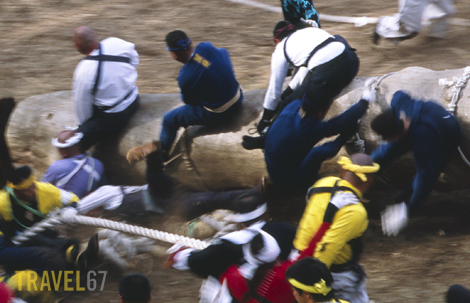
Crop from center of sixth image in the series
It’s hard to see on the smaller images but this crop shows just how dangerous this event is. The rear of the tree is off the ground and there are several limbs and at least one head near the rapidly closing gap between trunk and ground.
Although I started scanning the images from my trip in order, I grew impatient and skipped to the grand finale. The Onbashira Festival took place on last few days of my travels, and was the big event the entire trip had been planned around.
The festival takes place every 7 years. Huge tree trunks that will be used to rebuild the local shrine are dragged from the forest to the town. The route, however, includes a treacherous steep slope. The locals rather than use the slope as a respite from dragging, have made it a test of bravery, machismo, and it would appear, sanity.
This is an important traditional festival in Japan, but it does come at a cost. People are often injured and fatalities do occur. I photographed the event on the Friday and Saturday. On the Sunday, while I was flying back to Okinawa, one of the participants was killed. I hope the photographs give some idea of the spectacle. The following series comes from Saturday afternoon.
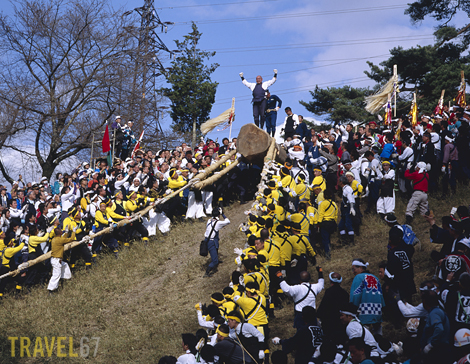
Chanting and cheers before the decent.
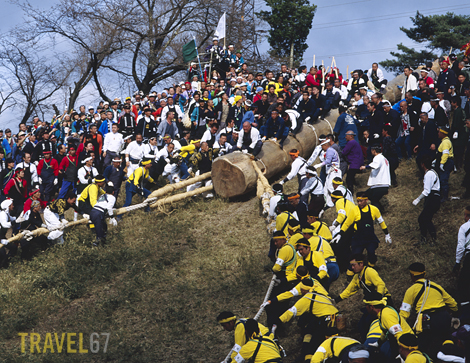
Slow at first...
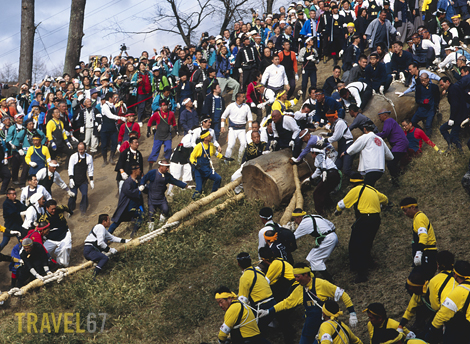
then picking up speed...
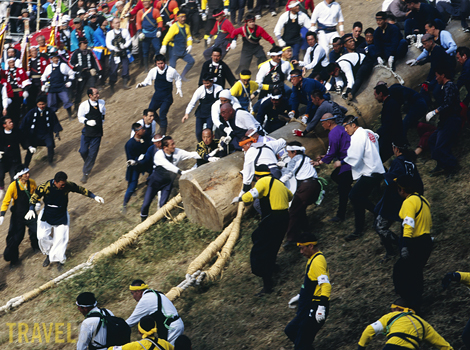
faster and faster...
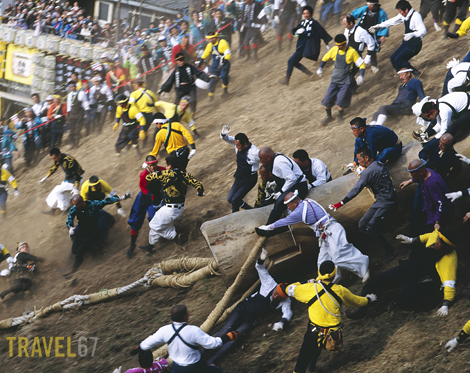
unstoppable
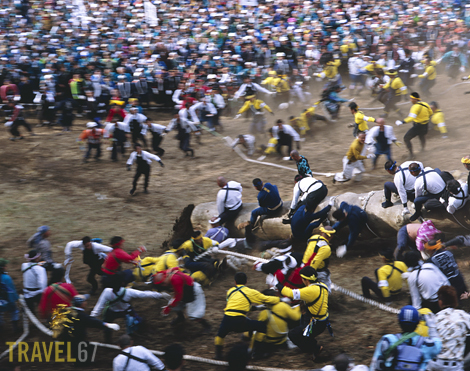
Some fall, others hold on.
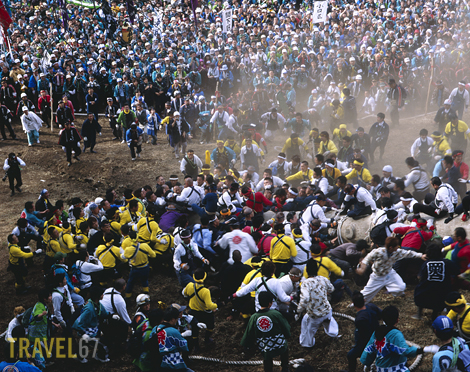
Team members surge to join the riders
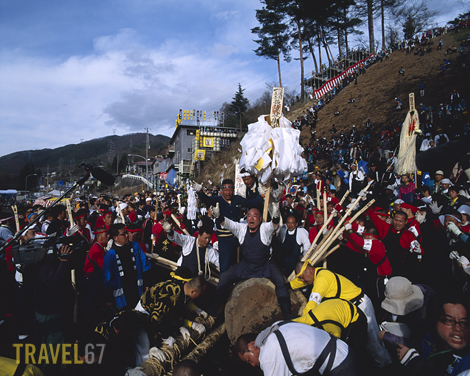
Celebrations
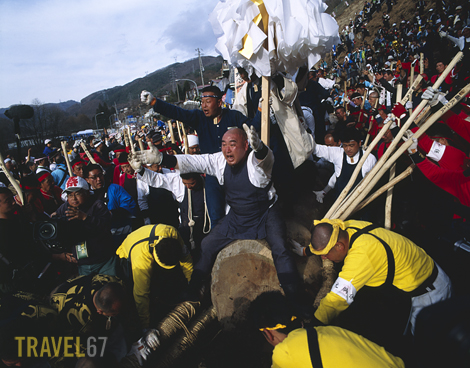
Once again, chanting and cheers.
I’m selling a few Pentax 67 lenses and accessories to create space in my dehumidifier cabinets (and improve my bank balance) before purchasing the 645D.
I’ve included the list price, and then selling price (in bold). If you’d like more information and photos of the items please email me at chris@travel67.com Payment with Paypal. I’ll put the items up for sale on Ebay (at the same price) later in week, but thought I’d give readers of the blog a first look.
Pentax 67 35mm Fisheye F4.5 155,000 yen (inc. case) 60,000 Yen
Pentax 67 75mm Shift F.5 221,000 yen 75,000 Yen
Pentax 67 T6 2X teleconverter (black) 20,000 Yen
Pentax 67 Angle Finder 35,000 yen (inc. case) 20,000 Yen
Pentax 67 Magnifier 14,000 yen (inc. case) 8,000 Yen
Pentax 67 Metal Hood with bayonet mount for 105mm 2.4 Lens. (inc. case) 5,000 Yen
Twenty minutes west of Beppu is Mount Takasaki National Park. The park is famous for the group of wild monkeys that live on the mountain. Throughout the day, park staff feed the monkeys barley so visitors are literally surrounded by wild monkeys. Unlike at a zoo, when the visitors leave and the feeding stops, the animals can retreat to the depths of the forest.
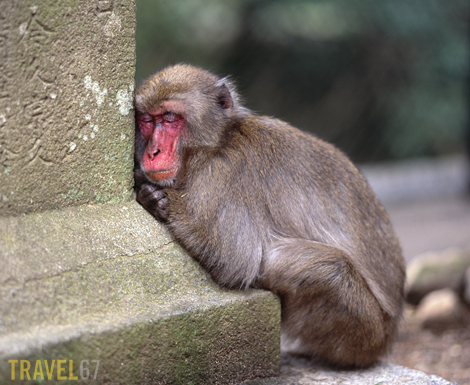
Mount Takasaki Japanese Macaque
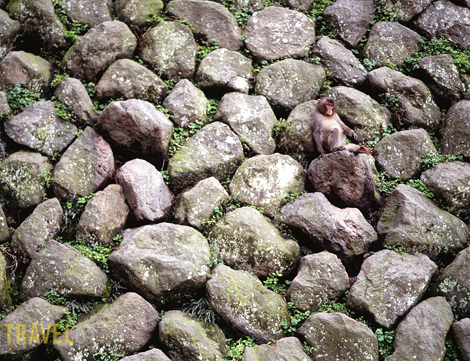
Mount Takasaki Japanese Macaque
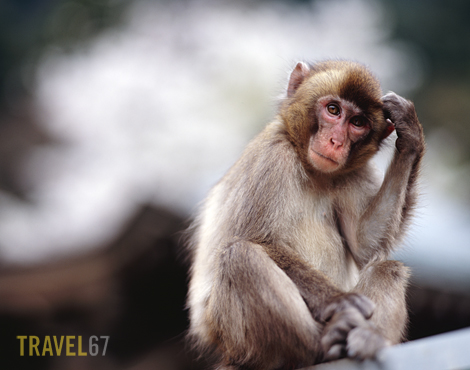
Mount Takasaki Japanese Macaque
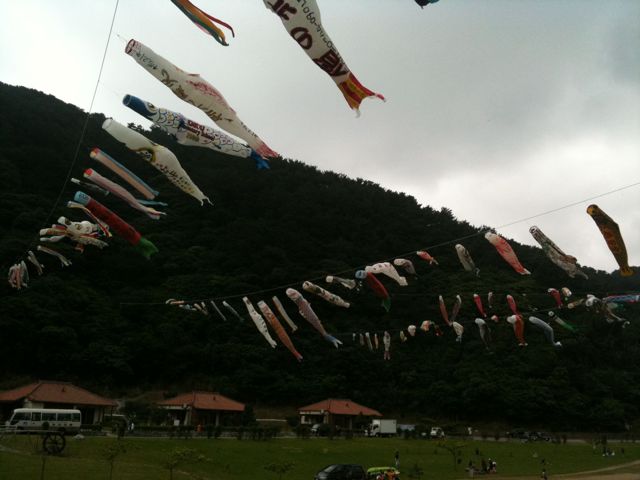
Yesterday, today and tomorrow, carp streamers are flying over the Oku River near Cape Hedo.
Weather wasn’t great this morning, but here’s a shot from my iPhone.
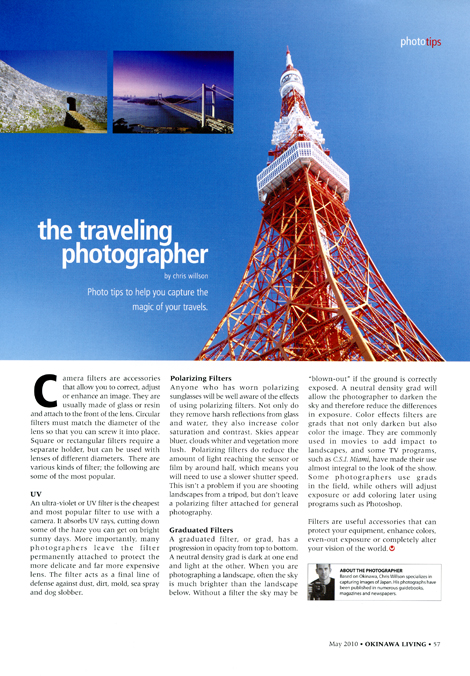
The Traveling Photographer #9 by Chris Willson Okinawa Living Magazine May 2010
See a larger, readable, scan of the page here.
Having talked about Ichiro Kikuta in my last post I realized I hadn’t put up an Island Icon interview I did with Ichiro three years ago. Here it is.
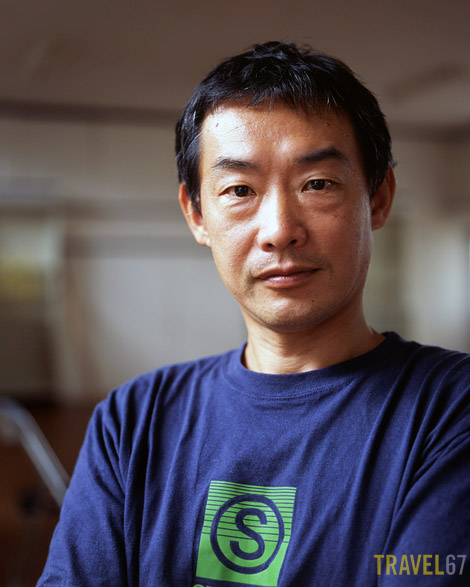
Wildlife Illustrator
Ichiro Kikuta is an artist trying to capture the spirit of Okinawa’s wildlife.
When he was only an elementary school student, Ichiro Kikuta loved to sketch and paint the birds that nested near his home. During high school, he was inspired by the work of British wildlife artist Charles Tunnicliffe. At that point,he knew what he wanted to do with his life. After graduation, he spent 6 months traveling around Britain exploring the landscapes and animals that had inspired Tunnicliffe. Upon his return to Japan, Ichiro began to explore his own country with sketchbook in hand. For the past 25 years, he has journeyed from Hokkaido to the Ryukyu Islands capturing the beauty of animals ranging from snow-covered crested cranes to the Okinawan rail. He now lives in the northern part of Okinawa known as Yanbaru. There, he continues to capture the spirit of Okinawa’s wildlife against the backdrop of the island’s wild and rugged landscape.
What materials do you work with?
“I use many different techniques ranging from simple pencil sketches and watercolors to woodblock prints. When I am out in the field, I take a notepad and small set of watercolor paints.”
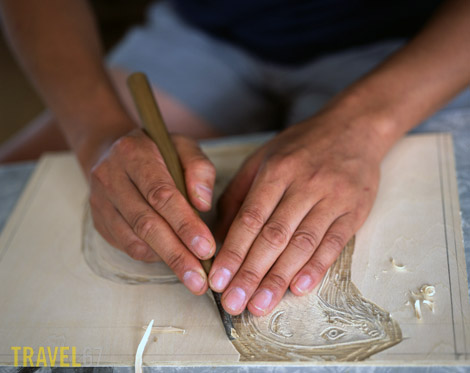
Creating a woodblock print
Do you have a favorite creature to illustrate?
“That’s a difficult question. I like many different kinds of animals and birds, but the species really isn’t that important. What I am trying to do is capture the atmosphere of the animal in its natural environment. The subject could be anything – from an eagle to a tiny insect.”
How does your style differ from that of other artists?
“I think that many American wildlife artists concentrate on showing as much detail as possible, a style known as ‘super-realism.’ I prefer a more abstract style…I am not trying to produce an image similar to a photograph; I am creating my own unique vision.”
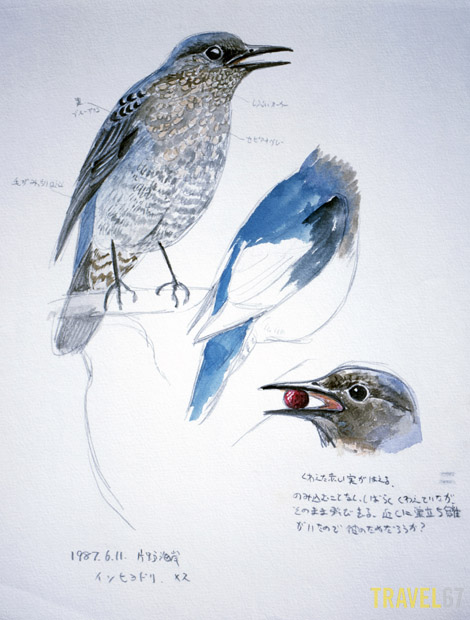
Blue Rockthrush (Iso-hiyodori) Illustration
Why do you live in one of the most remote places in Japan?
“There are many beautiful places, but Yanbaru is special. Ada, the tiny village where I live, has a very organic feeling to it. In most towns there is a distinct line between the urban and natural environment – in Yanbaru you don’t feel you are living beside nature, but amongst it.”
Do you have any advice for budding naturalists?
“The most important thing you need is a pair of binoculars. Huge magnification isn’t important, as it makes it difficult to find the birds, and you don’t need to spend a lot of money. The more expensive models, however, do have better lenses that give a brighter, sharper image. It is much easier to spot animals in open areas along the coast rather than in the forest. Sandpipers and egrets are common along the shoreline, and there are colonies of terns breeding in the area around Okuma. For a beginner, a field guide that shows all the different birds can be confusing, so I’d recommend going out with someone with a bit of experience who can point out the different animals and teach you their names.”
Could you ever return to life in a city?
“I guess it depends on the city. I really don’t like Tokyo and Osaka – for me they are too full of concrete, plastic, and people. I would feel more comfortable in places like Sapporo and Kyoto that have more greenery, but even there I think I would miss the countryside too much. I want to live and raise my family among nature, not skyscrapers. ”
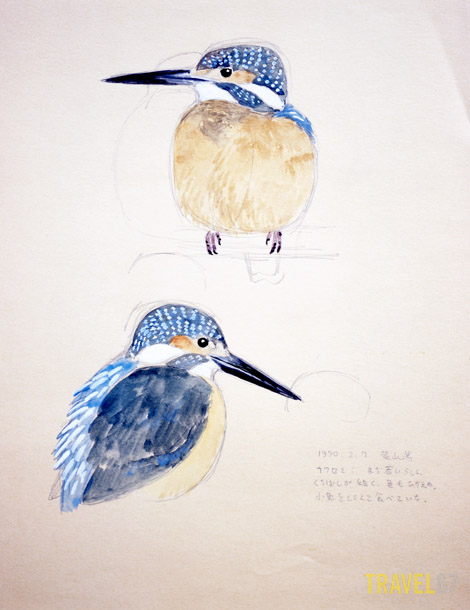
Common Kingfisher (Kawasemi) illustration
You can see more of his work at his blog.
This interview was first published in Okinawa Living Magazine May 2007.
 TRAVEL 67 : Chris Willson Photography