Latest Posts

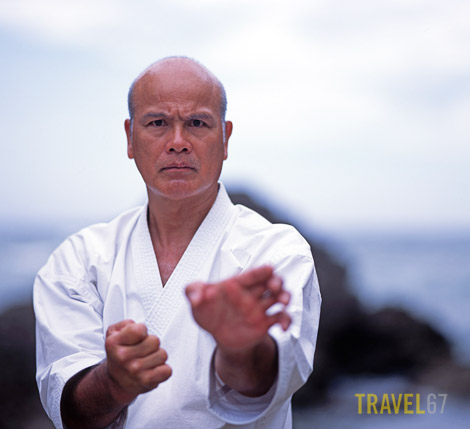
Island Icons – Karate Master Kiyohide Shinjo

Karate Master Kiyohide Shinjo

Karate Master Kiyohide Shinjo

Okinawan Superman

Kiyohide Shinjo is an 8th dan master of Uechi-ryu karate.

Kiyohide Shinjo was born on Ie Island in 1951. His family moved to Naha when he was five, and Kiyohide began studying karate at the age of ten from his father, Seiyu Shinjo, one of Okinawa’s karate masters. He earned his shodan (first degree black belt) at age 16, and in 1960, Kiyohide and his father opened a new dojo at Kadena Rotary.

Kiyohide Shinjo is the nine-time Okinawa Karate Champion in both kumite and kata - gaining him the nickname “the Okinawan Superman.” When his father died in 1979, Kiyohide retired from competition, undefeated, and took over the Kadena dojo.

In 2004, the dojo moved to Toguchi in Yomitan. There Kiyohide continues to inspire others with his passion for karate.

What’s your favorite technique?

“I use the toe kick. It’s one of Uechi-ryu’s iconic techniques; it’s devastatingly effective. It doesn’t matter where the blow lands, it will incapacitate the opponent leaving you in control of the encounter.” (At this point Kiyohide took a wooden beam and repeatedly slammed it against the bare toes of his foot. The wood bounced off them as if he had been wearing steel-toed boots.)

Karate is famous for being about unarmed combat, but you see some forms of karate using weapons like a bo or sai?

“That’s kobudo, another form of Okinawan combat, but the techniques you need to do kobudo are those from karate. The sai, for example, can be used to defend an attack with the centre prong running back down the forearm. The technique behind it, however, is traditional karate block.

Karate Master Kiyohide Shinjo outside his Yomitan dojo

Karate Master Kiyohide Shinjo outside his Yomitan dojo

What are the different styles of karate on Okinawa?

“There are many styles of karate, but there are only four traditional styles that have not been blended with other styles or martial arts. These four are Uechi-ryu, Goju-ryu, Shorin-ryu, and Matsubayashi-ryu .”

Have you taught Karate in other countries?

“Twice a year I go abroad to give seminars, judge competitions and check that overseas Uechi-ryu dojo’s are not diverging from the traditional Okinawan techniques. Karate is like a gayjumaru (banyan) tree with its roots based in Okinawa. Sometimes branches grow from the main trunk and it is my job to prune these outgrowths back so that Uechi-ryu remains in its pure form and is not mixed with other styles of martial arts or even gymnastics. It is my calling to make sure the traditional skills of Uechi-ryu are handed down to future generations. ”

Hollywood has many action stars, are you impressed by any?

“Most of them are just actors, not really fighters. Jackie Chan has his own unique style, but Bruce Lee was a real karate champion. He would be training constantly to stay in peak physical condition. Even now, his techniques and training methods are often discussed in karate magazines.”

Have you ever seen the karate kid movies?

“Of course. They were fun to watch, but Noriyuki ‘Pat’ Morita (the actor who played Mr. Miyagi) did have a good point that karate goes beyond the two hours you spend in the dojo. You can strive to improve your stances, breathing or strength doing everyday activities, like painting a fence or waxing a car.”

You are 8th Dan and have been studying karate for 46 years is there any more for you to learn?

“You can never achieve perfection; you just keep on training, staying fit, staying strong.”

Karate Master Kiyohide Shinjo

Karate Master Kiyohide Shinjo

(Interview first published in Okinawa Living Magazine November 2006)
Back in Okinawa

Just got back to Okinawa. An exhausting but exciting final couple of days taking photos of the Onbashira Festival in Shimosuwa, Nagano Prefecture.

Will drop off 17 rolls of 220 film  and 5 rolls of 120 film tomorrow. I’ll hopefully be able to see how successful this trip has been on Thursday.

Japan Times – Sushi Zen

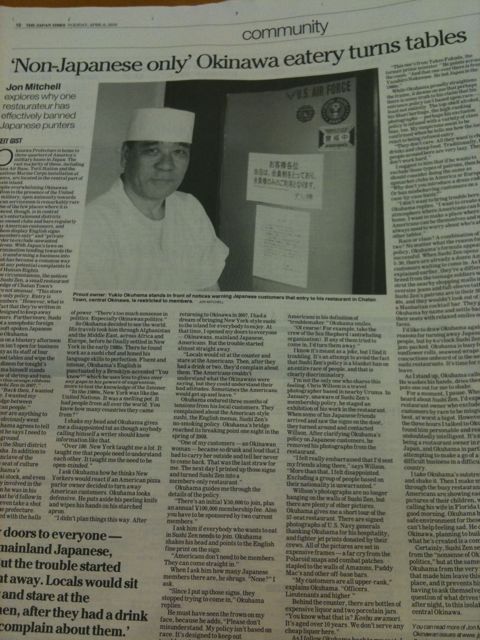
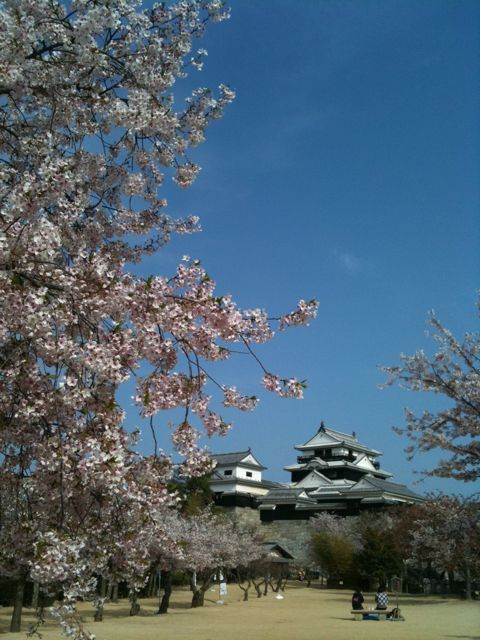
Got up at 6.00 A.M. to take early morning photos of Matsuyama Castle. Grabbed a coffee and had a quick look at today’s Japan Times in the hotel lobby. In the paper there is an article about the entrance policy at Sushi Zen, it includes a few quotes from me taken during a phone interview a couple of weeks ago. I thought the piece was well written although I have to note that I didn’t stage an exhibition of my work but merely displayed two pictures as part of a group. I also learned about the situation at Sushi Zen through Facebook rather than after Japanese friends saw the sign. The actual quotes are correct and as I have said before excluding a group of people based on nationality (religion, gender, sexual orientation, ethnicity, age or any other factor) is unwarranted and does not help create the kind of tolerant society in which I want to live.

Beppu

After 5 days in Beppu I am now on the ferry to Shikoku. Beppu was better than I had expected as guidebook descriptions such as “the Las Vegas of onsen towns” conjured up a somewhat tacky image.
The Eight Hells with their bubbling sulfurus pools are by far the most comercialized aspect of the town. Gift shops were sometimes larger than the actual attractions, and some Hells had made the dubious decision to include a mini zoo.
The main focus of Beppu, however, is relaxing in the many onsen. The hotels and ryokan usually have their own baths, but I headed down to the oldest, Takegawara Onsen, for a soak on the first night. The next day I hiked for an hour up to one of the natural mud onsen on the hillside above the town, and to complete the set I was burried up to my neck in a sand bath by the beach.

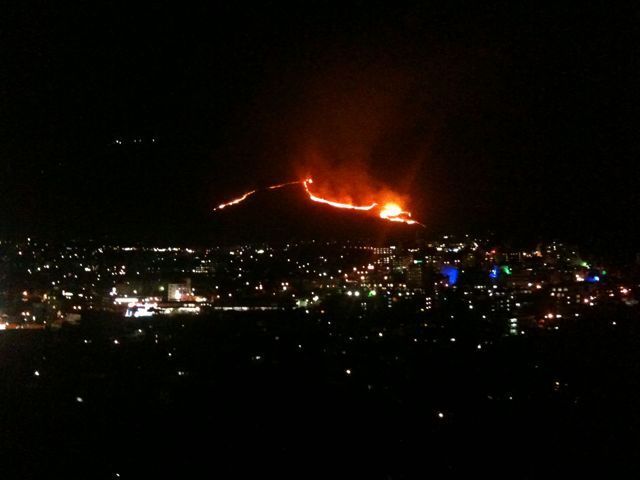
Last night was the Mount Ogi Fire festival where they set the hillside ablaze. Here’s a pic from my iPhone

Island Icons – Shisa Artist Mitsuo Miyagi

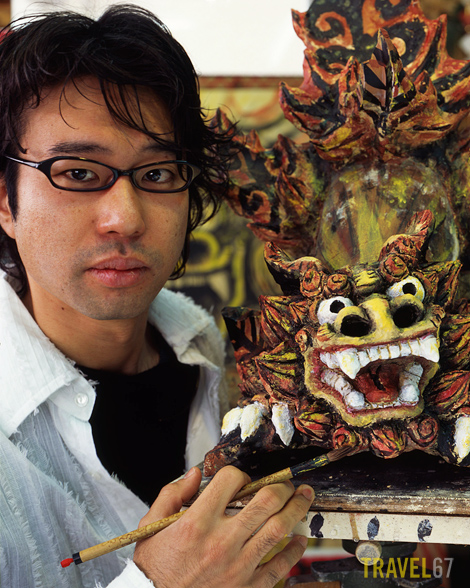
Shisa Artist Mitsuo Miyagi

Shisa Artist Mitsuo Miyagi

Lion King

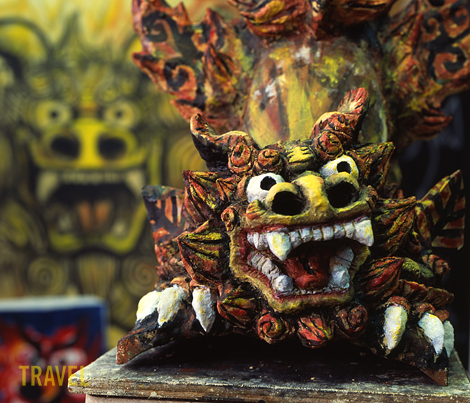
Mitsuo Miyagi creates plaster shîsâ. He operates his own store and gallery beside Kokusai-Street, and his designs have met with both critical acclaim and commercial success.

Mitsuo studied art at Kaiho High School on Okinawa before attending college in Kyoto. Rather than specialize in just one discipline, Mitsuo trained under several teachers to learn pottery, sculpture, papermaking, ink, and painting. At age 21, he returned to Okinawa and started creating shîsâ in his apartment. His unique designs became popular almost immediately, and soon he was overrun with too many orders and too little space. In 2001, he moved to a new studio in Onna Village from which he could create larger sculptures and paintings. On April 3, 2005, he opened his own gallery and store in Naha City, where visitors can browse his work or even create their own shîsâ.

What is a shîsâ? Is it a lion, a dog or some kind of dragon?

“Shîsâ are sometimes called lion-dogs, but I think this is only half-right. Shîsâ are based on lions, which have been used in sculptures since the Egyptian sphinx. The sphinx had the body of a lion and the face of a pharaoh. Sometimes the lions were given eagle’s wings, and this tradition continues in Europe today. (The symbol of Venice is a winged lion.) When lion sculptures became popular in China and later Okinawa, they lost their wings. Dragons meanwhile have a completely different heritage.”

What is the difference between ceramic and plaster shîsâ?

“Ceramic shîsâ are made from clay and fired in a kiln. The first plaster shîsâ were created by men who had materials left over after completing tile roofs atop homes. The used a few tiles as the core and then applied plaster to create the shîsâ. These methods are still used today.

The plaster is produced by burning crushed coral to make lime, mixing this was straw, and then letting it ferment for a month. Unlike ceramic shîsâ, the high temperature of a kiln isn’t needed. The shîsâ are constructed on the roof, and then dry naturally in the sunshine.”

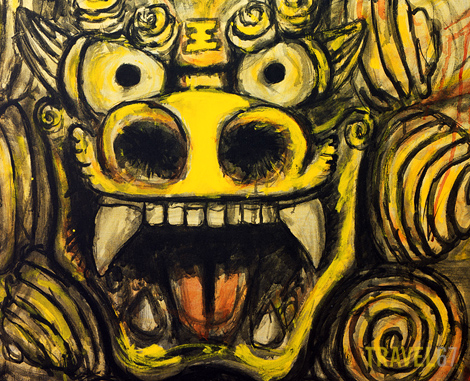
Shisa painting by Mitsuo Miyagi

Shisa painting by Mitsuo Miyagi

Are shîsâ always found in pairs?

“Shuri Castle has pairs of shîsâ by its gateways. One has its mouth open; the other has its mouth closed. In the past, most regular homes had one shîsâ on the roof. However, modern houses in Okinawa are often built with a flat concrete roof and there is nowhere to put the shîsâ. So people have begun to place shîsâ on either side of the door or gate. Pairs of shîsâ are now a more common sight than a single one on a red tile roof.”

Is shîsâ design evolving?

“There are now many different styles, materials, and colors of shîsâ. It has also become popular to have shîsâ indoors as well as outdoors. They welcome people into the home and make the place look cheerful. They can be seen as pieces of art or even as lucky charms.”

Shîsâ were originally talismans. Do they still have the power to protect?

“I think it depends how the shîsâ were created. Traditional shîsâ are said to be born, not built. There are two kinds of tiles on a roof: osugawara (male) and mesugawara (female). At the apex of the roof where the two kinds of tiles meet, the shîsâ is born. When an artist makes a shîsâ, the strength and love from his hands passes into his creation. I think it is this connection that gives shîsâ the power to keep away evil spirits. Mass-produced shîsâ, however, are nothing more than colorful souvenirs.”

Shisa by Mitsuo Miyagi

Shisa by Mitsuo Miyagi

( Interview first published in Okinawa Living magazine June 2006 )

His store is located just around the corner from the Starbucks on Kokusai Street in Naha. There is pay parking on the opposite side of the road.

– I published this to my blog using the WordPress App on my iPhone. Clever stuff 🙂

Beppu – Matsuyama – Okayama – Kyoto – Matsumoto

Tomorrow I’ll fly up to the Japanese mainland for a two week photo trip. I’m going to visit  Beppu and Matsuyama, then head north via Okayama and Kyoto for a festival near Matsumoto. I return to Okinawa on the 11th.

Blogs will be a bit sporadic once I am travelling, but I’ll hopefully return with some great shots or at least a few amusing anecdotes.

If there are any orders for prints while I am away, I will sort them out on my return. Sorry for any inconvenience this may cause.

Just finished getting all my gear together. Most of the camera equipment goes in a Lowepro DryZone rucksack that is just on the limit of carry-on. Tripod, flash, clothes, wash kit and tea bags go in a second larger bag.

All my bags are packed, I’m ready to go…

My bag of goodies (Camera, lenses, hoods, lightmeter, polarizing filters...)

My bag of goodies (Camera, lenses, hoods, lightmeter, polarizing filters...)

Island Icons – Veterinarian Takashi Nagamine

Veterinarian Takashi Nagamine

Veterinarian Takashi Nagamine

Bird Man of Okinawa

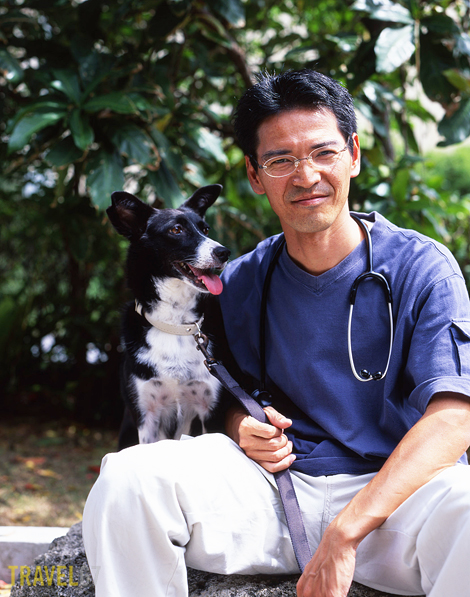
Takashi Nagamine is a veterinarian trying to save the Okinawa Rail from extinction.

Takashi Nagamine was born in Gushikawa City, Okinawa. He studied veterinary science at Nihon University, worked as a vet in Saitama prefecture for 11 years, and then returned to his hometown. In 2001, he set up Nagamine Animal Hospital where he treats the everyday ailments of local pets, and also injured wild animals from all over Okinawa.

What types of wild animals does your hospital receive?

“We get 150 to 200 cases a year, and these cover a wide range of species from the Crested Serpent-Eagle to the Okinawa Rail. Some animals have been injured by power lines or cars; others have been poisoned by pesticides.”

What kind of bird is the Okinawa Rail?

“The local name is the Yanbaru-kuina. It’s a small bird, about the size of a man’s hand, or a little larger than a pigeon. It was only discovered in 1981, because it is naturally a very shy bird. It is also the only flightless bird in Japan, which is one of the reasons that it is now endangered.

How many Okinawa Rails are there?

“The latest estimates are that there only 717 of the birds on Okinawa, and as it is endemic to the island, these are the last 717 individuals of this species in the world.”

Okinawa Rail, Yanbaru-kuina, Rallus okinawae

Okinawa Rail, Yanbaru-kuina, Rallus okinawae

Why are there so few of the birds left?

“There are several problems. The loss of habitat due to logging and the division of the remaining land by roads means there is smaller area in which the birds can live. Stray cats kill some birds, but the number one issue we need to deal with are the mongooses. In 1910, 19 mongooses were introduced from India to try to control the poisonous habu snakes. There are now more than 30,000 mongooses on the island. They have no natural predators, and the Okinawa Rail is easy prey. It’s particularly ironic because habu are nocturnal and mongoose are diurnal, so it was a bad idea from the start. ”

If the bird can’t fly and can’t defend itself, isn’t it just natural selection for it to disappear?

“The Okinawan ecosystem has always been in a delicate balance. The natural predators of the Okinawa Rail – the habu and jungle crows – were only able to kill a small number of the birds. Mongooses and domestic cats are foreign species that have upset this balance. If extinction were to occur, is wouldn’t be at all natural.”

What can be done to save the Okinawa Rail?

“In 2005, the Conservation Animal Welfare Trust was formed, and a rescue center was set up in Kunigami Village. At the center we provide injured birds with first aid, transport them to the animal hospital in Gushikawa, and there perform x-rays and surgery. The birds are returned to the rescue center where they can recover, before being released back into the wild. We also have a breeding program, with birds that we were unable to re-release, so far six chicks have hatched. The main problem, however, is still the large numbers of mongooses. The only long term solution is to remove all the mongooses from the area where the Okinawan Rail live. To do this we would need to build a fence across the northern part of the island, and catch every single mongoose north of it. ”

Are you optimistic about the future?

“It’s a very worrying, if not desperate situation, but I’m not willing to give up. I expect, in the near future, the numbers of birds will continue to drop. I do believe, however, we can save the Yanbaru-kuina from extinction. We just have to return Okinawa to its natural ecological balance.”

Okinawa Rail, Yanbaru-kuina, Rallus okinawae

Okinawa Rail, Yanbaru-kuina, Rallus okinawae

(Interview first published in Okinawa Living Magazine  March 2007)

The Conservation & Animal Welfare Trust has a website at http://www.yanbarukuina.jp/

67 lenses on the 645D body

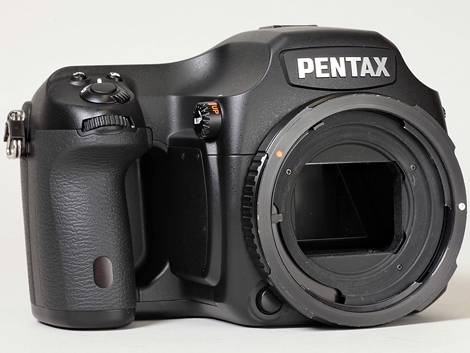
Pentax 645D body

Pentax 645D body

Pentax 645D with 67 to 645 adapter

Pentax 645D with 67 to 645 adapter

Pentax 645D with 67 to 645 adapter and 67 105mm lens

Pentax 645D with 67 to 645 adapter and 67 105mm lens (Images from DC Watch)

This post is to show how lenses from the Pentax 67 cameras will be able to fit on the Pentax 645D body.
Simply attach the 67 to 645 adapter to the camera, and then attach the 67 lens. The adapters were available from B&H Photo in the States but the site says they are no longer available. I got mine from Amazon.co.jp.
Using larger lenses on a smaller camera will mean that your normal lenses become telephotos, and your telephotos become super-telephotos. This particular adapter will allow aperture priority metering (unlike the 67 to 35mm adapter).
It is worth remembering that larger lenses can fit on smaller cameras, but smaller lenses can’t be used on larger cameras. This means that  lenses designed specifically for  cameras with APS sized sensors won’t work on a full frame 35mm camera. When buying lenses consider if you may be switching to full frame 35mm in the future so you  won’t have to replace incompatible equipment.

The Power of Okinawa

The Power of Okinawa

The Power of Okinawa

The Power of Okinawa is a website and a book by my friend John Potter. If you have any interest in Okinawan culture or history please check them out. Music is woven into the very fabric of the Ryukyu Islands. An appreciation of its beauty, or at least an awareness  of its importance, is one of the keys to understanding life on Okinawa.