Latest Posts

Baggage Allowances in Japan

Recent changes in the Japanese airline industry and are going to affect the way photographers select and transport their equipment. On my last couple of trips up to the Japanese mainland I noticed that when checked baggage is weighed the display shows the weight along with the excess charges for baggage over 20 kilograms. Carry on baggage is restricted by both weight and size,  and these dimensions are shrinking. For flights of 100 passengers or more maximum dimensions are 55cm x 40cm x 25cm (115cm total) and 10 kilos in weight. For flights less that 100 passengers this drops to 45cm x 35cm x 20cm (100cm total).

Why is this significant? Well your present bag which came with a sticker saying suitable for carry-on may no longer be small enough.

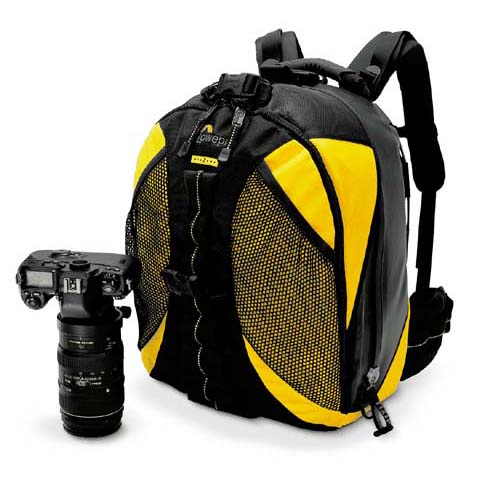
Lowepro DryZone 200

Lowepro DryZone 200 (37 X 29 X 48.5cm) Image from LowePro.com

My Lowepro bag is 37 X 29 X 48.5 cm which comes out at a total for the 3 dimensions of 114.5cm, just under the limit. However put a few extra items in the front pocket and and you will have a bag that is too big for carry-on. This  happened to me a couple of months ago, and it was only after a bit of begging and showing them the bag was full of camera gear did they let me take it in the cabin.

Pelican 1510 Carry On Case

Pelican 1514 Carry On Case 55.9 x 35.1 x 22.9cm

I am considering getting a Pelican 1514 Carry On Case as a way to transport the camera plus large telephoto lenses. At 55.9 x 35.1 x 22.9cm  (113.9 cm total) it again just sneaks under the 115cm limit. The advantage of this case would be that if it did have to go in the hold  the gear should be well protected. (This is useful when traveling on smaller planes, or if due to unforeseen circumstances you are not allowed cabin baggage.)

Interestingly this Pelican case also showed the bizarre price discrepancies you can get between countries. The U.S. recommended retail price for the Pelican 1514 is $289.95 and is available on Amazon.com for $159.09. In Japan the recommended price is ¥62,475 and is available from Yodobashi at ¥46,805 ($498). I know that Pelican cases are made in the U.S. but should customers in Japan have to pay more than three times the price?

Earth Day

Today, April 22nd, is Earth Day. I just watched The 11th Hour an interesting documentary about the impact of mankind on the planet and the changes we need to make to our lifestyles.

Another documentary that is worth watching is HOME. You can see the entire movie on YouTube, so if you’ve got 90 minutes to spare, please take a look. Double click on the video below to watch it on YouTube (embedded viewing has been disabled).

Pentax 645D v Nikon D3X v Canon EOS-1 Ds Mark III

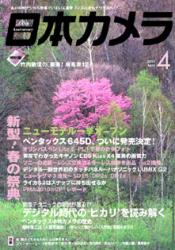
日本カメラ Nihon Camera April 2010

日本カメラ Nihon Camera April 2010

The April edition of Nihon Camera 日本カメラ includes a couple of very interesting things for Pentaxians. The first is a history of Pentax’s medium format cameras, the second is a detailed overview of the new Pentax 645D camera including a comparison of the camera with the top of the range 35mm digital cameras.

Here’s some (but not all) of the differences between the Pentax 645D, the Nikon D3X  and the Canon EOS-1 Ds Mark III.

Sensor

Pentax 645D: 44x33mm 40MP CCD

Nikon D3X: 35.9x24mm 24.5MP CMOS

Canon EOS-1 Ds Mark III: 36x24mm 21.1MP CMOS

Live View

Pentax 645D: No

Nikon D3X: Yes

Canon EOS-1 Ds Mark III: Yes

Dust Removal System

Pentax 645D: Yes

Nikon D3X: No

Canon EOS-1 Ds Mark III: Yes

Max Shutter Speed

Pentax 645D: 1/4000

Nikon D3X: 1/8000

Canon EOS-1 Ds Mark III: 1/8000

Frames per second

Pentax 645D: 1.1

Nikon D3X: 5

Canon EOS-1 Ds Mark III: 5

Memory Card

Pentax 645D: SD / SDHC cards

Nikon D3X: CF cards

Canon EOS-1 Ds Mark III: CF cards & SD / SDHC cards

Weight (body only)

Pentax 645D: 1480g

Nikon D3X: 1220g

Canon EOS-1 Ds Mark III: 1210g

Price (Japan list price / Amazon.co.jp / B&H)

Pentax 645D: ¥850,000 / ¥848,000 (10% points) / Not available

Nikon D3X: ¥830,000 / ¥740,520 /   $7,469.95

Canon EOS-1 Ds Mark III: ¥790,000 / ¥686,280 /  $6299.95

The very fact that the magazine chose to compare the Pentax 645 with 35mm digital cameras rather than other medium format cameras is interesting. Of course Pentax users with 67 and 645 lenses will be considering the 645D, but Pentax will be hoping that some of Japan’s Nikon or Canon shooters will defect and “upgrade” to the larger format.

The reality is that most Nikon and Canon shooters will probably have a large array of Nikon and Canon lenses that they want to continue using. Also brand loyalty is extremely strong in the camera world. I imagine that the auto focus for the Pentax will be much slower than its 35mm rivals. But a camera that can shoot a maximum of 1.1 frames per second is clearly not designed for sports photography.

The other big question is whether the Pentax 645D will tempt those who were considering getting a similar spec Leica S2, Hasselblad H3DII-39, or Phase One 645AF P40+ for around 3 times the price. The Pentax 67 was nicknamed Gulliver for its giant size. I have my suspicions that the photography world will nickname the 645D Godzilla as its performance will no doubt be monstrous.
Nicholas Centala at Global Gallery

Several interesting things happening in Okinawa this weekend. Ceramic artist Nicholas Centala has an exhibit at Global Gallery (Plaza House),  Kluso is playing Saturday night at Al’s Place in Okinawa City, and Erykah Badu is performing on Camp Foster Sunday night.

Just scanned this image of Nick firing up his kiln. Really happy with the shot, as it was very difficult conditions to shoot. I used a light meter to check how much light there was on his face and then asked him to stand still for a couple of seconds while I took the photograph. The heat was incredible, it was tough being so close to the flames for more than a fraction of a second. Nick came away a little singed but I think he’ll be happy with the portrait.

Potter Nick Centala Feeds his wood fired kiln

Potter Nick Centala feeds his wood-fire kiln

Island Icons – Karate Master Kiyohide Shinjo

Karate Master Kiyohide Shinjo

Karate Master Kiyohide Shinjo

Okinawan Superman

Kiyohide Shinjo is an 8th dan master of Uechi-ryu karate.

Kiyohide Shinjo was born on Ie Island in 1951. His family moved to Naha when he was five, and Kiyohide began studying karate at the age of ten from his father, Seiyu Shinjo, one of Okinawa’s karate masters. He earned his shodan (first degree black belt) at age 16, and in 1960, Kiyohide and his father opened a new dojo at Kadena Rotary.

Kiyohide Shinjo is the nine-time Okinawa Karate Champion in both kumite and kata - gaining him the nickname “the Okinawan Superman.” When his father died in 1979, Kiyohide retired from competition, undefeated, and took over the Kadena dojo.

In 2004, the dojo moved to Toguchi in Yomitan. There Kiyohide continues to inspire others with his passion for karate.

What’s your favorite technique?

“I use the toe kick. It’s one of Uechi-ryu’s iconic techniques; it’s devastatingly effective. It doesn’t matter where the blow lands, it will incapacitate the opponent leaving you in control of the encounter.” (At this point Kiyohide took a wooden beam and repeatedly slammed it against the bare toes of his foot. The wood bounced off them as if he had been wearing steel-toed boots.)

Karate is famous for being about unarmed combat, but you see some forms of karate using weapons like a bo or sai?

“That’s kobudo, another form of Okinawan combat, but the techniques you need to do kobudo are those from karate. The sai, for example, can be used to defend an attack with the centre prong running back down the forearm. The technique behind it, however, is traditional karate block.

Karate Master Kiyohide Shinjo outside his Yomitan dojo

Karate Master Kiyohide Shinjo outside his Yomitan dojo

What are the different styles of karate on Okinawa?

“There are many styles of karate, but there are only four traditional styles that have not been blended with other styles or martial arts. These four are Uechi-ryu, Goju-ryu, Shorin-ryu, and Matsubayashi-ryu .”

Have you taught Karate in other countries?

“Twice a year I go abroad to give seminars, judge competitions and check that overseas Uechi-ryu dojo’s are not diverging from the traditional Okinawan techniques. Karate is like a gayjumaru (banyan) tree with its roots based in Okinawa. Sometimes branches grow from the main trunk and it is my job to prune these outgrowths back so that Uechi-ryu remains in its pure form and is not mixed with other styles of martial arts or even gymnastics. It is my calling to make sure the traditional skills of Uechi-ryu are handed down to future generations. ”

Hollywood has many action stars, are you impressed by any?

“Most of them are just actors, not really fighters. Jackie Chan has his own unique style, but Bruce Lee was a real karate champion. He would be training constantly to stay in peak physical condition. Even now, his techniques and training methods are often discussed in karate magazines.”

Have you ever seen the karate kid movies?

“Of course. They were fun to watch, but Noriyuki ‘Pat’ Morita (the actor who played Mr. Miyagi) did have a good point that karate goes beyond the two hours you spend in the dojo. You can strive to improve your stances, breathing or strength doing everyday activities, like painting a fence or waxing a car.”

You are 8th Dan and have been studying karate for 46 years is there any more for you to learn?

“You can never achieve perfection; you just keep on training, staying fit, staying strong.”

Karate Master Kiyohide Shinjo

Karate Master Kiyohide Shinjo

(Interview first published in Okinawa Living Magazine November 2006)

Back in Okinawa

Just got back to Okinawa. An exhausting but exciting final couple of days taking photos of the Onbashira Festival in Shimosuwa, Nagano Prefecture.

Will drop off 17 rolls of 220 film  and 5 rolls of 120 film tomorrow. I’ll hopefully be able to see how successful this trip has been on Thursday.

Japan Times – Sushi Zen

Got up at 6.00 A.M. to take early morning photos of Matsuyama Castle. Grabbed a coffee and had a quick look at today’s Japan Times in the hotel lobby. In the paper there is an article about the entrance policy at Sushi Zen, it includes a few quotes from me taken during a phone interview a couple of weeks ago. I thought the piece was well written although I have to note that I didn’t stage an exhibition of my work but merely displayed two pictures as part of a group. I also learned about the situation at Sushi Zen through Facebook rather than after Japanese friends saw the sign. The actual quotes are correct and as I have said before excluding a group of people based on nationality (religion, gender, sexual orientation, ethnicity, age or any other factor) is unwarranted and does not help create the kind of tolerant society in which I want to live.

Beppu

After 5 days in Beppu I am now on the ferry to Shikoku. Beppu was better than I had expected as guidebook descriptions such as “the Las Vegas of onsen towns” conjured up a somewhat tacky image.
The Eight Hells with their bubbling sulfurus pools are by far the most comercialized aspect of the town. Gift shops were sometimes larger than the actual attractions, and some Hells had made the dubious decision to include a mini zoo.
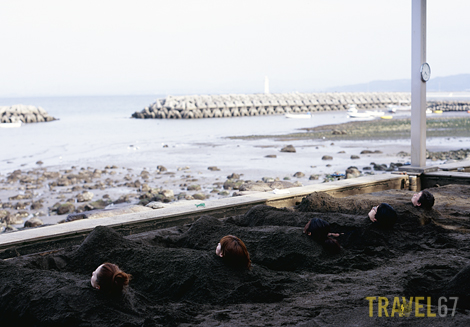
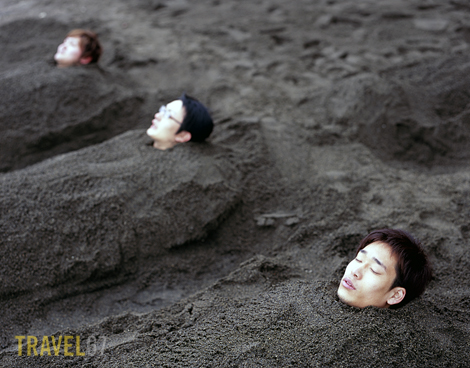
The main focus of Beppu, however, is relaxing in the many onsen. The hotels and ryokan usually have their own baths, but I headed down to the oldest, Takegawara Onsen, for a soak on the first night. The next day I hiked for an hour up to one of the natural mud onsen on the hillside above the town, and to complete the set I was burried up to my neck in a sand bath by the beach.

Last night was the Mount Ogi Fire festival where they set the hillside ablaze. Here’s a pic from my iPhone