Latest Posts

Sushi Zen: Apologies, Embarrassment and Disappointment

A couple of months ago I posted a blog entry advertising that an Okinawan photo club I belong to was having a mini exhibit at a local restaurant called Sushi Zen (see original post here). The pictures were up all January and when the month finished the owner was more than happy to have the exhibit continue on into February.

Yesterday, I saw a comment on Facebook saying that Sushi Zen didn’t allow Japanese customers. I thought that something must have got lost in translation, but unfortunately, the comments made on Facebook were true. A regular customer of the restaurant told me that the Japanese owner had worked in America and on his return to Okinawa he set up a restaurant making American style sushi that would be popular with  Americans on the island. Japanese customers however demanded Japanese style sushi,  and made negative comments about the American customers when talking in Japanese.

It appears that to create a comfortable atmosphere for his American clients, the owner decided to make the restaurant a private club. Entry to the restaurant is free for Americans, Japanese have to pay 100,000 yen to join. A Japanese woman is allowed into the restaurant without paying the membership fee if she is escorted by an American. All Japanese men have to pay the membership fee. I went over to the restaurant today to check, and saw these signs on the door.
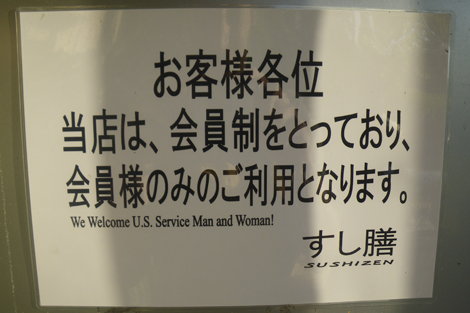
And below it
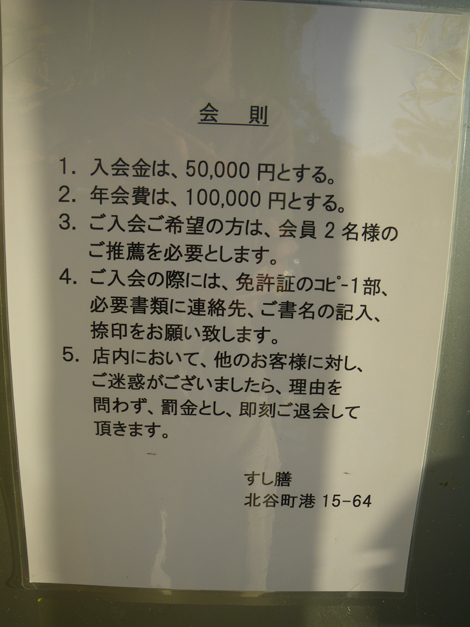
So first an apology.

I’d like to apologize to any of my Japanese friends or readers who may have gone to the restaurant and seen this sign and or been turned away. If I had known about the policy of Sushi Zen I would not have displayed my photographs there. Today, as soon as I saw the signs, I removed my pictures from the restaurant.

I briefly talked with the owner to again confirm the details and it was clear that he didn’t want Japanese customers and that this was his restaurant so it was his rules. He kept referring to the signs on the door.

I had expected this situation would make me feel angry, but instead I feel disappointment and sadness. Would his American customers feel so comfortable if they could read the signs telling Japanese they are not welcome. How would an American servicewoman feel if she was married to, or dating, a Japanese national and found that they were not allowed to eat there.

Some might use the argument that there are places in Japan that don’t allow foreigners. I agree this does happen. While living in Otaru (Hokkaido) I was told I couldn’t enter a ramen shop because “Russia-jin dame!!” (No Russians) or use one of the local onsen/sento because it would make Japanese people uncomfortable (we wouldn’t wash properly and might drink vodka in the bath). Just because there are other examples of exclusion on the basis of gender, skin color, religion or nationality does not make it any less wrong.

I hope that things will change for the better.
100 Yen CDs

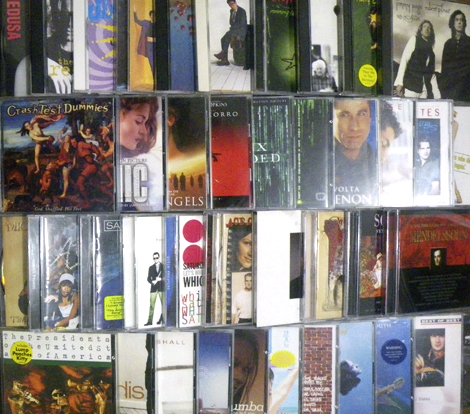
Japanese video stores such as Tsutaya and GEO rent DVDs, Blu-ray discs, comics, video games and CDs. Sometimes they sell off the older DVD’s and CD’s as ex-rentals and recently GEO had a big sale with whole shelves of CD’s on sale for just 100 yen each. It’s been fantastic wandering around the aisles of various stores and as an entire album is less than a single song on iTunes I’ve been quite happy to try things I wouldn’t have otherwise bought. Surprisingly a large number of the CDs were by Scatman John, which even at 100 yen, I managed to resist.

41 CDs = ¥4,100

So if you happen to see me in my car singing hits from the nineties you now know why.

“Movin’ to the country,

Gonna eat a lot of peaches.

Movin’ to the country,

Gonna eat me a lot of peaches”

Million Dollar Music Videos

I came across a list of the most expensive music videos ever made on Wikipedia. 31 videos on the list cost at least a million dollars to make.  I was surprised  that along with global superstars including Michael Jackson, Madonna and Britney, four of the million dollar videos were made for Japanese singer pop star Ayumi Hamasaki.

Here’s one of Ayumi’s videos, Fairyland. I expect that taking Ayumi, dancers and film crew to a tropical island probably took up a good part of the budget. The video also serves as a useful public information announcement on the dangers of candles.

The never ending cold and Photoshop.

I have had a cold for nearly 6 weeks. The sore throat and runny nose ended after a few days but I have a lingering cough that doesn’t want to disappear. So I tried to rest, eat healthy food and give my body time to recover. When that had no effect I went to the doctor and was given some antibiotics and various other tablets. When they had no effect the doctor gave me some different antibiotics and another selection of tablets. I think I just need a good dose of sunshine, as the weather has been miserable for weeks.

Meanwhile, I’ve been sitting at my computer and learning about Photoshop. You can do a lot of amazing things in Photoshop and it is surprisingly easy to manipulate reality.

Original

With Photoshop

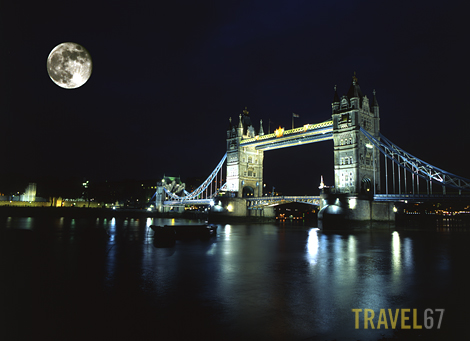
As a photographer this raises all sorts of ethical questions about what you should or shouldn’t do to an image. For news photographers the rules are clear, nothing should be changed. For travel photography I think it would be best to do the same. However, it is extremely useful to be aware of just how easily these changes can be made. For example, take an old photograph of the moon and an old photograph of London Bridge and in less than a minute you can combine the two.

Tower Bridge plus a Photoshop moon.

I’ve seen shots like this before and wondered how the photographer achieved it. Clearly I am no Photoshop master – you may have noticed that in my composite image the moon has no reflection – but it has made me wonder just how much “enhancing” has been given to the images we see in magazines.

Flip Canvas Horizontal

Flip Canvas Horizontal is a useful adjustment in Photoshop that gives you a mirror image of your photograph. A few words of warning, which photographers and particularly photo editors should remember.

Flipping an photograph that contains writing will create problems. This is obvious if you can read the text, less so if you can’t.  If a photo editor or graphic designer can’t read kanji it becomes far too easy for images to get flipped during layout. This has happened to me several times. Even more troubling are the cases where an image of a Japanese person in a kimono is flipped. In one simple step in Photoshop you have created the living dead. This is because

“For both men and women, always wrap the right side of the kimono over the body, then overlap it with the left side. Right on top of the left is only used to dress a corpse for burial.” Japanese kimono.com

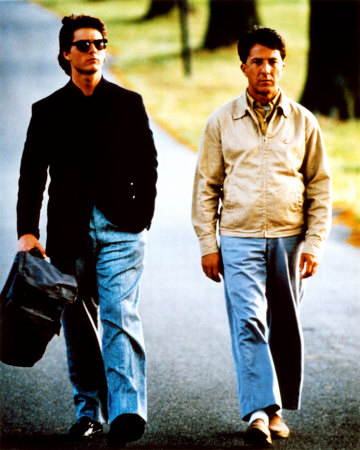
Soon you will begin to notice the flip canvas horizontal adjustment in unexpected places. This screen shot from the movie Rain Man has Tom Cruise holding the bag in his right hand, and Dustin Hoffman wearing a small red badge on the left side of his jacket.

Rain Man movie screen shot

Rain Man movie screen shot

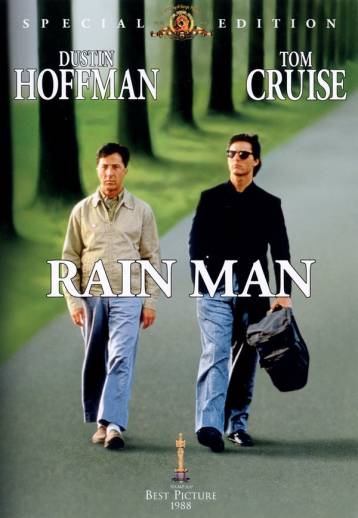
Movie poster, VHS/DVD cover has a flipped image. I presume this is because Dustin Hoffman takes top billing and therefore his name comes first on the movie poster. In order to have the correct name above each person they simply flipped the image. Who will ever notice?

Rain Man Poster flip canvas horizontal

Rain Man - flip canvas horizontal

Ugly Overhead Wires – Shifting Baselines

In response to a few comments to the previous post…

Do people get used to having electrical wires stretching through the sky, I’m sure. Does this lessen the frustration you might otherwise have, probably. Does it mean that it is no longer a problem, not at all.

The phenomenon of shifting baselines as applied in fisheries and ecology is that the perception of what a “healthy” ecosystem is worsens as we get used to successive levels of damage. In Okinawa this idea could be applied to the coral reefs, the forests, beaches or the presence of wiring and concrete poles.

Here’s a short public service announcement that explains a little more:

Ugly Overhead Wires

Last weekend was cloudy and rainy. Rather than taking photos of cherry blossom I was stuck inside sitting at the computer. Then, following a gust of wind, my internet connection went dead. I phoned NTT (on my mobile) and after confirming that one of the green lights on the modem was no longer lit, then sent around an engineer.

Turns out that the telephone line had been bent out of shape by the branches of a swaying tree. I didn’t ask, but I wonder how many people lose their phone, internet or electricity when typhoons bring much stronger winds. Isn’t it time that Okinawa thought about burying some of these cables?

This isn’t a new idea, a few years ago I had a monthly column in the Asahi Weekly newspaper. Here’s the column from March 2004.

Power to the People

I can see the ocean from my living room window. This may sound idyllic, but running directly in front of my house is a mass of wires. Concrete pillars support various sets of electrical and telephone lines that stretch off into the distance down both sides of the road. Thus, my lovely ocean view can only be seen through a spider’s web of steel cables.

The overhead wiring problem in Japan is widespread and not a new occurrence. Japanese people seem to be resigned to the fact that the sky above their neighborhoods and cities is crisscrossed by an ugly mess of steel spaghetti. What makes this so frustrating is that there is a good alternative: Get rid of the pillars, poles and pylons and send the wires underground.

There are a variety of problems with burying cables, however. Initially it costs more money to bury a transmission line than to hang it in the air. It is also more expensive to repair an underground cable should it be damaged. But the advantages far outweigh the disadvantages. Every year a large number of power outages are caused by lightning or tree branches coming into contact with power lines. Overhead cables are also susceptible to the effects of typhoons, earthquakes and ice buildup. And while a broken underground cable may be inconvenient to fix; collapsing pylons and live wires in the street are lethal.

Other countries are burying both their high voltage transmission lines and their local distribution lines. After a 1999 storm destroyed large parts of Denmark’s electricity supply network, it started replacing all its aerial power lines with underground cables.  Singapore, meanwhile, has stopped all overhead cabling in the city.

When trenches are dug to bury power cables it also offers the opportunity for other utilities to be placed underground, including telephone, broadband cables and even empty ducts for  future use. Japan has the opportunity to simultaneously revolutionize both its power and communications infrastructure.

The main reasons for burying cables are the environmental and aesthetic benefits. The problem is that these positive aspects are given little or no value when financial calculations are being made. I believe people would rather have their mountains covered with trees than with electrical pylons. They would rather see unobstructed clear blue skies than a sky filled with power lines. They would prefer to look out their windows at the ocean rather than at a forest of concrete poles and a web of wires.

Visual pollution is not a concept that is given much thought in Japan; it comes far down the list of government and industry priorities. It’s time for that to change. It’s time to bring back the beauty of Japan’s cities — and send the wiring underground.

Island Icons – Dolphin Trainers

Churaumi Aquarium, Okinawa Expo Park, Dolphin Trainers

Churaumi Aquarium, Okinawa Expo Park, Dolphin Trainers

Dolphin Delight

Ryo Nakasone and Azusa Watanabe are dolphin trainers at Okinawa’s Expo Park.

Ryo Nakasone grew up in Motobu not far from the aquarium where he now works. While at high school in Naha he was a champion boxer and was scouted by Nihon University where he fought in the light-fly weight class while a student. After graduation, he returned to his hometown and began working at Expo Park. Now 29, he has been a dolphin trainer for five years.

Azusa Watanabe majored in fisheries studies at Nagasaki University. She moved to Okinawa four months ago, and at age 23, is the aquarium’s newest dolphin trainer.

What types of dolphin live at Expo Park?

“There are 82 species of dolphin in the world, and we have five species living here at Expo. They are the Pacific white-sided dolphin, Indo-Pacific bottlenose dolphin, rough-toothed Dolphin, bottlenose dolphin and false killer whale.”

I heard a rumor that killer whales are actually a type of dolphin?

“It is true; they are part of the same biological family Delphinidae. They’re also the biggest family member, growing to lengths of up to 9.6 meters.”

Dolphins are marine mammals, which means they have lungs to breathe air, warm blood, live young, produce milk, and have hair. But where is the hair on a dolphin?

“Although adult dolphins don’t have hair, if you look at a very young dolphin, they have fine whiskers around their upper jaw, kind of like a little mustache.”

Dolphin Studio, Okinawa Expo Park

Dolphin Studio, Okinawa Expo Park

How much fish do they dolphins eat?

“Our dolphins eat between nine and twenty five kilograms of fish everyday. The variety of fish changes, but it’s mainly a mixture of capelin, squid, mackerel, flying fish and Japanese surf smelt.”

What are the key jobs of a dolphin trainer?

“Our primary concern is the health and happiness of the dolphins. We check each day to ensure individuals have no medical problems, prepare their food, and make sure their pools are clean. We’re also involved with the training of the dolphins and running the daily shows, which keeps them from getting bored.”

Are dolphin trainers and marine biologists the same thing?

“Not at all. Our job is solely about the welfare of these dolphins. Marine biologists, on the other hand, conduct research into every aspect of the oceans, from plankton to whales.”

Dolphin trainer Ryo Nakasone at Okinawa Expo Park

Dolphin trainer Ryo Nakasone at Okinawa Expo Park

Can you tell me about the rehabilitation of Fuji-chan?

“Fuji is a female bottlenose dolphin who’s around 36 years old. In 2002, she had problems with an infection and lack of blood flow to her tail flukes. 75% of the flukes died and had to be removed. Without an intact tail, Fuji-chan was unable to swim or jump as well as she had done before. We started a project to create artificial tail flukes for her. We have tried many different designs; our most recent is a combination of rubber and a reinforcing silicone plate that can be bolted in place. Fuji-chan is now slimmer and healthier and can even jump as much as three meters out of the water.”

Is being a dolphin trainer as good as everyone imagines it to be?

“It’s a dream job. Quite simply…fantastic.”

Dolphin Show, Okinawa Expo Park

Dolphin Show, Okinawa Expo Park

(Interview first published in Okinawa Living Magazine August 2006)

Nagoya

I’ve been busy the last few days writing a Best of Nagoya article.  I spent two weeks  in and around the city in March 2008 collecting information and taking photographs, but it is only now that I am finally getting around to converting my scrawled notes into what will hopefully become coherent sentences. Unfortunately a few things have happened in Nagoya over the last couple of years that have rendered images and possible recommendations a little redundant.

The Villagio Italia an Italian themed mini mall was so kitsch  it was wonderful. It had its own Venetian canal, boutiques selling Carnevale masks, and a supermarket stocked with Italian wines, cheeses and pasta. You could even have a gelata while sitting beneath Michelangelo’s David. Unfortunately less than 2 months after my visit it closed.

Carnevale mask, Villagio Italia, Nagoya

Carnevale mask, Villagio Italia, Nagoya

Then a month later, Kyu the star attraction of the Port of Nagoya Public Aquarium died.

Kyu Nagoya Aquarium's Killer Whale

Kyu Nagoya Aquarium's Killer Whale

And today, just a moment after writing about “the local textile firm that became the world’s largest automaker,” I hear that Toyota is suffering from its biggest crisis in recent history.

On the Bookshelf – Henri Cartier-Bresson Photographer / A Propos de Paris

Last Christmas both my parents and my brother gave me books on photography by Henri Cartier-Bresson. It turns out that by blogging about what is on my bookshelf, they were able to deduce what wasn’t there.

Henri Cartier-Bresson: Photographer is a comprehensive collection of Cartier-Bresson’s work spanning the years 1926 to 1979 and includes images from France, Mexico, China, Russia, and even Japan.

In Henri Cartier-Bresson: À Propos de Paris he delves deeper into his relationship with Paris.

One aspect of his images I find fascinating is his ability to get fly-on-the-wall shots where the presence of the photographer is unnoticed or ignored. I have never used Leica cameras, but their compact size would not only make the photographer more maneuverable, I presume, it also reduces the impact the photographer has on the scene. Subjects would have behaved differently for example if he’d used a giant camera like my Pentax 67 that tends to get stared at rather than ignored (Not to mention the rifle-like crack of the Pentax’s shutter).

My favorite Cartier-Bresson image can be found in both books, captioned Hyères, France, 1932, it  is a perfect example of  “the decisive moment.” I thought this would be an inspiring image to have on my wall, especially for a cycling photographer. I found one print here but it had already been sold. I guess I’ll just have to wait for Christie’s to auction another!

Hyères, France, 1932 by Henri Cartier-Bresson