The interview I did with Dr. Craig Willcox went on far longer than the single page that appeared in the magazine. I have posted the extended version of the interview below for those who are interested.
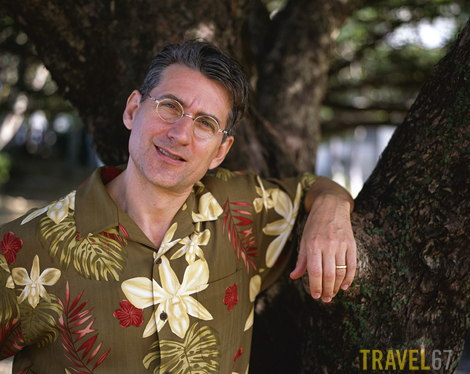
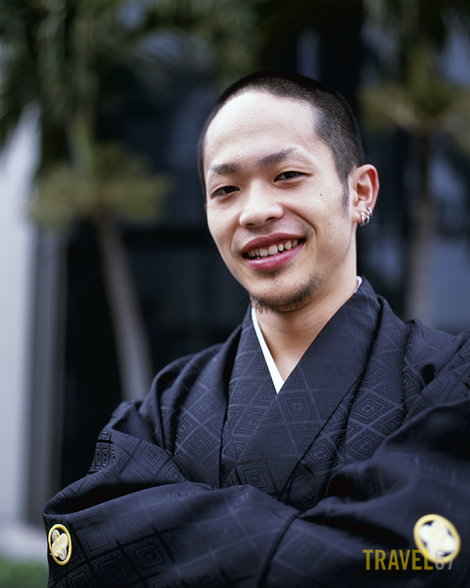
Gerontologist Dr. Craig Willcox
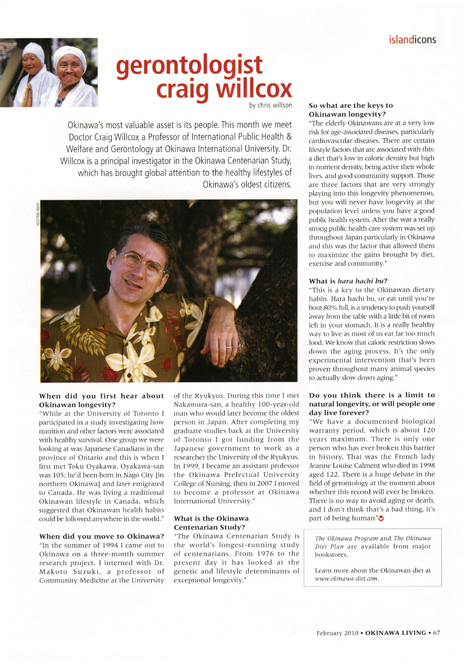
Gerontologist Craig Willcox
Okinawa’s most valuable asset is its people. This month we meet Doctor Craig Willcox a Professor of International Public Health & Welfare and Gerontology at Okinawa International University. Dr. Willcox is a principal investigator in the Okinawa Centenarian Study, which has brought global attention to the healthy lifestyles of Okinawa’s oldest citizens.
When did you first hear about Okinawan longevity?
“While at the University of Toronto I participated in a study investigating how nutrition and other factors were associated with healthy survival. One group we were looking at was Japanese Canadians in the province of Ontario and this is when I first met Toku Oyakawa. Oyakawa-san was 105; he’d been born in Nago City (in northern Okinawa) and later emigrated to Canada. He was living a traditional Okinawan lifestyle in Canada, which suggested that Okinawan health habits could be followed anywhere in the world.”
When did you move to Okinawa?
“In the summer of 1994 I came out to Okinawa on a three-month summer research project. I interned with Dr. Makoto Suzuki, a professor of Community Medicine at the University of the Ryukyus. During this time I met Nakamura-san a healthy 100-year-old man who would later become the oldest person in Japan. After completing my graduate studies back at the University of Toronto I got funding from the Japanese government to work as a researcher at the University of the Ryukyus. In 1999, I became an assistant professor at Okinawa Prefectural University, College of Nursing, then in 2007 I moved to become a professor at Okinawa International University.”
What is the Okinawa Centenarian Study?
“The Okinawa Centenarian Study is the world’s longest running study of centenarians. From 1976 to the present day it has looked at the genetic and lifestyle determinants of exceptional longevity.”
So what are the keys to Okinawan longevity?
The elderly Okinawans are at a very low risk for age-associated diseases, particularly cardiovascular diseases. There are certain lifestyle factors that are associated with this: a diet that’s low in caloric density but high in nutrient density, being active their whole lives and good community support. Those are three factors that are very strongly playing into this longevity phenomenon, but you will never have longevity at the population level unless you have a good public health system. After the war a really strong public health care system was set up throughout Japan, particularly in Okinawa, and this was the factor that allowed them to maximize the gains brought by diet, exercise and community.
So the Okinawan diet refers to the kind of food eaten by the community rather than a method to lose weight?
Yes, we’re referring to dietary habits. It’s about maintaining a healthy weight throughout their lives. If we list the three lifestyle factors that are most related to early mortality they’re smoking, obesity, and excessive intake of alcohol. Most centenarians didn’t smoke or smoked very little and quit, they drank moderately if at all, and were not obese at anytime during their lives. So you’ve knocked off the first three risk factors right there.
What is hara hachi bu?
This is a key to the Okinawan dietary habits. Hara hachi bu or eat until your about 80% full, is a tendency to push yourself away from the table with a little bit of room left in your stomach. It is a really healthy way to live as most us eat far too much food. We know that caloric restriction slows down the aging process. It’s the only experimental intervention that’s been proven throughout many animal species to actually slow down aging.
Can you explain the importance of tea?
Tea, and in particular sanpin cha or jasmine tea, is the favorite drink of the centenarians. They drink it hot or cold and it’s chock full of potent antioxidants such as flavonoids, which provide many health benefits, such as reduced risk for cancer and cardiovascular disease and it tastes great, so I drink it myself.
Have you adapted other parts of the Okinawan diet into your own life?
Sure, goya champuru, tofu champuru, lots of green leafy vegetables and the yellow root vegetables like the sweet potato, which was the former staple in the traditional diet (and has now been replaced by white rice). These are the kinds of foods you want to maximize in your diet. You want to think of the rainbow when you choose food. The colors are key, cause it’s the pigments in these vegetables where the carotenoids, the anthocyanins and your other phytonutrients mostly come from.
Do you think there is a limit to natural longevity, or will people one day live forever?
We have a biological warranty period, which is about 120 years maximum. Although there are a lot of claims for greater longevity none have had the necessary documents to prove their cases. There is only one person who has ever broken this barrier in history. That was the French lady Jeanne Louise Calment who died in 1998 aged 122. There is a huge debate in the field gerontology at the moment about whether this record will ever be broken. There is no way to avoid aging or death, and I don’t think that’s a bad thing, it’s part of being human.
What’s the difference between health expectancy and life expectancy?
Just extending life expectancy without increasing health expectancy is an empty prize. Nobody wants to live a long time if you spend most of those years in a state of poor health.
Which is more important for a long life good genes or good actions?
They’re both important. There’s no disease that doesn’t have some kind of genetic component to it. There are multiple genes that contribute to the aging process but our actions play a very large role. Our changing actions have made it a lot easier to become a centenarian. In the early 1960`s, there were less than 200 centenarians in Japan. Last year’s (2009) count in Okinawa alone was 928 persons, and there are now over 40,000 centenarians throughout Japan. Obviously, it is social changes, good public health, good medical care, and good lifestyle changes that are leading this longevity revolution. More and more people are able to maximize the genetic hand that nature has dealt them.
How important is the mind in health and healing? Can people will themselves back to health?
The mind is a very powerful tool and it’s something that we understand very little about. I think it does have credible healing powers that we have yet to tap into. We know that when we are undergoing stress or depression that the immune system will drop in effectiveness. The opposite, having a positive attitude and being full of hope, will definitely play in your favor and we can see this physiologically by looking at things such as immune factors. A positive attitude is particularly important for older people who are faced with bodies that are not functioning as well as they used to. They are also faced with a lot of psychological challenges, loss of a loved one, loss of a partner, and eventually the loss of their own life. Almost every centenarian we have interviewed has outlived one of their children, they tell us this is one of the most psychologically challenging experiences for them as, of course, children are not meant to die before their parents.
How important is Okinawa’s warm sub-tropical climate?
We think it’s quite important as it allows for fresh fruit and vegetables all year around. It also allows for people to be outside more often. Older people generally do better in warmer climates. That’s why you get people from where I lived in Canada flying south for the winter to places like Florida.
Can you explain the role of kenshin?
Kenshin or health screening is offered to everyone in Japan. This is really important as you are catching diseases in their vary early stages. They are cheap, widely available and they are even mandated by law. Each city, town, and village is required to offer these health screen exams to their residents and they even have target participation rates.
How are lifestyles in Okinawa changing?
The diet and activity levels have undergone a lot of changes for worse. People eat more fried, fatty and fast food, and are a lot less active. Most people drive, the only group of people that seem to be walking regularly is the elderly. The result of this is the highest obesity rate in Japan. There is a lot of work related stress that younger people have to deal with and the pace of life is much quicker.
Do I have to completely give up chocolate and pizza to live healthy?
Why don’t your just add more vegetables to your pizza and eat dark chocolate which is high in flavonoids.
The Okinawa Program 

Learn more about the Okinawa diet at www.okinawa-diet.com and the Okinawa Centenarian Study at www.okicent.org



 TRAVEL 67 : Chris Willson Photography