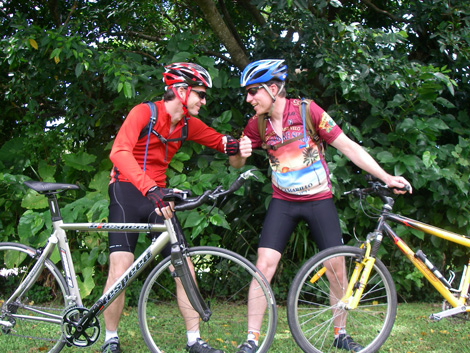
Last weekend I went for a bike ride with my friend Tom. He was visiting from California, and as a keen cyclist wanted to get at least one good ride in while he was in Okinawa.
The problem with riding with Tom is that he is simply too fast. (Tom has ridden at 66 miles an hour while facing backwards on a recumbent tandem bicycle!) To give me a fighting chance, Tom started 40 kilometers away, riding my old heavy mountain bike. When he reached my house I joined him on my road rocket and we did a 70 kilometer loop up to Nago City and back.
It was a great ride with fantastic weather, and we were both able to maintain a similar pace. The joys of an unfair advantage.
I didn’t study photography at school or university. To be honest, if you showed me a selection of famous photographs and told me to name the photographer I would probably only get a couple right. ( an Ansel Adams shot of Yosemite and the Afghan girl by Steve McCurry)
I am however trying to broaden my knowledge of great photographers. Not knowing where else to begin I thought I’d start reading about one of the most famous – Annie Leibovitz.
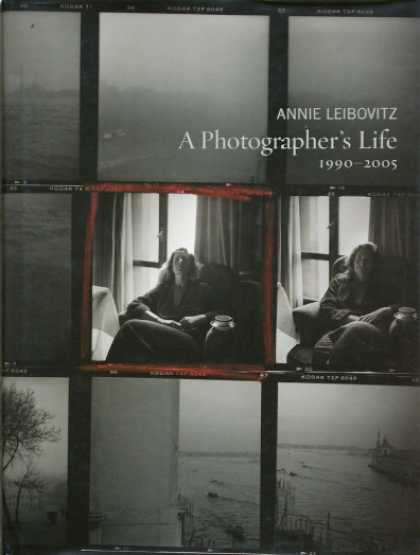
Annie Leibovitz A Photographer's Life 1990-2005 by Annie Leibovitz
The book is a mix of commercial portraits, and far more personal images from her own life. Shots of her family, and pictures from her various travels around the world are woven between photographs of Nelson Mandela, Carl Lewis, Bill Clinton, Michael Jordan, Brad Pitt. and R2-D2.
There is a brief introduction and simple captions. I would have liked to have read the story behind each image, but the focus is kept (and perhaps rightly so) on the images.
It’s a great book, but I did get a feeling similar to when I bought Aretha Franklin –Greatest Hits (1980-1994) and discovered that Respect, Chain of Fools, and Think were on the earlier CD I should have bought instead.
It’s my birthday next month, and my parents asked if there was anything I wanted. I said I wasn’t sure, but next time we chat I’lI know exactly what to say: a copy of Annie Leibovitz Photographs 1970-1990 and some 60’s Aretha.
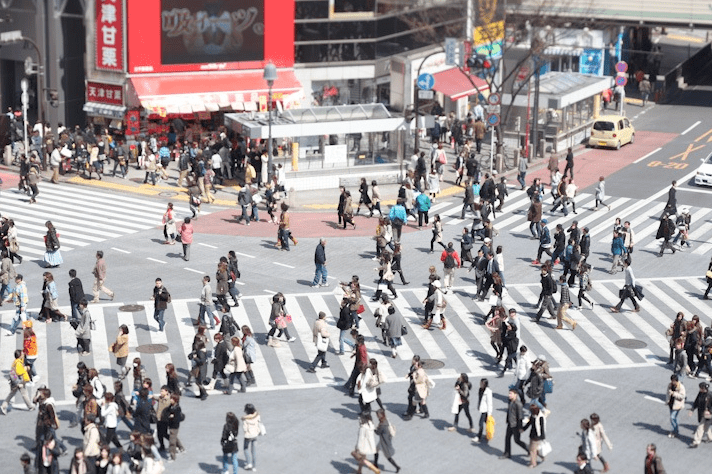
As a follow up to the David Levene post, and the audio-recorders post I thought I would put up a link to David’s audio-slideshow on Tokyo’s Shibuya crossing.
You can watch the video on the Guardian website here.
John Burgreen of Okinawa HDR was up in Tokyo a couple of weeks ago and managed to get this fantastic image of the behemoth.
Gundam Statue Odaiba Tokyo in HDR by John Burgreen
What is HDR?
HDR stands for high dynamic range. The photographer takes multiple shots of the same subject varying the exposure so that some shots accurately expose the shadows while other shots accurately expose the highlights. Combine all the photographs in Photoshop and you produce a image which doesn’t lose detail in areas that would normally be too dark or too bright. Read more at the Wikipedia page here.
HDR is an exciting development in digital photography. Some people love it, some people hate it. In my opinion, it is a technique that is difficult to do well, and can’t remedy an otherwise poor photograph. But, get it right and the images produced can be stunning. John’s Gundam photo is an example of HDR done well.
Now that I have had my car for a couple of months, I thought I would make a few brief comments.
Exterior:
The motoring press has made a lot of comparisons between the Swift and the Mini. Many comment that the new body shape of the Swift is a copy of (or homage to) the Mini. I am not so sure. If anything, it looks like Suzuki have been borrowing from (inspired by) the designers at Audi. Compare the front of the Swift and the TT.
.
.
.
.
Perhaps my favorite external feature of the car, are the subtle twin exhausts. It may seem like a strange pet peeve, but the asymmetry of a single exhaust on a car niggles me. However, a single central exhaust like on the Porsche Boxster just looks a little odd. Of course no exhaust would be even better, but the Tesla Roadster is a little out of my price range.
Interior:
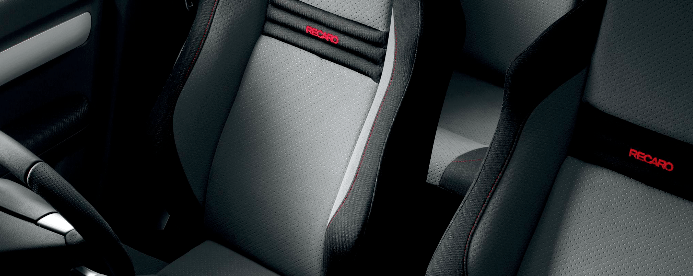
One of the best features of the Japanese spec car is the option for grey Recaro sports seats rather than the bright red generic seats that come as standard. Firm and supportive it took a few days to get used to being clamped, but now I love them.
Economy:
The official figures for the car are 15 km/l. I am not driving the car aggressively, but it’s summertime in Okinawa and the air conditioner is blasting away most of the time. On average the car is doing 12.2 km/l.
Performance:
The Swift Sport has a similar 1.6 liter engine, the same amount of power, and is a comparable weight to my previous car, a 20 year old Mazda Miata MX-5. It is nimble and quick, but doesn’t feel as fast or as well planted . The first reason is that Swift is simply much quieter. The thin canvas roof of the MX-5 meant you were far more aware of the engine and exhaust. The second reason is that the Swift sits much higher on the road, compared with the low slung roadster. Another big difference is that the Swift is front rather than rear wheel drive. I would have to agree with purists that rear wheel drive is more engaging, but for everyday driving the Swift is still a great car to be in.
Overall:
Fantastic little car. Motorists around the world are beginning to realize that bigger isn’t always better. If you want a fun, practical, small car it doesn’t have to be Mini.







 TRAVEL 67 : Chris Willson Photography