Latest Posts

Multitasking for Photographers

The job of a photographer is getting more and more complicated. In the past photographers have had to be their own promoter, accountant, travel agent, porter and therapist.

More recently  many photographers have added the role of writer and blogger, but perhaps the biggest change is going to be the increasing importance of both video and sound. 

Take a look inside the camera bag of travel photographer Tewfic El-Sawy:

* Canon EOS 5D Mark II
* Canon G10 (ideal for unobtrusive street photography)
* Canon 17-40mm f4.0
* Canon 28-70mm f 2.8
* Canon 24mm f1.4
* Marantz PMD 620 Audio Recorder
* Acer Aspire One 8.9-inch Mini Laptop (w/LR2 and SoundSlides)
* A 250gb G-Tech Mini G-Drive External Hard Drive 
* Blackberry & an iTouch

 Along with all the camera gear there is a Marantz PMD 620 Audio Recorder.
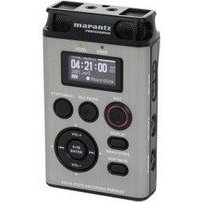
Marantz PMD620 Handheld SD MP3 WAV Recorder

Marantz PMD620 Handheld SD MP3 WAV Recorder

When I met Guardian photographer David Levene a few months ago I noticed that along with  two Canon EOS 5D Mark IIs and a wide selection of lenses he also carried an Edirol Audio Recorder. He recorded sound at Okinawa’s Churaumi Aquarium which would later be combined with photographs to create the slideshow that can be seen on the Guardian website here.
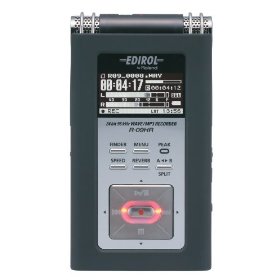
Edirol R-09HR High-Resolution WAVE MP3 Recorder

Edirol R-09HR High-Resolution WAVE MP3 Recorder

The Marantz PMD620 Audio Recorder and the Edirol R-09HR Audio Recorder are both able to record high quality stereo sound in either MP3 or WAV format to the same type of SD cards you use in a digital camera. At around 300 dollars each they are also a significant investment.

Both photographers use Soundslides (you can see Tewfic has it loaded onto his laptop). Soundslides is a “rapid production tool for still image and audio web presentations.” Basically, it’s a computer program that allows you to upload a series of photographs and a soundtrack to produce a slideshow that can then be easily uploaded to the web.

I used Soundslides to create the slideshow for my latest exhibition using guitar music a friend had recorded (If you haven’t seen it you can still check it out here on You Tube.).

The next challenge for me is to produce a slideshow with both my photographs and sound I’ve recorded. I am planning on documenting the Awa Odori Festival in August, so hopefully this will be the perfect opportunity for me to get some great shots and interesting audio. 

Of course the big challenge after that is finding a market for the work, but I’ll cross that bridge (or at least attempt to ford the river) when I come to it.

More waterproof cameras… Pentax Optio W80

Pentax have just announced the latest model in their popular waterproof compact camera range, the Pentax Optio W80.

Pentax Optio W80

Pentax Optio W80

I mentioned in a previous blog about how good these little cameras are as a worry free point & shoot.

My sister, dad and Seiko all have different models of the camera, and yesterday I was given my own W60 so that I’m not always borrowing theirs.

The W80 will be on sale from next month for just under 300 dollars at Amazon.com. This latest model has 12.1 megapixels and is now coldproof as well as waterproof (to 5 meters) along with being able to record HD video.

This does mean that as soon as the W80 is available there should be plenty of places selling off the W60 cheaply. Right now, at Amazon the W60is $259, but I wouldn’t be surprised if this dropped to $200 over the next few weeks.

I won’t be using the camera for assignments, but for everyday events, images for the blog and documenting things the dogs have destroyed the camera should be perfect.

Which reminds me…  waterproof, coldproof, dustproof but probably not Bear-proof. Must keep it out of reach.

Okinawan Bus Driver Kills Boy

From JapanUpdate Okinawa’s weekly English newspaper:

City bus strikes, kills bike-riding youngster

Date Posted: 2009-06-25


A seven-year-old boy is dead after being run over by a Nanjo City bus Monday afternoon.

Nanjo City Police say the fatality occurred as a city bus driver on the Baten Branch run in Tsuhako, Sashiki area of Nanjo City, on Route 331, encountered the young boy on a bicycle in front of him. The bus driver reportedly tried to get the youngster, Kousei Chinen, to move to the side of the road, and tried to pass him. When the bus driver sounded his bus horn, the noise surprised the elementary school student and caused him to lose control of his bicycle.

Chinen fell from the bicycle, and beneath the bus. The driver, realizing what happened, stopped the bus about 100 meters from the accident. A passenger aboard the bus ran to the youngster, saw his school nametag, and called him “Kousei chan, Come on, please. Can you hear me?” The boy was transported to a nearby hospital, where he died less than two hours after the accident.

The bus company says the driver has a long record of safe driving, more than 20 years. The company says he was an expert driver, but police say they’ll now investigate.


This whole article amazes, angers, saddens, infuriates, but does not surprise me.


Blast your horn, run over a kid and then stop 100 meters (300 feet) later!!! Expert driver!!!


Some of the worst driving I see on Okinawa is committed by truck drivers, bus drivers and taxi drivers. 


I hope the police send a photo of the little boy to every truck, bus and taxi company across the island. 

The end of KODACHROME

On June 22, 2009 Kodak announced it was ending production of KODACHROME slide films.  KODACHROME was an icon in the world of photography. The first professional photographer I talked to said he used nothing but KODACHROME 64.

KODACHROME 64

KODACHROME 64

Kodak has however moved on. Not only does KODACHROME amount to less than one percent of Kodak’s film sales there is only one place in the world that still processes the film. I am amazed it has survived this long.

Kodak  still produces transparency film. So once again this is not the death of film, but simply a change in the type of film people are using. Kodak’s pro films are the KODAK PROFESSIONAL ELITE Chrome series which I haven’t used, but I am sure are excellent.

KODAK PROFESSIONAL ELITE Chrome

KODAK PROFESSIONAL ELITE Chrome

I however will stick with Fujifilm Provia. It’s what I have used almost exclusively over the past 9 years, and it provides exactly what I want – fine grain and great saturated colors. 

Fujifilm Provia

Fujifilm Provia

Island Icons – Sanshin Virtuoso Byron Jones

Byron Jones - Sanshin Virtuoso

Byron Jones - Sanshin Virtuoso

After mentioning Byron Jones in the previous post I thought I should put up the entire interview for those who didn’t see it in the magazine.

Sanshin Virtuoso

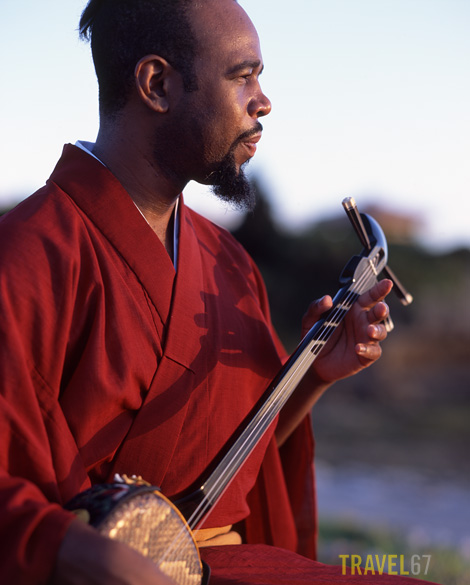
Byron Jones was born in Quantico, Virginia. In 1985 his father, a colonel in the U.S. Marine Corps, was transferred to Camp Foster on Okinawa. Byron attended high school on base, but developed a deep interest in the local Ryukyu culture. At 19, he started playing the sanshin, a traditional Okinawan three-string instrument, which would become his passion. As his proficiency increased, he gained a reputation in the local and national media as “more Japanese than the Japanese.” Byron now teaches the sanshin at various places including the University of the Ryukyus.

What is your musical background?

I played the clarinet when I was in the 4th Grade, and in high school, one of my friends taught me to play guitar. I saw a sanshin for the first time while visiting my friend’s house and immediately wanted to learn how to play. It wasn’t possible to rent a sanshin so I saved some money and bought my first sanshin for $350. My dad thought I would get bored and give it up, but I’ve been playing for nearly twenty years.

What exactly is a sanshin?

“The sanshin is an instrument similar to a guitar or banjo, but with only three strings. The body is covered with snake skin, while the neck is made of lacquered wood. The shamisen that is played on mainland Japan is actually a derivative of the traditional Okinawan sanshin. The most obvious difference between the two is that the bodies of the original shamisen were covered with white cat skin. ”

Was it easy to learn how to play?

“I progressed very slowly. I’m a terrible student, and at first I didn’t practice that much. Gradually, I learned how to read the music, tune the instrument and perform a few songs. I studied the classical music that is used to accompany Ryukyu dance by reading sheet music, and I listened to CDs of Okinawan folk music to learn the more popular songs. I spent many evenings sitting on the seawall watching the setting sun and practicing.”

What kind of music can you play on the sanshin?

“The sanshin is a fretless instrument, so you can pretty much play anything. I usually play the classical and folk music that was written for the sanshin, but I can also play gospel, latin and others.”

Even Hendrix?

“Sure, it’s possible. But it would require some serious practice. The most popular song that I play is a medley that mixes Amazing Grace with the Okinawan folk song Tinsagu-nu-Hana (The Balsam Flowers).”

You have produced three CDs already, what are your future plans?

“I am hoping to get together with a friend who plays African djembe drums and a jazz pianist. I hope to create a new kind of East / West jazz fusion. It should be a really interesting project.”

Can a foreign-born person in Japan ever become integrated with the community or do you think they will they always be seen as an outsider.

“I think it’s possible, but it depends on the individual. There will always be people who have a closed heart and view me as an outsider, and they are entitled to their opinion. Speaking from experience, the first time I walk into a classroom filled with children I often hear the word gaijin. However, by the end of the day, I’m just “Byron-sensei.” After the children get to know me, my country of origin and the color of my skin are no longer an issue.”

“It also depends on how you perceive yourself – do you see yourself as a visitor or a resident? How far are you willing to engage with the local community?

I guess it depends how you view the world – do you look for the similarities or differences between people?”

“Personally, I think we should all see how much we have in common.”

Byron Jones - Sanshin Virtuoso


(Interview first published in Okinawa Living Magazine December 2006)

Okinawan Sanshin in a Pussycat Dolls’ Song?

Listening to the local radio station the other day I heard a song by The Pussycat Dolls. The tune would have been forgettable except for the fact that it sounds like an Okinawan sanshin is playing in the background. Does anyone happen to know if it really is a sanshin?

The song is called Whatcha Think About That 

The Okinawan sanshin is a three stringed instrument, similar to a banjo. It is a close relative of the shamisen that is played on mainland Japan. Here’s a shot of professional sanshin player Byron Jones that I took for Okinawa Living

Byron Jones & Okinawan Sanshin

Byron Jones & Okinawan Sanshin

Polarize your views

Polarizing light

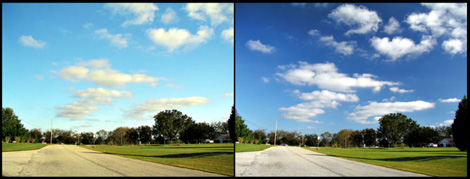
Putting a polarizing filter between the sunlight and your eyes (or your camera) reduces glare and increases color saturation. In the image below the left side had no filter while the right side had a polarizing filter.

Effects of Polarizer (Image by PiccoloNamek)

Effects of Polarizer (Image by PiccoloNamek)

Polarized Sunglasses

Polarized sunglasses are for me one of life’s joys. They make the world just a little bit better. Reducing glare reduces eye strain while driving. When you are on a dive boat you can see what is underwater much more easily. And the sky is bluer with better defined clouds.

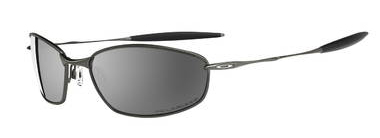
Polarized sunglasses tend to be more expensive than regular sunglasses and like with most optics you tend to get what you pay for when it comes to quality. I am a fan of Oakley’s polarized sunglasses which manage to combine high optical quality with light weight.

Oakley Polarized Whisker Titanium (image from Oakley.com)

Oakley Polarized Whisker Titanium (image from Oakley.com)

Polarizing filters for your lenses

Putting a polarizing filter on the front of your camera will have the same effect as polarized sunglasses. It will reduce glare and increase color saturation. It will also halve the amount of light that reaches the film or sensor in your camera which means that you will be using a slower shutter speed. (As a polarizer is usually used in landscapes longer shutter speeds are not an issue if you are already using a tripod.)

Polarizing filters come in two main types circular and linear. You need a circular polarizer if you are using an autofocus camera or TTL metering.

As polarizing filters tend to be thicker than regular filters there are also regular and wide versions. Wide versions are specially designed to be thiner so that there is less chance of mechanical vignetting when you are using a wide-angle lens.

Polarizing filters also come in different sizes to match the diameter of your lens. This means that you may need to buy several polarizing filters of different sizes if you have lenses of different diameters. I often use a polarizing filter with my standard and wide-angle lenses but rarely with the telephotos.

Numerous companies produce polarizing filters, again you tend to get what you pay for. I use Kenko’s Vernier polarizing filters, their Japanese web site is here.

Kenko Circular Polarizer Wide Vernier

Kenko Circular Polarizer Wide Vernier

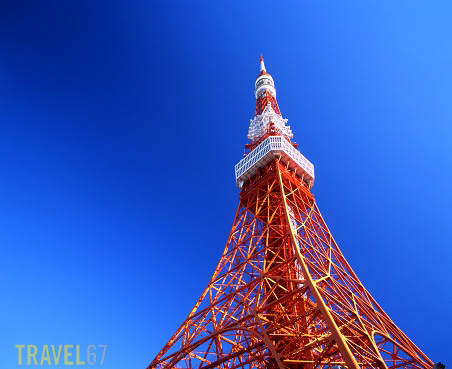
 One interesting thing to note is that when using a polarizing filter on wide-angle lenses the level of polarization may be uneven across the frame leading to bands of darker and lighter areas. Sometimes that effects are unwanted but sometimes it can add to a shot.

Wide angle shot of Tokyo Tower using polarizing filter.

Wide angle shot of Tokyo Tower using polarizing filter.

Fender Japan Stratocasters

The Fender Stratocaster guitar is an American icon. So why you may ask am I writing about it in a photography blog about Japan…

Imitation may be the highest form of flattery, but in the early 80’s Fender USA was trying to deal with a flood of foreign-made Stratocaster-like guitars. Fender decided to make the best of a bad situation and set up Fender Japan to produce Japanese Fender guitars for the Japanese  market.

Fender Japan was particularly good at producing vintage reissues. So good in fact that Dan Smith, Fender’s Director of Marketing said:“Everybody came up to inspect them and the guys almost cried, because the Japanese  product was so good – it was what we had been having a hell of a time trying to do.” 

Fender Japan guitars are not officially exported to Europe or America, these markets are supplied with Fenders from Mexico or, for the higher end models, from the US. There is a healthy used market however. My friend John exports Japanese made guitars to musicians and collectors all over the world. You can check out his website here.

Last year, when we were sure it wasn’t going to rain, John and I lined up a few guitars outside for a photo shoot.

Fender Japan Stratocasters

Fender Japan Stratocasters

 My guitar is the one in Fiesta Red. Unfortunately, the fact that I rarely practice means I will never play like Mark Knopfler. However if you’d like to hear a painfully bad rendition of either Sweet Home Alabama, Blaze of Glory or Come Together then I’m your man.

Green Tea Coke!

Most Japanese women prefer to drink green tea rather than soda. This is good for their health but bad for soda companies.

But then big business had a cunning plan…..

Green Tea Coke

Green Tea Coke

On June 8th, Coca-Cola Plus Green Tea Flavor appeared in stores across Japan.

Gion Matsuri, Kyoto July 17th

As I mentioned in a previous post it’s probably more useful to learn about festivals before they occur rather than seeing photos of an event you just missed.

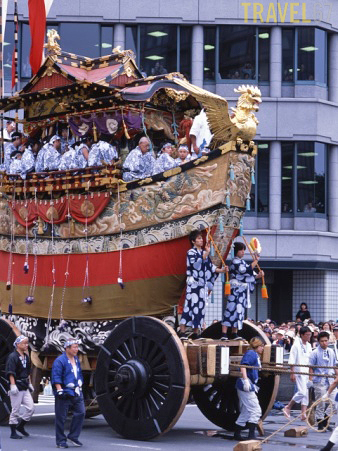
In exactly one month, on July 17th the main parade of floats will take place as part of Kyoto’s Gion Matsuri.

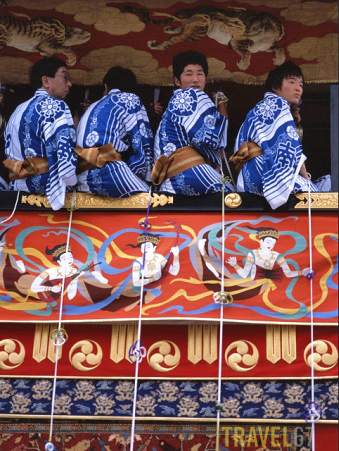
The huge floats are called Yamaboko and are dragged through the streets by teams of men. They do not go through the cobbled streets of Gion but rather trundle along the main shopping streets Shijo, Kawaramachi and Oike.

The streets are packed with spectators but usually you can find a spot where you can get a decent view. I recommend the main intersections as this is where the floats have to be rotated 90 degrees, an impressive feat of strength and teamwork.

Gion Matsuri, Kyoto

Gion Matsuri, Kyoto

Gion Matsuri, Kyoto

Gion Matsuri, Kyoto

You can read more about visiting Kyoto in my article The Best of Kyoto.