
Byron Jones - Sanshin Virtuoso
After mentioning Byron Jones in the previous post I thought I should put up the entire interview for those who didn’t see it in the magazine.
Sanshin Virtuoso
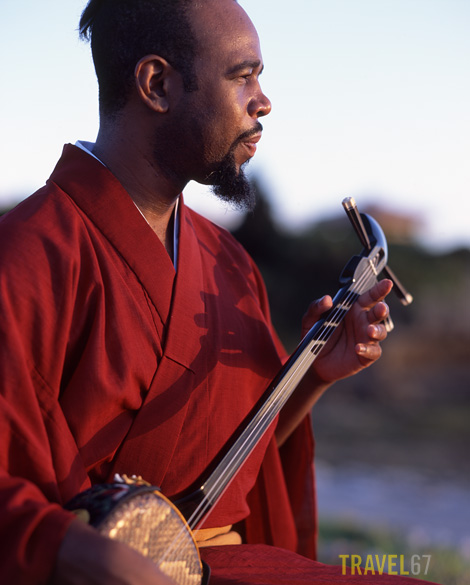
Byron Jones was born in Quantico, Virginia. In 1985 his father, a colonel in the U.S. Marine Corps, was transferred to Camp Foster on Okinawa. Byron attended high school on base, but developed a deep interest in the local Ryukyu culture. At 19, he started playing the sanshin, a traditional Okinawan three-string instrument, which would become his passion. As his proficiency increased, he gained a reputation in the local and national media as “more Japanese than the Japanese.” Byron now teaches the sanshin at various places including the University of the Ryukyus.
What is your musical background?
I played the clarinet when I was in the 4th Grade, and in high school, one of my friends taught me to play guitar. I saw a sanshin for the first time while visiting my friend’s house and immediately wanted to learn how to play. It wasn’t possible to rent a sanshin so I saved some money and bought my first sanshin for $350. My dad thought I would get bored and give it up, but I’ve been playing for nearly twenty years.
What exactly is a sanshin?
“The sanshin is an instrument similar to a guitar or banjo, but with only three strings. The body is covered with snake skin, while the neck is made of lacquered wood. The shamisen that is played on mainland Japan is actually a derivative of the traditional Okinawan sanshin. The most obvious difference between the two is that the bodies of the original shamisen were covered with white cat skin. ”
Was it easy to learn how to play?
“I progressed very slowly. I’m a terrible student, and at first I didn’t practice that much. Gradually, I learned how to read the music, tune the instrument and perform a few songs. I studied the classical music that is used to accompany Ryukyu dance by reading sheet music, and I listened to CDs of Okinawan folk music to learn the more popular songs. I spent many evenings sitting on the seawall watching the setting sun and practicing.”
What kind of music can you play on the sanshin?
“The sanshin is a fretless instrument, so you can pretty much play anything. I usually play the classical and folk music that was written for the sanshin, but I can also play gospel, latin and others.”
Even Hendrix?
“Sure, it’s possible. But it would require some serious practice. The most popular song that I play is a medley that mixes Amazing Grace with the Okinawan folk song Tinsagu-nu-Hana (The Balsam Flowers).”
You have produced three CDs already, what are your future plans?
“I am hoping to get together with a friend who plays African djembe drums and a jazz pianist. I hope to create a new kind of East / West jazz fusion. It should be a really interesting project.”
Can a foreign-born person in Japan ever become integrated with the community or do you think they will they always be seen as an outsider.
“I think it’s possible, but it depends on the individual. There will always be people who have a closed heart and view me as an outsider, and they are entitled to their opinion. Speaking from experience, the first time I walk into a classroom filled with children I often hear the word gaijin. However, by the end of the day, I’m just “Byron-sensei.” After the children get to know me, my country of origin and the color of my skin are no longer an issue.”
“It also depends on how you perceive yourself – do you see yourself as a visitor or a resident? How far are you willing to engage with the local community?
I guess it depends how you view the world – do you look for the similarities or differences between people?”
“Personally, I think we should all see how much we have in common.”

(Interview first published in Okinawa Living Magazine December 2006)











 movie.
