All posts tagged: japan

Humpback Whale Watching on Okinawa

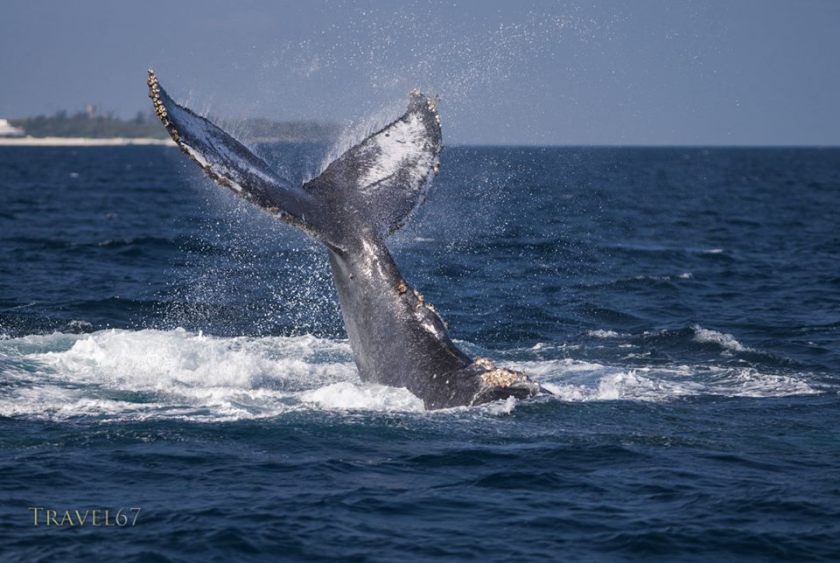
Here’s my latest collaboration video with Skylum Software. I take to the waters off the coast of Motobu, Okinawa to try and photograph humpback whales. Please like, share and comment on the video as it will help others find it and allow us to keep on making videos! Skylum Software just released a new update to Luminar this week so it is now faster with a few new editing options also. A big thank you to Okinawa Island Crew for letting me shoot photos and video on the boat. I much prefer whale watching from Motobu rather than Naha as the whales are located much closer to the port. The gear used in the video was the Pentax 645Z camera with the 300mm f4 lens. The tripod was a carbon fibre LEO by 3 Legged Thing, and the bag is the Whistler by Lowepro.
Naha Giant Tug of War – Oct 8th 2017

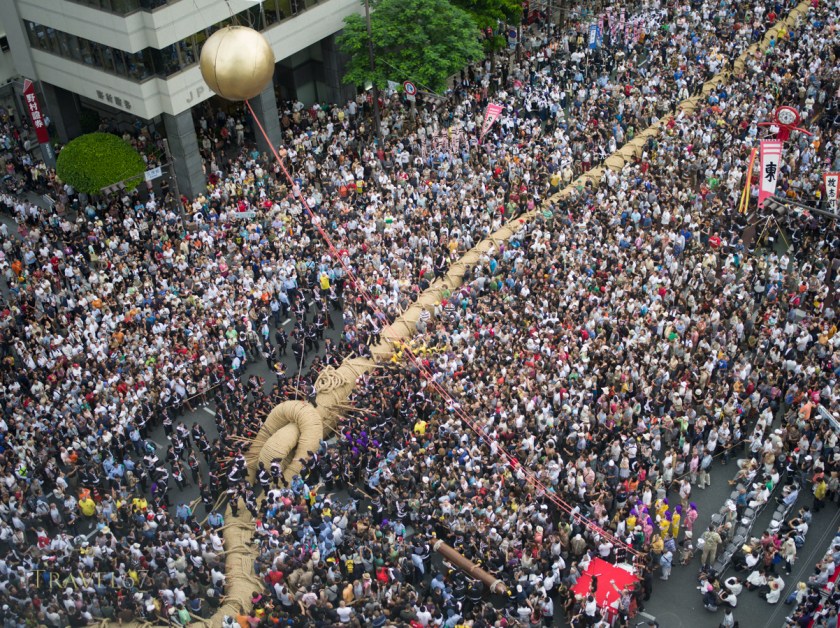
This afternoon the world’s biggest tug of war will take place on Route 58 in Naha City, Okinawa.  I’ll be missing it this year as I’m selling prints at the Holiday Bazaar on Camp Foster, but it’s a great thing to see if you’re in Okinawa today. (You can also drop by the bazaar!) There are parades on Kokusai Street before the main event, which starts at around 2.45pm with the ceremony, then bringing the ropes together at 3.30 and the actual tug of war happens around 4pm  (Please confirm times for 2017 yourself!). Here are a few pictures from previous years.  

Shy Guy

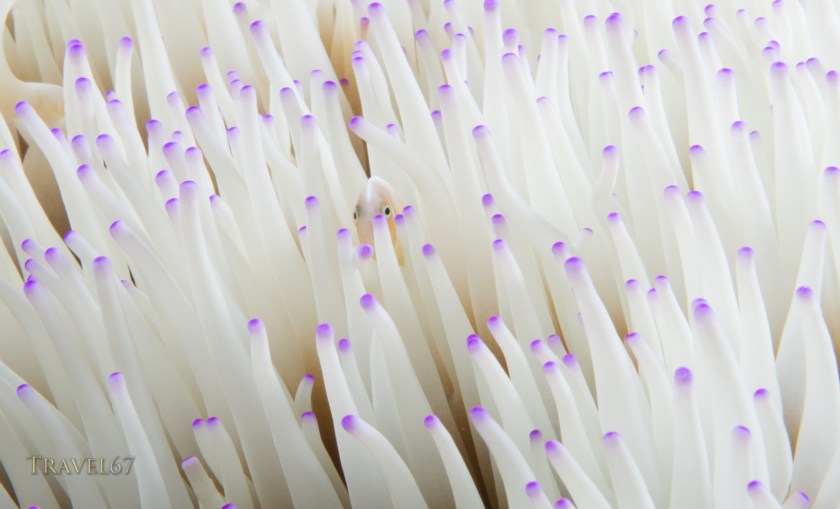
Nemos a.k.a. false clown anemonefish (Amphiprion ocellaris) are surprisingly brave, if not aggressive. They’ll come out of their anemone and try to intimidate larger fish or scuba divers. The pink anemonefish (Amphiprion perideraion) is far more shy. It is quite happy to stay hidden among the tentacles of an anemone and wait until the danger has past. This little fish has made home in a sebae anemone (Heteractis crispa). Seen at Horseshoe reef near Cape Manza, Okinawa, Japan.

Fantastic Beasts

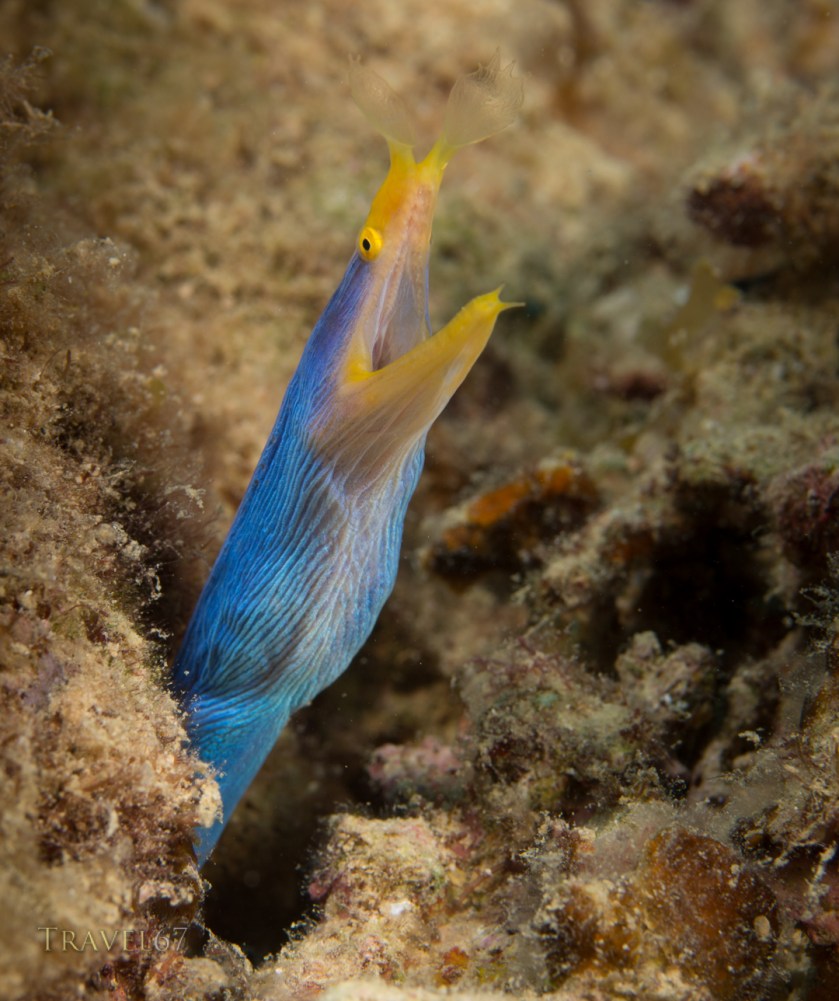
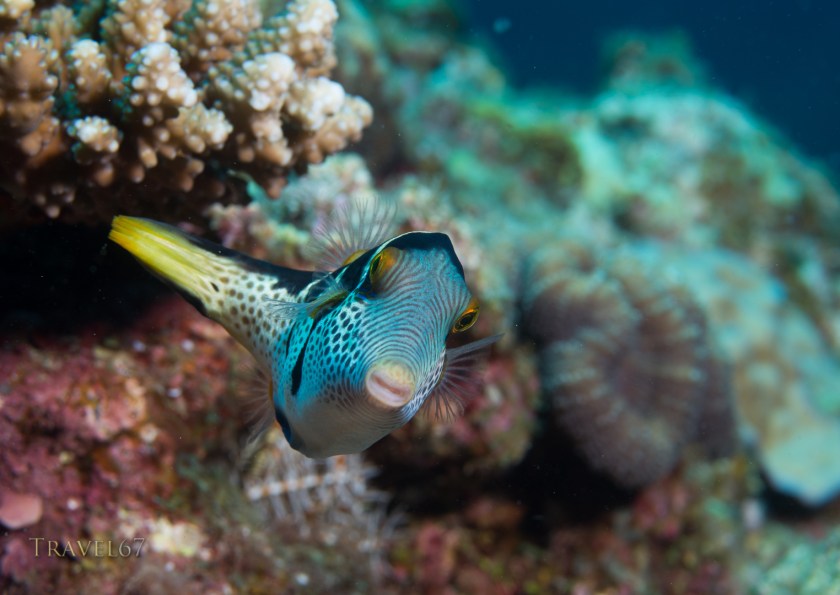
A few of the amazing creatures living in Okinawa’s ocean.  The top photo is of the male ribbon eel (Rhinomuraena quaesita). Amazingly, some blue male ribbon eels change to bright yellow female ribbon eels in later life. This next fish is a honeycomb grouper (Epinephelus merra) whose spots help camouflage  it while on the reef. It was also named “Fish most likely to turn into a giraffe.” Next is a Naia pipefish (Dunckerocampus naia) which was about 3 centimeters long. Similar to a seahorse, but less pretentious. The striped puffer (Arothron manilensis) looks like it’s wearing prison uniform. It’s a relative of the tiger blowfish (Takifugu rubripes) that occasionally kills diners with its  tetrodotoxin poison. The black-finned snake eel (Ophichthus altipennis) watches the world swim by from its hole in the sand. This tiny Dinah’s goby ( Lubricogobius dinah ) didn’t have to bother making a hole, it was quite happy with a ready-made glass bottle. Just as tiny was this sea cucumber crab  (Lissocarcinus orbicularis) living on the surface of a sea cucumber. And even smaller was this tiny emperor shrimp (Periclimenes imperator) who …

Bull Wrestling

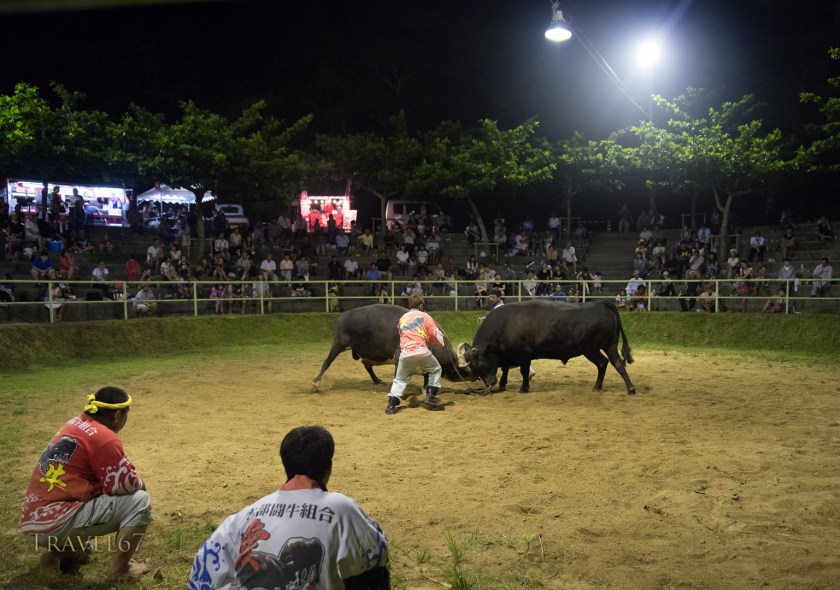
The Motobu Kanko Bunka Festa took place the evening after the Expo Fireworks festival. There were a few hundred rather than tens of thousands of spectators, and the entertainment was far more traditional . There was a karate demonstration by Kiyoshi Yogi, followed by some goat wrestling, folk singing, and then bull wrestling. There were five bouts of bull wrestling. The bulls locked horns, and then pushed until one of them gave up and turned away. Sometimes they can can get superficial cuts from the other bull’s horns, but they all came away uninjured and lived to see another day. Occasionally you see the giant bulls being taken for walks or even a dip in the ocean. They are pampered by their owners, living a life far better than most male cows. I wonder what happens when they get older. Can a gladiator ever earn their freedom.

In search of the frogfish!

Shawn, Hiroshi and I went out for a dive at Cape Maeda, and for the first time in a while I set up the underwater camera rig. Our main goal was to find a frogfish Shawn had previously spotted. We found him sitting on the second reef at about 25 meters deep, his pelvic and pectoral fins acting like little feet. Other creatures I snapped on our dives were nudibranchs (sea slugs), anemonefish (Nemo), and trumpetfish (both silver and yellow species). As it was a Saturday, summer, glorious weather, and a famous spot, Maeda was packed with people.  By mid-morning there was a line all the way up the steps of people waiting to get in.  (A quick P.S.A. to a couple of snorkelers we saw: if you must ignore the line and push past all the people waiting, you might want to cover up your USMC tattoos so you’re not such poor ambassadors to your corps.) Maeda’s popularity, particularly with new divers, does have a negative impact on the reef.   Ideally, divers should …

Koichi Nakasone 9th Dan Ryukyu Kingdom Sui-di Bujutsu

Yesterday I made the short drive over to Nakijin Village to the home of Koichi Nakasone, 9th Dan Ryukyu Kingdom Sui-di Bujutsu. He is the 76th sensei to be photographed for the Karate Masters Portrait Project. James Pankiewicz, Becka Tedder, and I sat down for a chat in the traditional wooden house that Nakasone sensei had recently built by himself. He told us a few stories about his karate training, and the three months he spent in the USA traveling from dojo to dojo, challenging the members to fight. (Known in Japanese as dojo yaburi.) After our chat, we set up the black background on the side of the house and took the portraits. (Pentax 645Z with 90mm lens. Profoto B1 with white softlight reflector.) We then drove a couple of minutes to beautiful Nagahama Beach for some more location shots. I switched lenses to the 25mm wide-angle and removed the softlight reflector as we needed as much power as possible to try and fill in shadows. Becka held the light, while James put on his …

Summer in Okinawa

Goldfish shoals, nibbling at my toes. Fun, Fun, Fun in the Sun, Sun, Sun. HAPPY WELCOME to the summer heat and humidity. Beautiful blue skies, and sweaty sweaty t-shirts. Spent the weekend out in the sun for the North and South Intermediate Workshop.   82 year old Jahana-san showing how to stay cool in the summer heat. Put on a hat and stay in the shade. Time for some fresh mango juice.

Coconut Crabs of Okinawa

Coconut crabs, Birgus latro, are the world’s largest land-living arthropods. Okinawa is the northernmost habitat for the species. They hibernate during the winter, and are nocturnal, so many Okinawans have never seen one. The crabs can grow up to 3 kilos, and have large powerful claws. They are scavengers and usually eat fallen fruit from trees such as the adan (Pandanus odoratissimus), but they will nibble on the occasional dead animal. Coconut crabs grow very slowly and can live for up to 60 years. As sexual maturity doesn’t occur until 5 years old, predation of larger crabs by animals or humans can lead to a population being unable to recover. Researchers such as marine biologist Shin-ichiro Oka monitor the coconut crabs in Okinawa. Crabs are measured, photographed, tagged, and have their position logged. Other interesting aspects of coconut crab biology have been studied including their grip strength. Oka explains that a large coconut crab has a grip strength similar to the jaws of a lion. Thank you to Shin-ichiro Oka for letting me tag along …

Dino Park in Nago, Okinawa

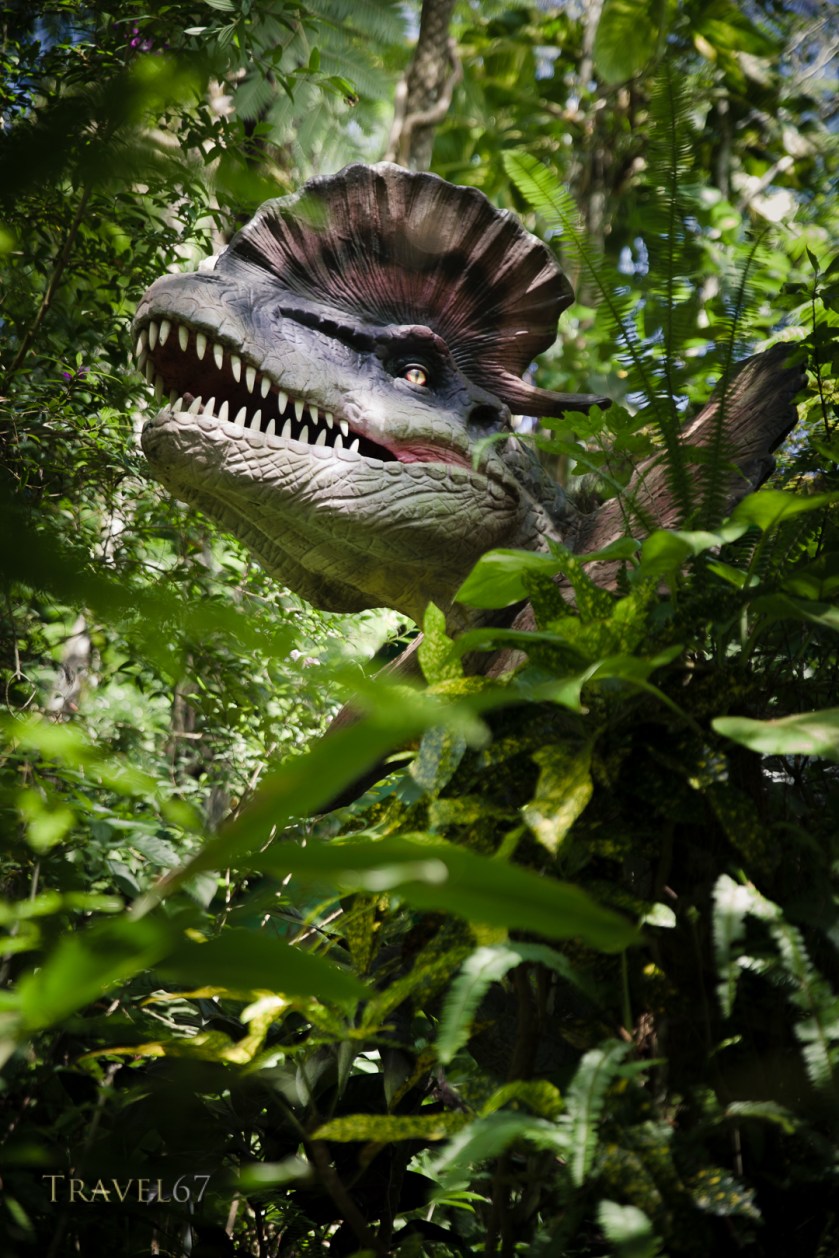
Visitors to the Nature Park Yanbaru Subtropical Forest could quietly stroll along a short paved trail among the trees looking at various types of vegetation including palms and orchids. Unfortunately, the tourists didn’t really come. In 2016, the addition of around 50 dinosaurs many of which have basic animatronics and sound, has transformed the nature park into “Dino Park” a far more popular sightseeing destination. The new additions do fit in well with the subtropical forest setting and several are quite impressive. The dinosaurs are reasonably realistic and vary in the level of animatronics from static models to automatons with jointed necks, jaws, tails and eyelids.  They do not surge forwards out of the undergrowth, and there are no fully mobile dinosaurs so they probably won’t terrify many children.  The outdoor speakers that give the dinosaurs voices are also a little small and lack any bass, so although you hear the roar of the T-Rex you don’t feel it in your body. The Nago Dino Park  is located on route 85, the winding mountain road …