Latest Posts

Christmas Tree Worms- Spirobranchus giganteus

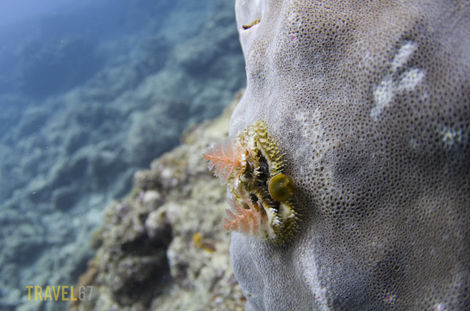
Christmas Tree Worms at Kadena Steps, Okinawa

Christmas Tree Worms at Kadena Steps, Okinawa

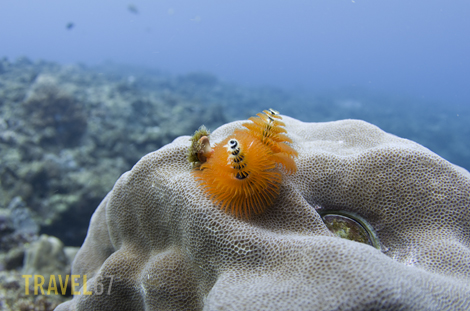
Spirobranchus giganteus, commonly known as Christmas tree worms, are small, tube-building polychaete worms belonging to the family Serpulidae (Wikipedia). Each worm has two Christmas tree like structures that are used for both feeding and respiration. If you move too close to the worm they rapidly retract back into the coral. (In the movie Avatar some of the plants on the alien world behaved in a similar fashion.)

Christmas Tree Worms at Kadena Steps, Okinawa

Christmas Tree Worms at Kadena Steps, Okinawa

These were shot with the K5 and the fisheye lens. The lens isn’t designed for macro work, but you can still get some interesting wide-angle close-up images.

Christmas Tree Worms at Kadena Steps, Okinawa

Christmas Tree Worms at Kadena Steps, Okinawa

Cherry Blossom at Nakijin Castle

Nakijin Castle

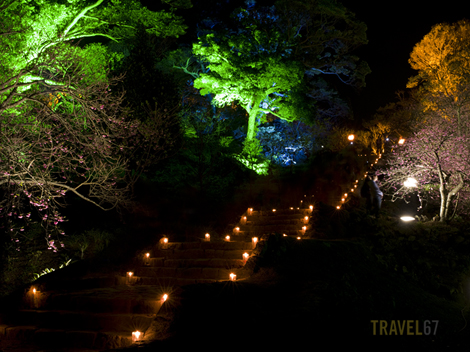
Cherry Blossom Light Up Nakijin Castle

Cherry blossoms are out in Okinawa. At Nakijin Castle, a UNESCO World Heritage Site, cherry blossoms and surrounding trees are illuminated for a few nights in early February.

It’s called the Cherry Blossom Festival, but due to the lighting, it appears to be celebrating giant broccoli.

Cherry Blossom Light Up Nakijin Castle

Cherry Blossom Light Up at Nakijin Castle

Ikelite K5 Housing – Open Water Test

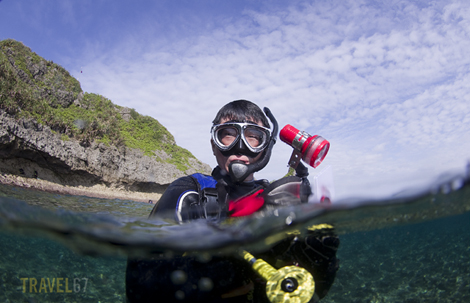
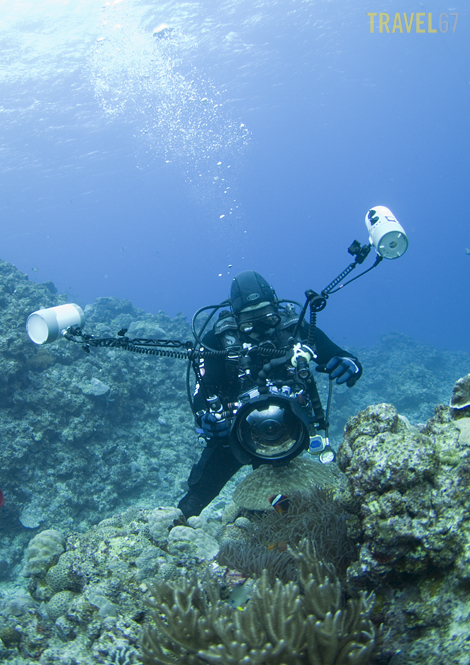
Dive Buddy Shawn Miller

Dive Buddy Shawn Miller

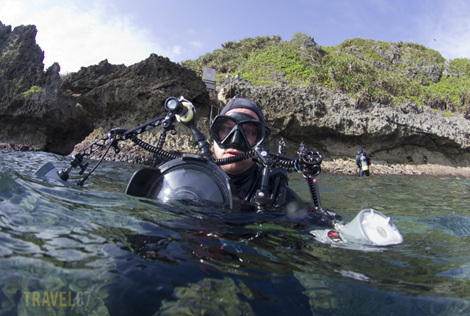
Tested out the underwater housing for the K5 at Cape Maeda this morning. Hiroshi and Shawn were my buddies for the dive. As more experienced underwater shooters, they could make sure that I’d sealed everything down properly.

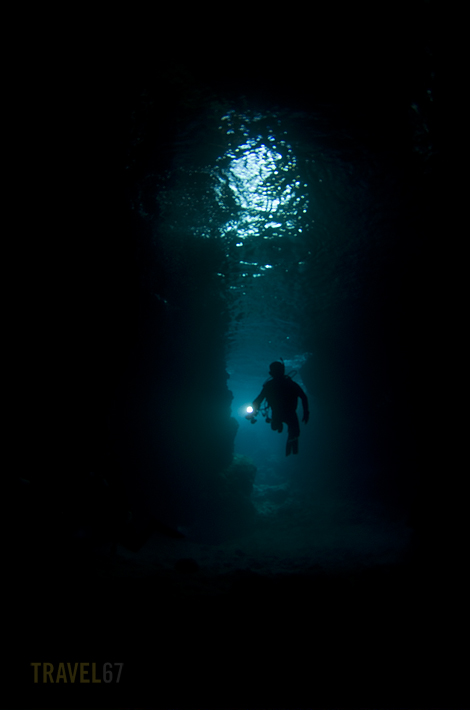
Dive Buddy Hiroshi Tsuji

Dive Buddy Hiroshi Tsuji

So what did I learn?

The housing didn’t leak and you can operate all buttons while underwater.

There also appears to be a button (labeled Fn Button in the manual) that allows you to press the lens release button. I may contact Ikelite to see if I’m just being dimwitted or if this is some design issue. (I didn’t try to use this while underwater.)

Operating functions that require doing two things at the same time are tricky e.g. pressing the ISO button and turning the rear e-dial. This means using exposure compensation underwater will be more problematic than simply using manual mode and adjusting exposure with the e-dials.

The controller for the “Green Button” can easily get stuck. Probably not an issue as I don’t use the Green Button normally, but strange nonetheless.

Live View is useful as it can make composition much easier when you can’t see through the  viewfinder.

When underwater the autofocus gets it right more often than I do.

Shawn Miller - Finding Nemo

Shawn Miller - Finding Nemo

A few more things about underwater photography:

You get colder than on a regular dive as you’re not swimming as much. After 45 minutes I was feeling decidedly chilly.

You need to be completely comfortable with your camera. Underwater in the dark is not the right time to start learning which button does what.

You need to be completely comfortable diving. This makes for better photography, but is more important for personal safety. Things like buoyancy control and checking gauges should be second nature before adding a camera, particularly a large cumbersome one. If you have an emergency, you don’t want to be fumbling around for your regulator only to find it tangled up in all your flash cables and straps.

Hiroshi Tsuji - The Abyss

Hiroshi Tsuji - The Abyss

All in all, a good dive. Hope to get in a couple more before heading down to Yonaguni.

Yongnuo YN560 Speedlite Review

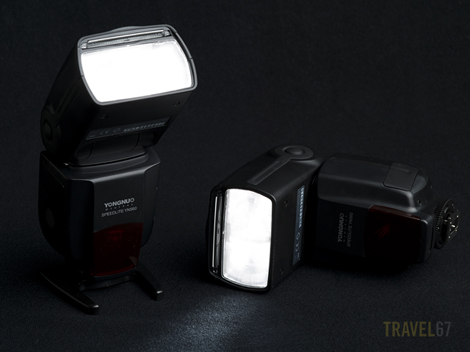
Yongnuo YN560 Flash

Yongnuo YN560 Flash

Is buying a cheap alternative brand hot-shoe flash a great way to save hundreds of dollars or are you just wasting your money?

Let’s start with the key difference.

Cost

Nikon SB910 $538.81

Canon 580EX II $457.00

Pentax AF540FGZ $399.00

Yongnuo YN560 $67.40

So what are the similarities?

Power: The Yongnuo Flash has a guide number of 58. This means the camera has a similar maximum power to the other top end flashes listed above. (Guide Number indicates the power of the flash.  GN = max distance to subject x f-stop at ISO 100 – e.g. if GN is 58,  max distance to subject is 29 meters when aperture is  f/2 and ISO is 100.)

Manual Control: All four flashes allow you to manually control both the level of power and the zoom on the flash.

Slave Modes: All four flashes allow you to slave the flash so it fires when it detects the light from another flash.

Bounce: All four flashes allow you to both tilt and rotate the flash head to bounce the flash off the ceiling or walls

PC Sockets: Three flashes (not the Pentax) have a PC socket – particularly useful when using Pocket Wizards for manual off-camera flash.

Differences other than cost. The Yongnuo YN560 doesn’t have the following:

TTL Flash Metering (Auto Power Control): The cheap Yongnuo is all manual. You need to adjust the power rather than the camera sending out a pre-flash, measuring the amount of light that has returned and giving out a main flash that will give you what it assumes to be the correct amount of light.

Flash Compensation Control: The ability to increase and decrease the power of the flash when in TTL mode. (Similar to exposure compensation  when using in-camera metering)

Auto Zoom Control: The camera can tell the flash the focal length of the lens being used and therefore the angle of view. The flash automatically adjusts its zoom so that the spread of the light matches the angle of view.

High Speed Sync: High speed sync allows you to use flash at shutter speeds greater than the flash sync speed of the camera, useful when you want to shoot outdoors with a wide aperture.

Infrared Wireless Communication: The ability to communicate with off camera flashes using an on camera (or pop-up) flash. This allows you to use TTL flash metering when using off camera flash.

LED Display: A clear display on the back of the flash that shows mode, power settings, zoom settings.The Yongnuo displays all the information through a series of LED lights on the back of the camera. The row of orange lights is used to  indicate both zoom and power which can lead to confusion.

Build Quality and Reliability: The first time I used one of the YN560s it gave off a strange burning smell. I thought I’d fried it, but it has continued to work without any strange smells or problems since then. I doubt it has the same degree of weather sealing or ruggedness as the other flash units, but I’m not planning on a series of drop tests.
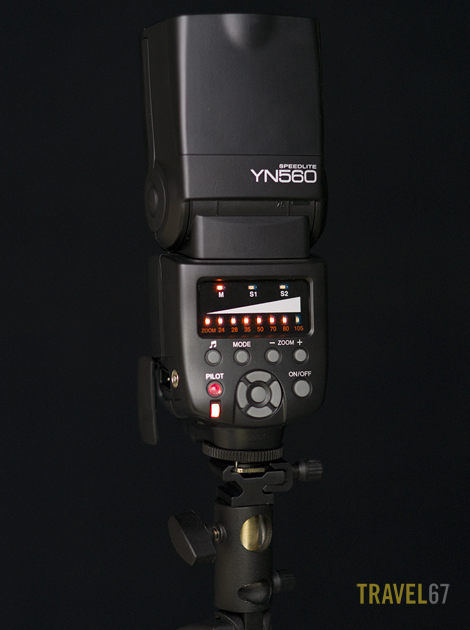
Yongnuo Speedlight

Yongnuo Speedlight ( lacks LED display on back, but has a PC connection on side )

In summary, the more expensive flashes can do everything the cheap flashes can do plus various bells and whistles. The ability to use TTL metering is useful in some circumstances, but once you are using multiple flashes and radio triggers it is less useful or not even usable. The advanced infrared communication systems also have their place, but are less effective than radio triggers when using manual mode.

If you’re buying a single flash, have the money, and want the flexibility to shoot with TTL then get the matching flash from your camera’s manufacturer. If, however, you’re experimenting with off-camera flash and looking at getting a second or third flash then you could happily save yourself several hundred dollars by getting a couple of Yongnuo YN560s.
Successful Strobing – The Off Camera Flash Workshop

Off Camera Flash Workshop Image by Robert Malon

Off Camera Flash Workshop Image by Robert Mallon

A huge thanks to Robert, Michelle, Danielle, Shawn, Amanda, David,  Jen and Dave for being such fun and motivated participants in last weekend’s off camera flash workshop.

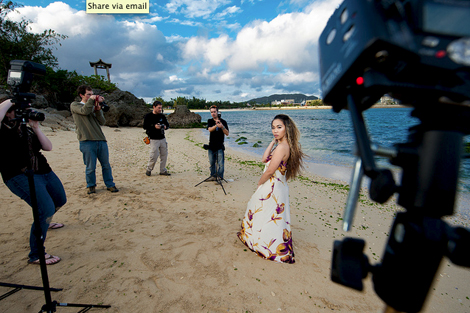
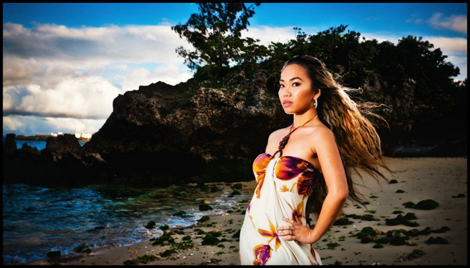
The first day we learned all about the different types of strobes and getting the most out of them on and off camera. The second day we moved from TTL to manual flash control, and from wired to wireless triggers. By the end of the weekend we were on the beach as Pete gave a short masterclass in location lighting.

Off Camera Flash Workshop Image by Robert Malon

Off Camera Flash Workshop Image by Robert Mallon

I’ll post a few more of the photographs from the weekend soon. It all goes to show that a little bit of off camera flash can brighten anyone’s day.

Off Camera Flash Workshop Image by Pete Leong

Jan 2012 Off Camera Flash Workshop Image by Pete Leong

Thanks Pete!

Triple Terabyte Time Machine

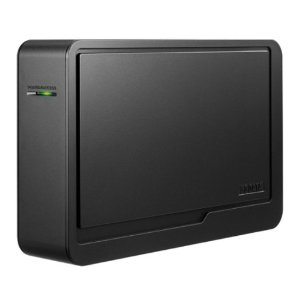
I-0 DATA 3TB Hard Disk

I-0 DATA 3TB Hard Disk

As you shoot more photos, or buy more media from iTunes you are going to fill up both the hard disks on your computer, and if you’re a Mac user, your Time Machine. My 1.5TB Time Machine was so full it couldn’t update easily so I decided to get something bigger. The hard disk I was previously using as the Time Machine will then be used for off-site backups.

Fortunately as the need for storage grows, the price per terabyte  has gone down. In Japan, you can now get a 3TB hard disk for less than ¥16,000  which is about the same amount I paid for the 1.5TB model a year or two ago.

Not a particularly exciting piece of gear, but if you don’t back up your data…

“All those moments will be lost in time, like tears in rain.”

Hardball with Ryukyu Bus Kotsu – 琉球バス交通

The Joys of Japanese Auto Insurance

The Joys of Japanese Auto Insurance

At the start of the year, I wrote a post about being involved in a minor traffic accident. A coach decided to merge into my lane and, although I wasn’t moving and beeping my horn, the coach scraped the fender and bumper of my car. It’s annoying to have to fill in paperwork, get your car fixed, and drive around a loaner for a week or two, but accidents happen.

In the previous blog post I wrote:

The one issue that does remain is exactly whose insurance will be paying for the repairs. You might assume that the bus company’s insurance would pay for everything, but in Japan blame is rarely attributed entirely to one driver. If the discussion between insurance companies results in me being given a token 10% of the blame, my insurance will pay for 10% of the damage to my car and the bus, and next year’s insurance premium will go up.

A couple of weeks ago, I got the accident summary from my insurance company ( J.A. ) it said that both vehicles had been moving at the time of the accident. On the day of the accident I had been told that the accident summary would be written after consultation between myself, the bus driver and both insurance agencies. I pointed out that not only was the accident summary wrong, but that the J.A. investigator had never contacted me.   I said I wouldn’t sign the papers until the correct accident summary was written. They pointed out that it didn’t really matter as I have comprehensive coverage so I won’t have to pay either way. I said I understood, but I still wouldn’t sign the papers until it was correct.

Later that day the accident investigator phoned me and said that he, the bus driver, the representative for the bus company, and I would meet at the accident site to discuss the matter. This wasn’t a good sign. There shouldn’t be much to discuss when you’re not moving, beeping your horn and someone else hit you.

A few days later I was standing by the side of the road in Nago with the J.A. accident investigator, the bus driver and two representatives of the bus company. The representatives from the bus company got straight to the point –  If you looked at my fender it showed a compression crimp that indicated frontal collision rather than a side collision. I therefore must have been moving when the accident occured. Amazingly, the J.A. accident investigator also said this sounded correct.  I said that as I was in the car, with my foot on the brake, and beeping my horn, I was certain I was not moving when the bus hit me. For thirty minutes a strange circle of repetition took place where the bus company representatives pointed to photographs of the fender, and then brought out my actual damaged fender from their car to prove their point, while I continued to tell them I was stationary. At one point the bus driver started to speak and he was gestured to remain quiet by the bus company representatives. I finally said that my story wasn’t going to change no matter how many times they repeatedly showed their evidence. They said they would agree on 70% of the responsibility. I said that’s unreasonable. We decided to continue the matter at a future date.

The J.A. guy asked me what I wanted to do and I said I wanted an accurate accident summary before I would sign the report. I told him again the sequence of events and even wrote them down: Bus signals, I stop, bus moves closer, I beep my horn, bus clips the car, bus stops.

A few days later the papers arrive with a correct accident summary. I sign and send back the papers.

Yesterday I get a phone call from J.A. thanking me for sending in the papers. The J.A. man says they have decided to agree on 70% / 30% and am I okay with that. I say of course I’m not happy, but there’s nothing I can do about it realistically. J.A. guy says no.

I agree to the split, so that this minor fender bender doesn’t grow from an irritation into a surreal nightmare.

I didn’t mention the name of the bus company in the original post, because accidents happen. However the actions of Ryukyu Bus Kotsu – 琉球バス交通 in dealing with what should have been a simple matter have shown they have some ethical issues they need to sort out. As for J.A. they have shown either a lack of  competence, or a desire to meet the needs of a company rather than one of their own clients.

Shisa Artist Sano Toshio ( Portraits with the 645 FA 150mm )

Shisa Maker Haru Toshi ( Pentax 645 FA 150mm )

Shisa Maker Sano Toshio ( Pentax 645 FA 150mm )

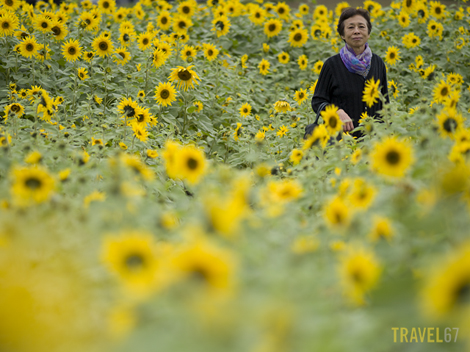
Shisa artist Haru Toshi was at the sunflower festival in Kitanakagusku Village.  He said he had a face like the lion-dog talismans he creates.

The 150mm lens for the Pentax 645 is a great portrait lens. It is the equivalent of a 118mm lens on a 35mm FF body so it gives nice proportions to the face, and at wide apertures gives a very limited depth of field.

If we put the following information into a depth of field calculator: 645D sensor, f/stop 2.8, lens 150mm, focus 1m 20cm it gives the depth of field as 1.58cm. This means if you focus on the eye, the tip of the nose and ear will be fading into bokeh.  (Interestingly it’s about the same D.O.F. as you get with an 85mm at f/1.4  at 1m 20cm on a FF)

Sunflowers in Kitanakagusku, Okinawa

Sunflower Festival in Kitanakagusku Village, Okinawa

Sunflower Festival in Kitanakagusku Village, Okinawa

There’s a sunflower festival taking place in Kitanakagusku Village at the moment. Local farmers have grown thousands of sunflowers in vacant plots of land between the vegetables. It’s free to wander around, and there are small paths that wind through the flowers if you want to immerse yourself in nature. Enterprising locals have set up a few stalls selling ramen, soba, shisa and garden plants should you wish to help the local economy.

Sunflower Festival in Kitanakagusku Village, Okinawa

Sunflower Festival in Kitanakagusku Village, Okinawa

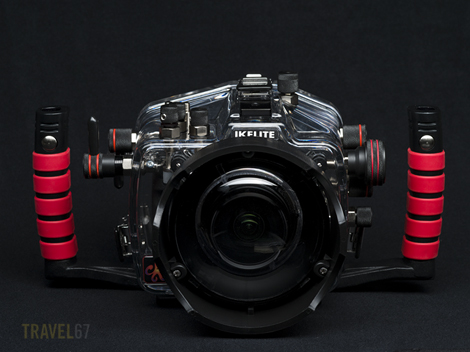
Ikelite Underwater Housing for Pentax K5 / K7

Ikelite Housing for Pentax K5 / K7

Ikelite Housing for Pentax K5 / K7

Living on Okinawa, I can scuba dive most weekends. If you shore dive and only pay for tank rental, a day’s scuba diving actually works out cheaper than an evening bowling. I’ve tried underwater photography a couple of times before. First with an EWA Marine bag for my Nikon film camera that was good down to 5 meters, but limited functionality. Then I got a used Sea & Sea MX-10 submersible camera that you could take scuba diving, but the optical quality wasn’t great. I sold off the MX-10 and for the last 8 years have dived without a camera. From 2012, however, things are going to be different.

Ikelite recently started production of a housing for the Pentax K5 / K7 cameras.  I ordered an Ikelite housing from the States and picked up a K5 on sale at Amazon Japan.

The housing is rated to be waterproof to 60M (20M below the maximum depth for recreation divers) and allows you to access all the functions of the camera while underwater.

You must attach a lens port to the front of the housing to complete the system. The type of port will depend on the lens you are using. For the 10-17mm fisheye lens I can use the standard dome port. The port comes with a shade that will vignette the image if the lens is wider than 12mm, but the shade is removable.

Taking your camera underwater is not cheap at around US$1200 dollars for the housing plus a couple of hundred dollars for the port. If you wish to use flash underwater you can get specialist strobes from Ikelite that mount onto the arms of the housing. I will probably get these in the future, but they are not required for the shots I want to take in Yonaguni.

So far I’ve read the manuals and tested it out in the bath. I thought about a test dive today, but weather conditions weren’t really favorable. Hopefully I’ll get in the ocean sometime this week as I need to be comfortable with the new gear before heading down south to Yonaguni next month. You don’t want to be  fumbling with new equipment when you’re also trying to deal with cold water, ocean currents and … sharks.