
The Traveling Photographer #11 Okinawa Living July 2010
Here’s this month’s traveling photographer page from Okinawa Living. You can view a larger readable version of the page on Flickr.
The Traveling Photographer #11 Okinawa Living July 2010
Here’s this month’s traveling photographer page from Okinawa Living. You can view a larger readable version of the page on Flickr.
Feeling the Beat
Keith Gordon is a DJ and musician, who combined dance beats with traditional Okinawan music to create Ryukyu Underground.
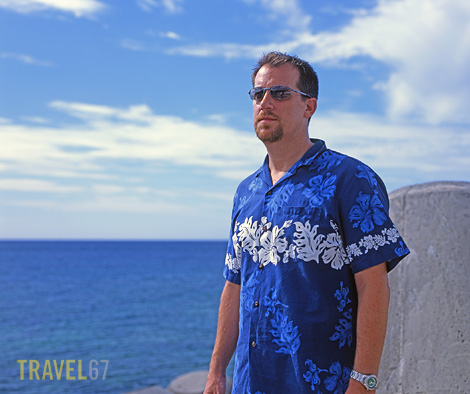
Island Icon: Keith Gordon / Ryukyu Underground
After graduating from college in the United Kingdom, Keith Gordon backpacked around the world working as a club DJ. In 1997, he settled in Okinawa, and had his record collection shipped from home. Keith developed a passion for Okinawan music, and with American Jon Taylor, he formed Ryukyu Underground, producing a fusion of Okinawan, western and world music. After 3 successful albums, which have met with critical acclaim, he continues to find inspiration from the world’s music.
What are your musical influences?
“Coming from the UK, I grew up hearing bands like The Smiths and The Cure. At around 16, I got into hip-hop artists such as KRS-One, Jungle Brothers, Eric B, and Public Enemy. My tastes widened and I started to listen to older stuff that a lot of these hip hop artists sampled – such as James Brown, Roy Ayers and Donald Byrd. I guess it’s this stage of funk, soul and jazz that really excites me.”
“Recently I’ve become far more interested in world music than what passes for modern pop music. World music has become much more mainstream as well. Music used to have distinct boundaries that could be clearly categorized – African, South American, Cuban. Through people like Sting, Punjab MC and Hip Hop artists adding Indian samples to their tracks, I think genres have begun to mix to a greater extent, and world music has reached a much wider audience. These days, musicians and listeners are looking for something new, rather than tired retreads of older music.”
What is involved in the process of creating a new track?
I have a huge collection of traditional Okinawan music. For our first album, I found sections that I found interesting, from a melody to single note, and sampled them. I uploaded these samples into a sequencer on my laptop and then added the beats, drums, percussion, effects and keyboards to produce the finished track.
For the second album we had much professional equipment to work with – better software and improved synthesizers. The biggest change, however, was that through the success of the first album we were able to work with Okinawan musicians like Toru Yonaha and singer Mika Uchizato. This was much more organic, more natural, rather than just using samples of Okinawan music.
For our most recent album, Shimadelica, we took things a stage further. We were more confident working with the musicians and they were less nervous performing with us. It allowed us a much deeper collaboration, and I think the resulting music really shows this.
What instruments do you play?
“I’m not a professional, but I do play drums, percussion, keyboards, bass guitar and sanshin. Unfortunately, I’m not a virtuoso of any of them. Some people think what I do is merely putting other people’s music into a computer and that it requires no talent to work like this. I respond to them by saying that the computer is just the tool to get my ideas into the world. The fact is, however, that it doesn’t matter how much technology or money you have backing a project, you still need creativity and original ideas to make good music.”
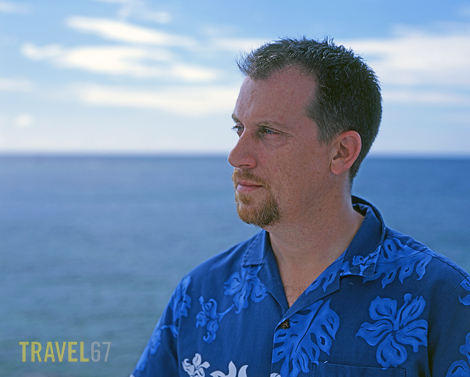
Island Icon: Keith Gordon / Ryukyu Underground
Your albums have been described as having influences from dub, trip hop, and breakbeats. What exactly are these music styles?
Dub is a style of reggae with few vocals, heavier bass, and more effects. Breakbeats are old syncopated funk drum beats, which are usually sped up and were used heavily by bands like The Chemical Brothers and The Prodigy. Trip hop, has a hip-hop rhythm but is more experimental, usually with a hundred or less beats per minute. Both Jon and I listen to a wide range of music, so this comes out in the variety of styles that are present in the tracks we produce.
Future plans?
“We’re currently thinking about the direction for out next album. We are toying with a few ideas. I guess it’s all about trying a variety of different things and finding what works or what takes Okinawan music into new areas. In the end, the greatest thing is simply being part of the musical culture and community here on Okinawa. ”

Ryukyu Underground albums are available for purchase on Amazon
After putting up some full size Jpegs from the 645D on Flickr I’ve received several requests asking if I can send people the full raw DNG files.
The first issue is that the file sizes are very large, too big to send as attachments to an email. The second issue is one of control and copyright. I rarely put images on the net that have a width larger than 470 pixels and these are all watermarked. As you may have noticed I have not attached full sized Jpegs of my latest images to Flickr, but will post crops when I need to show how much detail there is in the image. I feel that sending out the raw DNG files to people over the internet would be asking for trouble.
The decision I have made is that I can burn a selection of raw DNG images to DVD and include copyright information explaining clearly that these files are for personal evaluation purposes only. Having the files will allow photographers to process the raw images and make prints for evaluation, but of course I don’t want to see those same images appearing on the net or even worse on stock agencies.
On request, I would be happy to include a DVD with the raw DNG files free of charge when people purchase one of the prints through my main website. This means I will have your name and address (Yes I will know where you live!), it will ensure I am not getting requests from people with just a passing interest in the camera, and it will reward those who are supporting my own work. (If you recently purchased a print, and want a DVD just let me know and we’ll sort something out, I will still have your details on file.)
I hope this seems fair.
Chris
On Sunday, as the sun dropped lower in the sky, I switched focus from Ursula to Liz. (I shot Liz in the studio a couple of months ago, you can see the images here.) For lighting Eboh brought a studio strobe with battery pack and a smaller hot shoe strobe. Both were triggered wirelessly using PocketWizards. This was the first time I’ve used studio lights on location, and it was interesting balancing the light from the strobes with the natural light. Keep the power of the strobes low for a more natural look as in this shot.
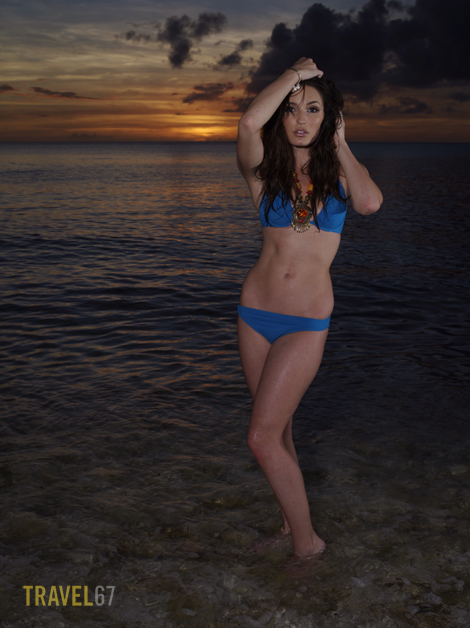
Beach Shoot - Liz 1 (645D 55mm lens)
Or crank up the power of the lights, and produce a brighter look more similar to what you see in advertising.

Beach shoot - Liz (645D with 55mm lens)
Thanks to Liz for being a great model, Kim for make-up and Eboh for lighting. Looking forward to working with you all again soon.
Late Sunday afternoon, a small group of photographers, models, a make-up artist and I gathered on the beach in Okinawa for an almost impromptu shoot.
Urusla, the wife of photographer Eboh, is simply stunning. She’s a fantastic model who knows how to produce great dynamic shots. I first went wide with the 645D 55mm lens to emphasize her stature.
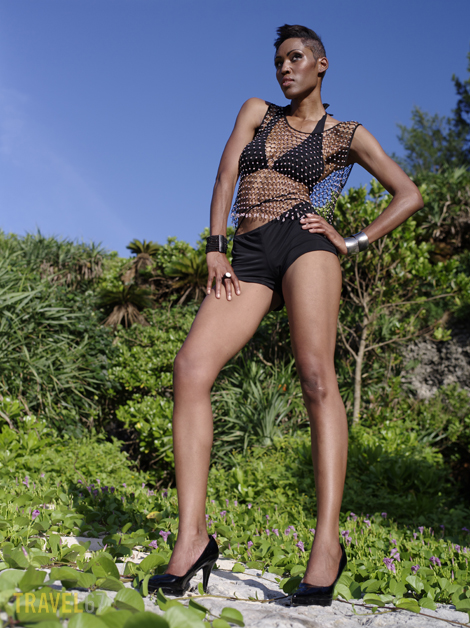
Urusla on the beach, channeling Grace Jones. (645D with 55mm)
I switched lenses to try out the 67 105mm on the 645D body, while Ursula put on a shawl.
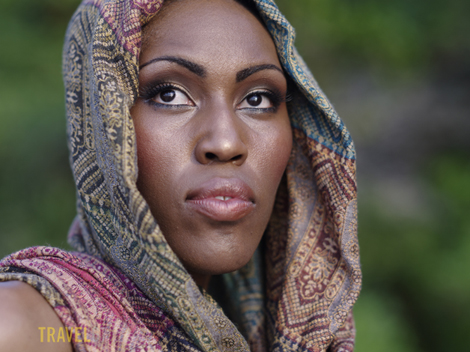
Ursula Beach shoot (645D with 67 105mm lens)
I had been wondering if the 67 lenses would be a good match for the 645D body. I was pleased with the results of the test shoot with Bear, but a quick focus check on Ursula’s eye really blew me away.
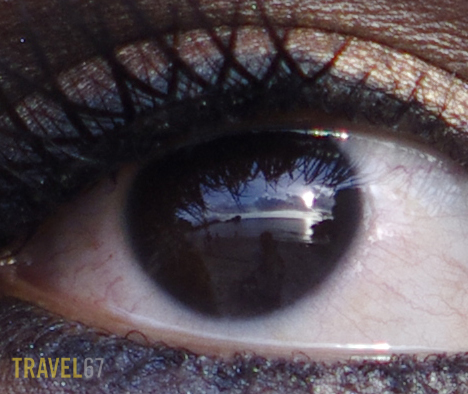
Crop of the above image at 100%. (645D 67 105mm lens)
That’s not just a self-portrait of the photographer, but a mini landscape!
A big thanks to Ursula for modeling and Kim Clay for make-up.
More images from the shoot in future posts…
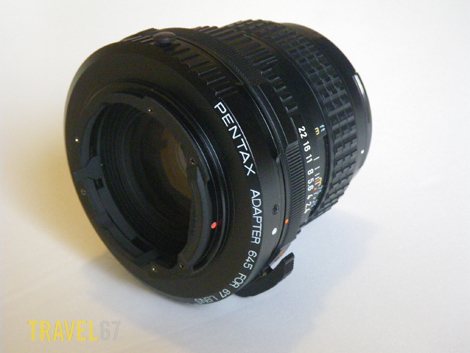
Pentax 67 to 645 adapter on 105mm lens
Please check out the first part of this post here.
I just tried out attaching my 105mm Pentax 67 lens to the 645D body.
Adapter works well. Lovely mechanical clicks as everything locks into place.
When you turn on the camera the readouts on the viewfinder, rear monitor and top panel all show the aperture reading as blank. The camera is however still metering so when I set the lens aperture to 2.4, the shutter speed automatically adjusted to give the correct exposure (or it’s best estimate of the correct exposure).
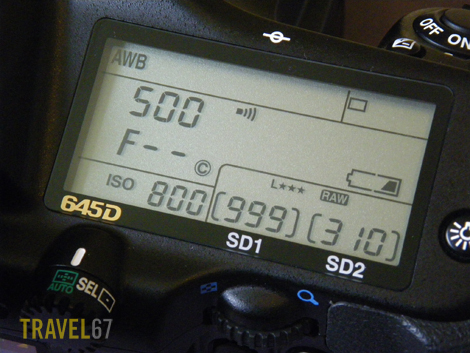
67 lens on 645D panel
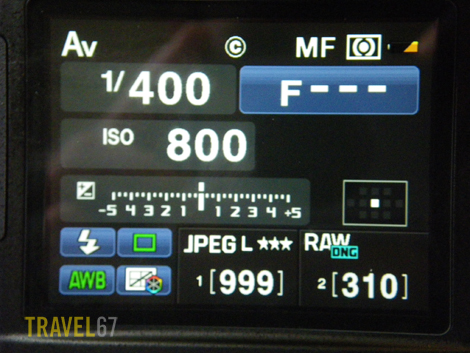
67 lens on 645D monitor
Found Bear, and took another portrait shot. Of course not only do you have to manually set the aperture with the aperture ring, you also need to focus as the 67 lenses are all manual focus.
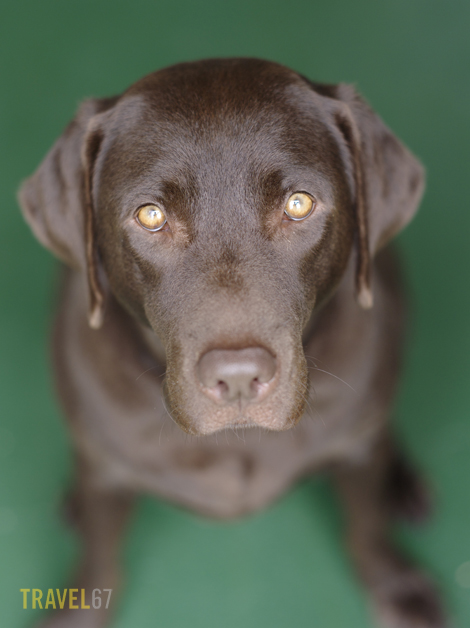
Bear portrait shot with 645D and 67 105mm lens
Pleased with how this came out. Not having the aperture reading in the viewfinder isn’t a problem, in fact this is the same as when using the Pentax 67II normally. The 67 lenses give a nice bokeh and at 2.4 a very shallow depth of field. I will have to experiment with the 105mm, the 100mm macro and the 165mm to decide which I prefer for portraits.
I’ve put the full size image of Bear up on Flickr.
Dreams of Paradise
Kyoko Nakamoto is an Okinawan artist whose paintings of “Paradise” show a world of beauty and vibrant colors where childlike inhabitants live simple, happy, and equal lives.

Okinawan Artist Kyoko Nakamoto
When did you start painting?
As a small child, I scribbled and painted all over the walls of our house. My mother never got angry, perhaps because we were living in a rented house. During high school, I knew I wanted to be a painter. However, when I went to university, I set aside my ambitions and chose to study business rather than art. After graduation, I got a job at an insurance company, but three days a week, I kept my dream alive by going to night classes at art school and slowly improving my skills. After ten years, I quit my job selling insurance and began working as an illustrator for magazines and packaging. Two years after that, I achieved my dream and became a full-time painter.
Was it hard to suddenly start a new career?
Of course, it was a tough decision. I had thought I should give up on my own dreams, I was married with three young children, and I had a job with a decent salary. But when I was 34 years old, I made up my mind to follow my own path, and at the same time I had the inspiration for the characters in my “Paradise” series.
Why do all your characters look so similar?
I didn’t want them to have a specific age or gender. They even have identical faces and hairstyles. Essentially, they all look the same, and this similarity shows the equality I imagine in paradise.
And the same clothes too?
Yes, they all wear little white robes. I chose white for its simplicity and purity. Also none of them wear shoes – I think being barefoot is very natural and gives a sense of freedom, so my “Paradise” characters never wear shoes.
So are they all meant to be perfect little people?
Not at all. They make mistakes, dropping things or even stealing. I guess you could say they have child-like qualities, but they’re not meant to be children.
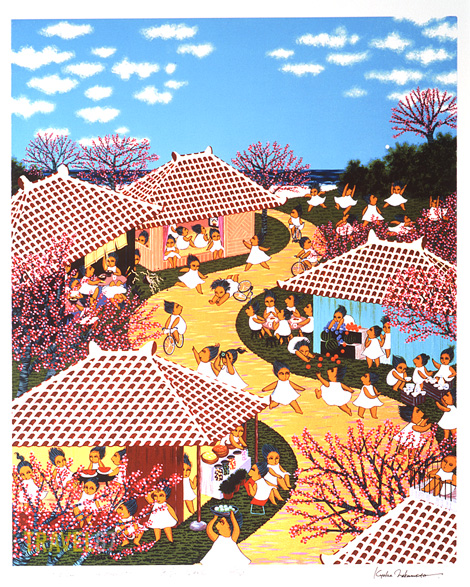
Painting by Okinawan Artist Kyoko Nakamoto
Is your vision of paradise based on a real place?
I think it’s a mixture of my imagination, and places I have visited on my travels. I loved the mood of downtown New York, with people from all over the world living as one community. Some of the scenery in my paintings comes from the central coast of California when I once had an exhibition of my work. Above all, however, I am inspired by Okinawa. I love the weather, the people, even the air. I like to read and watch movies, but above all I like to travel. I think it’s important, especially for artists to experience new places and talk to people from different cultures.
Are you always so outgoing?
Sometimes, but I also need time by myself, to be quiet. I usually spend about 5 hours a day alone in my studio, but as an exhibition approaches, I become even more focused. I can spend 10 hours in front of my easel concentrating so hard I don’t even want to go to the bathroom.
What are your future plans or ambitions?
I’d love to have solo exhibitions in New York, Tokyo and Europe. I’m really interested in France and Italy, but I can only speak Japanese and English so maybe I’ll have to study some foreign languages first.
I hope to be able to offer something toward a more peaceful world. I’d like there to be more equality between people and countries, I understand it would be difficult, but it’s a dream of mine. And I think that everyone should be able to follow his or her dreams.

Okinawan Artist Kyoko Nakamoto
Kyoko’s gallery is located in Naha near Shuri Castle. Directions to the gallery along with more information about Kyoko and her paintings can be found at http://www.kyokoart.com/
Interview first published in Okinawa Living Magazine, November 2008.
Dropped by Shuri Castle early this afternoon to take some photos. Unfortunately the sky clouded over and scaffolding covered half of the building. I did however mange to get a couple of portraits of the girls in traditional Okinawan costume that pose with visitors to the castle.
After a couple of days with the camera I was comfortable enough using it for these opportunistic shots. I quickly opened up the aperture with the thumb dial to blur the background, moved the girls into some open shade and took a couple of photographs of each girl.
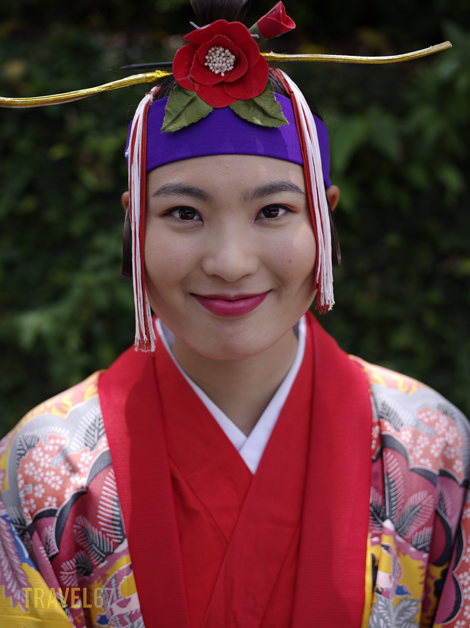
Girl in Okinawan Costume Shuri Castle 645D 55mm
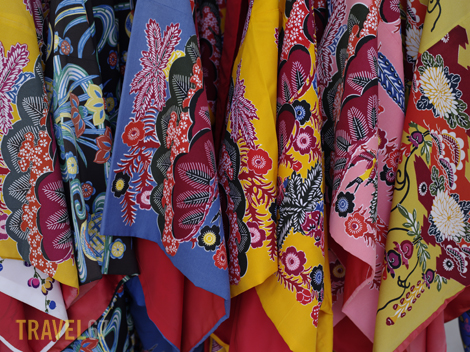
Okinawan Kimono at Shuri Castle 645D 55mm
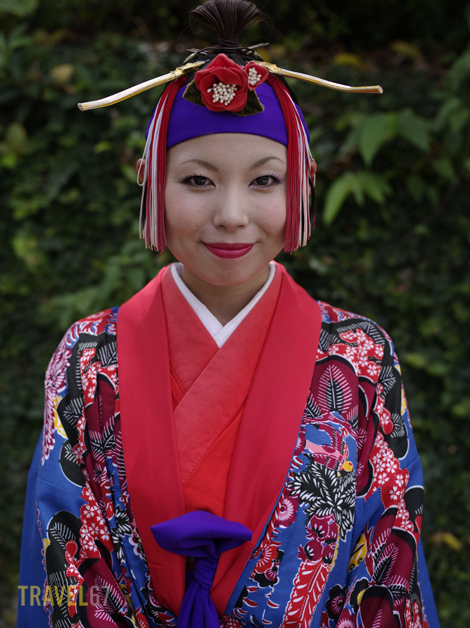
Girl in Okinawan Costume at Shuri Castle 645D 55mm
I just realized that I never showed the girls the preview images after I took the shots. I hadn’t even considered it! It was only 30 minutes later when I sat down with a cold drink that I even looked at the pictures I’d taken. I think this is a case of delayed chimping. Must remember I’m shooting digital not film 🙂 I will however make a couple of prints and drop them off next time I’m at the castle.
I’ll put a full size image of one of the girls on Flickr. Another interesting thing I’ve noticed is that every outdoor portrait I take includes two mini self portraits one on each pupil!
Having taken photos of the dog and a quick landscape I wanted to give the camera a bit more of a challenge.
I hoped to take a portrait shot that would show all the detail in a person’s face down to individual strands of hair. I knew just the man for the job.
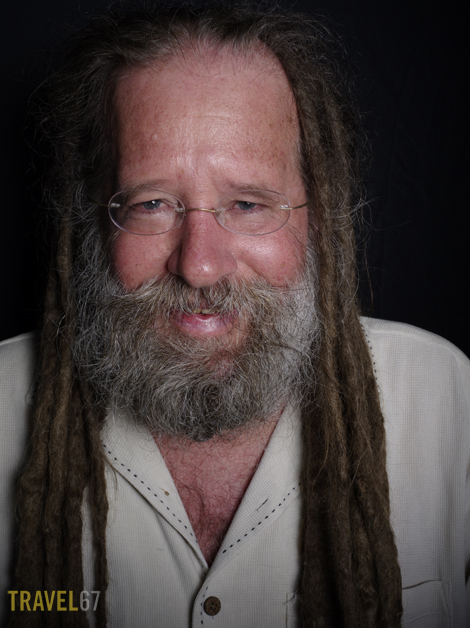
Pentax 645D Studio Portrait of John
Now check out the full size image on Flickr. (Click view all sizes then click full image.) For those who don’t have the time or patience. Here’s an idea of what you can see.
This is John’s right eye. (As a bonus, the shot of the eye also reveals how I lit the photograph, a single gridded beauty dish just above my right shoulder.)

645D John 1 right eye crop
There’s a whole lot of detail in the image. More importantly I am pleased with the way the image looks, the gradations in colors look pleasing and natural. If I can take shots like this out in the field, I’ll be a happy man.
Thanks to John for being a great model. I’ll make sure you and Martha get a print!
The story continues…
Attached Kirk baseplate to camera so I can mount to tripod.
Drove to Cape Maeda. Set up tripod.
Set aperture to F11. Took a photograph of the Manza Hotel.
Hung around for a couple of hours chatting to Nate, Luna and Akira. Unfortunately the sky clouded over so there was no spectacular sunset.
I learned how to set copyright information, and change colour space from sRGB to AdobeRGB.
Returned home and copied files. Uploaded small res. image to blog and full size image to Flickr.
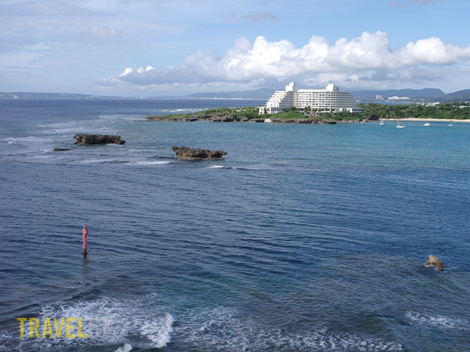
645D 55mm Manza Hotel
I am sure most experienced digital photographers will be shaking their heads, looking at the blown out highlights in the cloud by the hotel. I realize it’s a rookie mistake, and with time I will learn to use the histogram, but I am still amazed by the witchcraft that makes my pictures appear instantly on the back of my camera. More confusing is the purple fringing that seems to be appearing on some of the windows of the hotel. You will have to look at the full size file on Flickr to see this. Any ideas? (Lens? Color Space? Jpeg/RAW?…)
The detail in the shot is fantastic. Very pleased.
An interesting discovery was that when reviewing pictures the images automatically orientate themselves correctly whichever way you are holding the camera (In a similar way to an iPhone). Clever stuff.
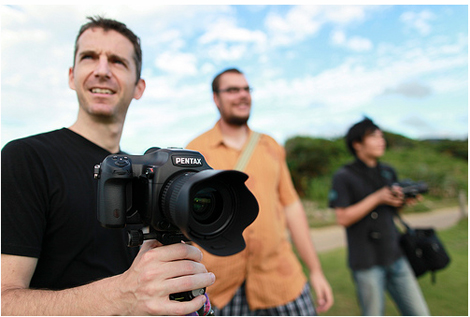
Hanging out at Cape Manza with Nate and Akira. (Photo by Luna)
 TRAVEL 67 : Chris Willson Photography