Latest Posts

In search of the Noguchi-gera

The Noguchi-gera or Pryer’s Woodpecker is a rare bird species, endemic to the forests of northern Okinawa. I’ve been hoping to photograph one for a while but in general you’ve probably got a better chance of spotting a Yeti.

However as is often the case it’s not what you know, but who you know and my friend Ichiro Kikuta is a birdwatching guru living near the northernmost tip of the island. A couple of days ago Ichiro gave me a call saying he’d found a nest and I headed up north to get some shots.
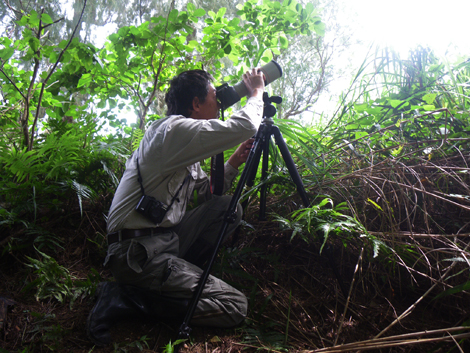
Birder Ichiro Kikuta on lookout for the Noguchi-gera

Birder Ichiro Kikuta on lookout for the Noguchi-gera

We set up  our cameras not far from the tree. Due to the size and weight of my 400mm lens and the addition of a 2X converter I brought along a 20 liter water container and hung it from the underside of the tripod to provide some stability.
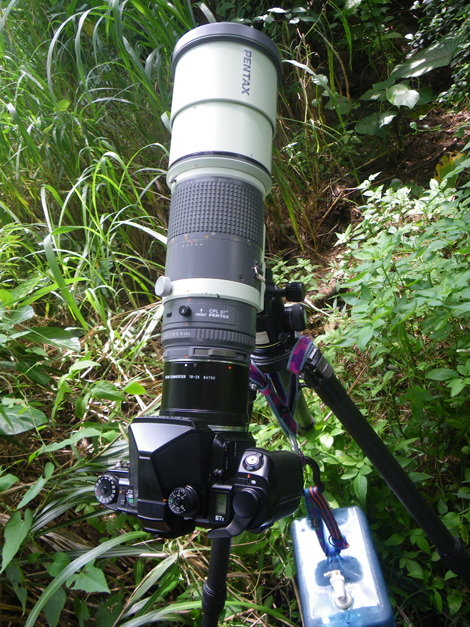
Pentax 67 400 EDIF with 2X rear converter

SMC Pentax-M*67 400mm f/4 ED(IF) with 2X rear converter

The Noguchi-gera did appear on several occasions over the course of the afternoon. Unfortunately we were shooting into the sun so although I may have some nice backlit images of the birds I will head back up there soon to get some shots in the early morning.

Another important thing I learned is that we are now in mosquito season. Do not sit in the forest in a T-shirt without any repellant. My arms and neck are currently covered in welts. I hope the little blood suckers enjoyed their meal because next time I’m bringing the DEET.
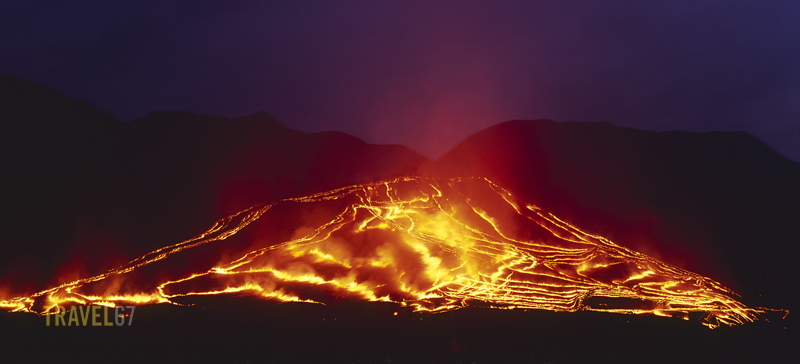
Mount Ogi Fire Festival, Beppu

Mount Ogi Fire Festival, Beppu

Mount Ogi Fire Festival, Beppu

The image above is of Mount Ogi, Beppu during the fire festival. It was quite a challenge to take this shot. The fire is lit at the top of this triangle and flames slowly creep down the sides and then burn inwards over the course of around an hour. If you were to take a single photo for a few seconds you get an unimpressive thin line of fire on a large mountainside. The secret is to use a long shutter speed or shoot multiple exposures on the same roll of film. Both techniques are tricky but as I had forgotten to pack a shutter release I opted for the second method. I shot a 4 second exposure then without winding the film onto the next frame I cocked the shutter. (How to do this varies between cameras. With the Pentax 67II you hold the multi-exposure lever while turning the wind lever.) I repeated this 4 second exposure on the same piece of film every 4 minutes until the fire had finished. There were a total of around 20 different exposures on the same piece of film. I am sure I will return to this event in the future and try a single one hour exposure, but I’m pretty happy with the way this image came out.

I’ve put up a slightly larger version of this image on my Flickr account here.

Japanese translators

I love the nonsensical English that appears when you put Japanese into an online translator.

I just received the following email in Japanese, after ordering a dehumidifier cabinet from an electronics store.

商品が入荷次第、お届けの手配をさせていただきます。 今しばらくお待ちいただけますようお願いいたします。

And the translation…

The commodity arrival circumstance, can point to the arrangement which is the delivery. Now for a while to wait, it can receive, the fish we ask.

I presume there has been a delay with my order. I wonder which fish they are going to ask.

F.A.Q.’s: Which printer do you use?

Short Answer: Canon image PROGRAF 5100

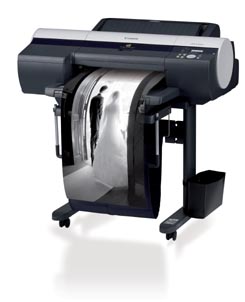
Canon iPF5100

Canon iPF5100 Large Format Printer

Long answer: I use the Canon image PROGRAF 5100 for many reasons. The first is the Lucia 12-color pigment ink system that produces vivid colors and archival levels of longevity. The second is that it can handle rolls rather than just sheets of paper which enables me to use a thick cotton rag Hahnemühle paper for my prints. The third is that it has a special print plug-in for Photoshop that allows you to export 16-bit RGB files directly to the printer. Printing at 16-bit produces higher quality images particularly with regard to areas of color with smooth graduations e.g. an expansive blue sky. I love this printer and have recommended it to fellow photographers and artists.

However…

this is a big machine which will take up a large chunk of your room, not just your desk (It comes with it’s own forklift pallet). The printer is expensive and the ink cartridges, of which there are 12, are close to $80 each (a shocking £95 in the U.K.). This is a case of you get what you pay for, but it is worth considering if your clients or customers are willing to pay for such quality.

Also be aware that the printer cartridges are chipped and only work with printers from the same region and due to it’s huge weight it isn’t the kind of thing that you could ship very easily. As a specialist item the printer isn’t on sale at most photographic outlets however it is available at B&H or Amazon.com in the US and Amazon.co.jp in Japan.

A tale of two cameras

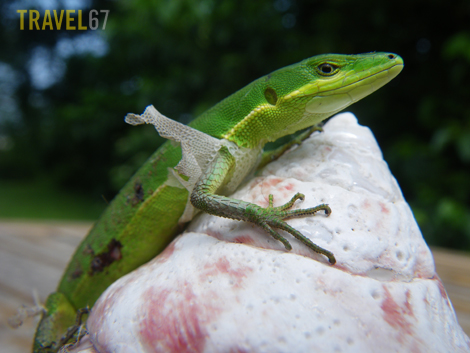
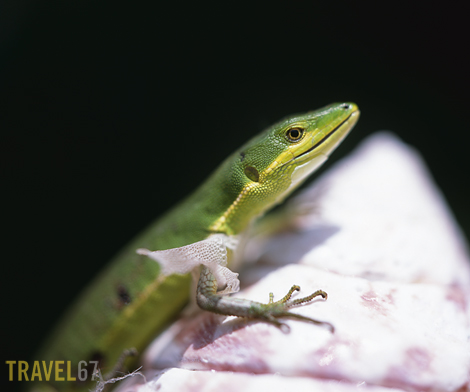
Here’s a quick game of spot the difference between two images of the same lizard.

The first is the one I put up a couple of months earlier. Taken with the Pentax W60 compact point and shoot.

Okinawan Lizard - Pentax W60 compact=

Okinawan Lizard - Pentax W60 compact digital camera

The second image was taken just a few minutes later in the same lighting conditions with my medium format Pentax 67II and Provia 100F slide film.

Okinawan Lizard - Pentax 67II medium format camera with Provia slide film

Okinawan Lizard - Pentax 67II medium format camera with Provia slide film

Together these are a great example of how sensor / film size influences the depth of field. It is also interesting to see just how different the level of contrast is between the two shots.

iPhone Apps for Photographers

On my last trip I found my iPhone to be a fantastic companion. Although it did struggle to  make phone calls (possibly due to the fact that it uses the Softbank network) it was filled with many other great features. Of course I could listen to music, watch videos and check emails, but there are several applications out there that are particularly useful for photographers.

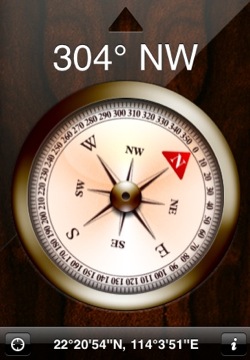
The first one comes as standard on the phone: the compass. While walking around at night scouting locations, I could check where the sun would be the next day. Also it  stopped me walking a couple of kilometers in the wrong direction when confused by Japanese street signs.

iphone compass

iPhone compass

The Simple Depth of Field Calculator is a useful learning tool and field tool that allows you to calculate which parts of your photograph will be in focus for a given film/sensor size, lens length, f-stop, and focus point.  Use it to check you will have front to back sharpness when shooting landscapes or calculate just how shallow your depth of field will be when taking a portrait.

Simple DoF Calculator screenshot

Simple DoF Calculator screenshot

Easy Release is a clever tool for professional photographers that want to get model releases for their images. Models can read the contract on the phone, sign with their finger on the touch screen, and then a photo of the model can be taken with the iPhone camera and added to the release. The application then creates a PDF of the signed model release and mails it to both the model and photographer. Even better you can select the language for the release, and the list of languages includes Japanese. Yatta!

Easy release screenshot

Easy release screenshot

Of course you could just use a real compass, the DoF markings on your lens and paper model releases, but for a few dollars it’s useful to have them all on your phone.

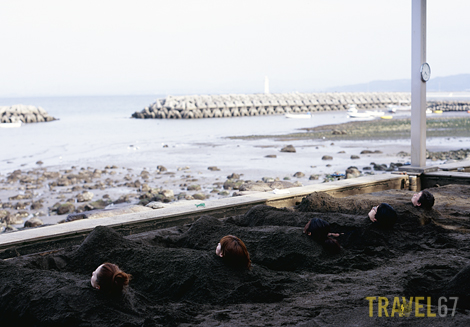
Beppu Sand Baths

Beppu Sand Baths, Oita, Japan

Beppu Sand Baths, Oita, Japan

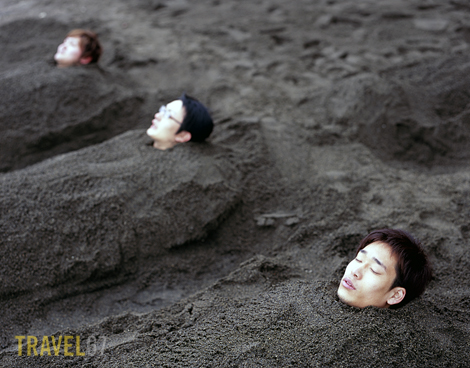
Just started scanning the images from my trip. Here’s a couple of shots from the sand baths of Beppu. I tried the sand baths myself, and although it was  an interesting experience, the sensation of the heavy sand pressing down on your chest while your arms are pinned to your sides was more unnerving than relaxing. One great part of the day was that I met a few fellow sand bathers who didn’t mind me taking a few photos of them while they were buried alive.

Beppu Sand Baths, Oita, Japan

Beppu Sand Baths, Oita, Japan

A little help for vegetarians in Japan

If you are vegetarian or vegan and living in Japan shopping can be tricky, especially  if you can’t read ingredients labels. I ate what I thought was vegetarian Miso (bean paste) ramen for many months before I found out that it also contained ポークエキス (pork extract). I hope the following list of words will make things a little easier for others.

Gelatin ゼラチン

Beef ビーフ  Beef Extract ビーフエキス

Chicken 鶏  or チキン Chicken Extract チキンエキス

Pork ポーク Pork Extract ポークエキス

Katsuobushi (fish sprinkles) 鰹ぶし

Another useful thing to know is that when you are buying eggs in Japan the most expensive ones are not free range eggs but rather fertilized eggs. These are labelled 有精卵 yuu-sei-ran. There doesn’t appear to be any particular labelling for free range eggs, but they are usually priced between the battery eggs and the fertilized eggs. At my local supermarket the free range eggs have a photo on the box showing chickens wandering around in the dirt.

Baggage Allowances in Japan

Recent changes in the Japanese airline industry and are going to affect the way photographers select and transport their equipment. On my last couple of trips up to the Japanese mainland I noticed that when checked baggage is weighed the display shows the weight along with the excess charges for baggage over 20 kilograms. Carry on baggage is restricted by both weight and size,  and these dimensions are shrinking. For flights of 100 passengers or more maximum dimensions are 55cm x 40cm x 25cm (115cm total) and 10 kilos in weight. For flights less that 100 passengers this drops to 45cm x 35cm x 20cm (100cm total).

Why is this significant? Well your present bag which came with a sticker saying suitable for carry-on may no longer be small enough.

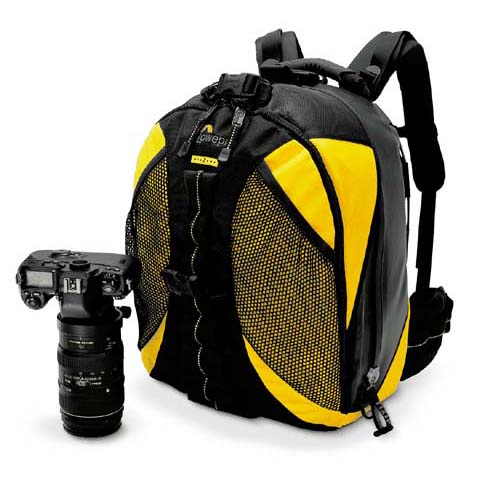
Lowepro DryZone 200

Lowepro DryZone 200 (37 X 29 X 48.5cm) Image from LowePro.com

My Lowepro bag is 37 X 29 X 48.5 cm which comes out at a total for the 3 dimensions of 114.5cm, just under the limit. However put a few extra items in the front pocket and and you will have a bag that is too big for carry-on. This  happened to me a couple of months ago, and it was only after a bit of begging and showing them the bag was full of camera gear did they let me take it in the cabin.

Pelican 1510 Carry On Case

Pelican 1514 Carry On Case 55.9 x 35.1 x 22.9cm

I am considering getting a Pelican 1514 Carry On Case as a way to transport the camera plus large telephoto lenses. At 55.9 x 35.1 x 22.9cm  (113.9 cm total) it again just sneaks under the 115cm limit. The advantage of this case would be that if it did have to go in the hold  the gear should be well protected. (This is useful when traveling on smaller planes, or if due to unforeseen circumstances you are not allowed cabin baggage.)

Interestingly this Pelican case also showed the bizarre price discrepancies you can get between countries. The U.S. recommended retail price for the Pelican 1514 is $289.95 and is available on Amazon.com for $159.09. In Japan the recommended price is ¥62,475 and is available from Yodobashi at ¥46,805 ($498). I know that Pelican cases are made in the U.S. but should customers in Japan have to pay more than three times the price?