Latest Posts

Island Icons – Artist Naka Bokunen

Okinawan Artist Naka Bokunen

Okinawan Artist Naka Bokunen

Bokunen was born on the small Okinawan island of Izena in 1953. As a child, he always carried a sketchbook, and drew pictures of the island’s creatures and landscapes. At that time, he never imagined a career as an artist, and thought he would become either a fisherman or a carpenter. His talent, however, did not go unnoticed. One of his teachers recommended that he attend an art-based high school on the main island of Okinawa. After graduation, Bokunen became a graphic designer and set up his own design production company, Project Core.

It is his skills as a woodblock artist that have gained him them most recognition. His colorful, dream-like prints were used for the Kyoto Climate Conference in 1997, the G8 Summit in 2000, and in numerous exhibitions across Japan.

What process do you go through to create the prints?

I begin with a vague idea of what the image will be like, but as soon as I start to carve the wood, things change. The whole process is very fluid, almost like someone is working through me. I’m not creating the image directly on the paper, but in the wood which I’ll then print from. Because of this, I feel the process has an almost spiritual quality. You’re never quite sure what’s going to happen.

Once the woodblock is finished, I spread black ink on the surface of the wood, and then press it against the paper. The black and white print is a mirror image of the carving in the wood. I then turn the paper over and paint in the colors on the back of the paper. This reverse coloring technique gives the process its name: uratesaishoku. Traditional woodblock prints, such as the tsunami by Katsushika Hokusai, use another technique called ukiyo-e. Ukiyo-e uses a different woodblock for each color and all are applied to the front of the paper. Painting from the back keeps the blacks dark and vivid, and gives my prints their distinctive style.”
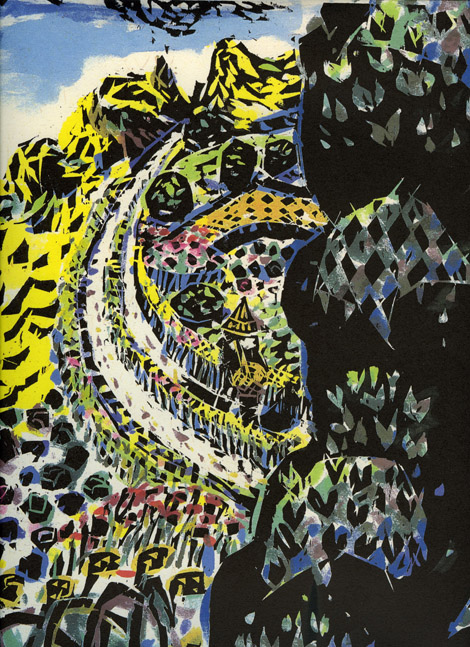
Naka Bokunen Cartway and Fukugi Tree 1997

Naka Bokunen's Cartway and Fukugi Tree 1997

Do you now work exclusively with woodblocks?

“Not at all. I sometimes do sculptures such as the bronze mermaid at Moon Beach. I also do pen and ink designs, which I print as lithographs then paint with watercolors. Woodblocks, though, are my favorite method. I love the process of carving the image; it’s unlike anything else.”

What are your main artistic influences?

The greatest influence comes from the things around me: Okinawa’s plants, animals, people, ocean and mountains. I also want to do more traveling, as whenever you make a connection with a place or a person, you get inspired, and it is this inspiration I can then channel into my work

I like the paintings of Van Gogh and Picasso. Some people say that my prints remind them of Chagall because the women in my pictures seem to be flying through the sky.

The other person who has inspired me is Shiko Munakata. He was the first to use the uratesaishoku technique in Japan, and was one of this country’s great 20th century artists.”

As nature is you main inspiration, do you worry about the future of the environment?

Of course. I believe that the power of life lies hand in hand with the power of nature. I do not directly campaign for environmental protection, but I hope that, through my work, people will see the beauty of Okinawa, and not want to lose it.”

A lot of your creations include images of women or mermaids, but there don’t seem to be any men?

I think that women are the spiritual heart of life. In Okinawa, they also have the special roles of kaminchu and yuta, priestess and shaman. To some this female power is known as Gaia, others call it Mother Nature. When I begin to draw or carve, the images just come naturally from my subconscious. Maybe, I just spend more time thinking about women than I do about men.”

Naka Bokunen Bronze Mermaid Moon Beach

Naka Bokunen's Bronze Mermaid at Moon Beach


(Interview first published in Okinawa Living Magazine February 2006)
Fast cars, slow roads.

A Japanese motoring website just reviewed the much anticipated Nissan GTR specV sports car. The V-spec is the faster, lighter version of what was already one of the fastest sports cars on the planet.

The video however is a great example of the paradox for sports cars in Japan: fast cars, slow roads.

Speed limits in Japan are surprisingly low. In cities the maximum is usually 40 or 50 kilometers an hour. Toll-road expressways have speed limits of 100 kph ( and in Okinawa only 80 kph). In rural areas of Japan the low speed limits continue. Unlike Britain where country roads often have 60 mile per hour  limits,  many deserted rural roads are still restricted to 40 kilometers an hour. Unless you live close to a track the Nissan GTR specV is simply all dressed up with nowhere to go.

The motoring journalist in the video however happily hurtles along  past signs and road markings for 50 kilometers an hour. This disregard for the speed limit isn’t unusual, it’s epidemic. If you simply drive with the flow of traffic you will usually be traveling 10 or 20 kilometers over the limit. The speed limits are not rigidly enforced, although there are a limited number of speed cameras and unmarked police cars on the toll-road expressways.

So what is the solution? Raise speed limits on roads then vigorously enforce the new limits with speed cameras and more police? Or should we follow the advice of another friend of mine and reduce speed limits until it’s just as fast to go everywhere by bicycle or bus.

As for the GTR specV, I’d love one, right after I buy my own racetrack.

The Windows 7 Whopper

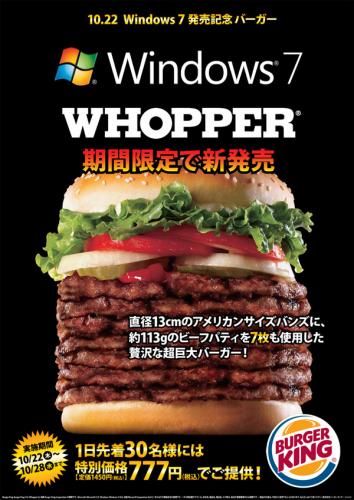
This news is a little outdated  but from the 22nd to the 28th of October Burger Kings in Japan were selling Windows 7 Whopper burgers to celebrate the arrival of Microsoft’s Windows 7 operating system.

Windows 7 Burger King Whopper Japan

The Windows 7 Whopper at Burger Kings in Japan

What amazes me is that someone at a PR firm thought this was a good idea, and even more remarkably, people at Microsoft agreed. Companies pay millions to be associated with certain sports stars or actors, why would Microsoft want to link itself to something quite so noxious. The campaign could almost have had the tagline “Want system failure and fatal errors, try Windows 7”.

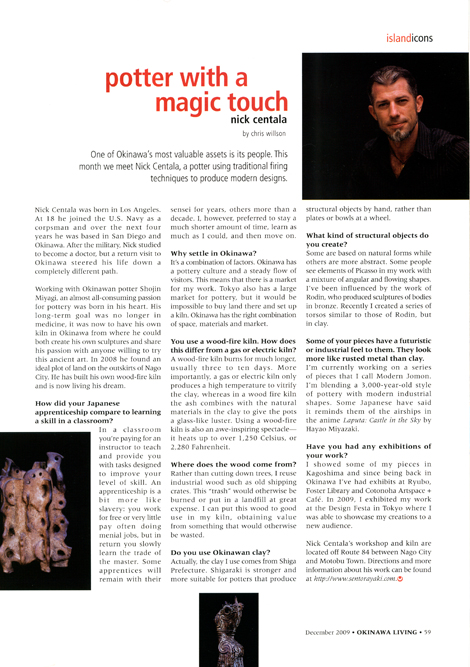
Island Icons – Ceramic Artist Nick Centala

In the December issue of Okinawa Living magazine there’s an interview I did with ceramic artist Nick Centala. I’ve added the extended text and a few images below for people who can’t get hold of the magazine.

Nick Centala Interview by Chris Willson, Okinawa Living Magazine

Nick Centala Interview by Chris Willson, Okinawa Living Magazine

Potter with a Magic Touch

Okinawa’s most valuable asset is its people. This month we meet Nick Centala, a ceramic artist using traditional firing techniques to produce modern designs.

Nick Centala was born in Los Angeles. At 18 he joined the U.S. Navy as a corpsman and over the next 4 years he was based in San Diego and Okinawa. After the military, Nick studied pre-med to become a doctor, but a return visit to Okinawa steered his life down a different path.

In 2001, he spent five weeks learning about sculpting shîsâ with Okinawan potter Miyagi Shojin. A consuming passion for pottery grew from this experience. He switched his life goals from medicine to art, and became an apprentice to a potter in Kumamoto. After 3 months, he was offered a job managing a large wood-burning oven in Kagoshima, and it was there he spent 3 more years honing his craft. Nick still hoped to return to Okinawa, and when the opportunity arose to work for Okinawan potter Matsushima Choogi, he moved back to the Ryukyu Islands. His long-term goal, however, was to have his own kiln in Okinawa. From there he could create his own sculptures, but also make his knowledge and workshop available to others who have an interest in ceramics.
In 2008, Nick found the ideal plot of land on the outskirts of Nago City. He has since built his own 5-meter wood-fire kiln, and is finally living his dream.

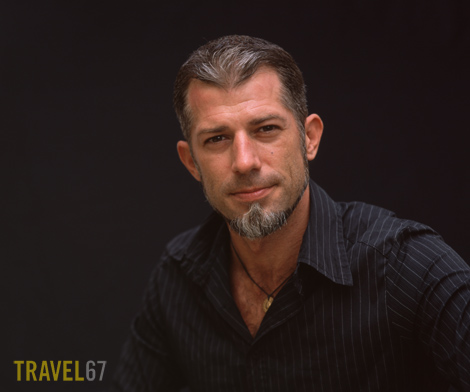
Potter Nick Centala

Potter Nick Centala

How did your Japanese apprenticeship compare to learning a skill in a classroom?
In a classroom, you’re paying for an instructor to teach and provide you with tasks designed to improve your level of skill. An apprenticeship is a bit more like slavery, you work for free or very little pay often doing menial jobs, but in return you slowly learn the trade of the master. Some apprentices will remain with their sensei for years, often more than a decade. I, however, preferred to stay a much shorter amount of time at a variety of different workshops. I’d learn as much as I could about a particular style then move on. Because of this, I could choose the kiln style that suited me the best.

Why base yourself in Okinawa?
It’s a combination of factors. Okinawa has a pottery culture and a steady flow of visitors, therefore a market for my work. Tokyo also has a large market for ceramic art, but it would be impossible to buy land and set up a kiln there. Okinawa has the right combination of space, materials and market.

You use a wood fire kiln, how does this differ to a gas or electric kiln?
A wood fire kiln burns for much longer, usually three to ten days. More importantly, a gas or an electric kiln only produces a high temperature to vitrify the clay. In a wood fire kiln the ash combines with the natural materials in the clay to give the pots a glass-like luster.
After cave painting, wood-fired pottery is the oldest art form in existence. Using a wood fire kiln is also an awe-inspiring spectacle. The kiln heats up to over 1250 Celsius or 2280 Fahrenheit. It burns white hot, an inferno contained within the walls of the kiln.

Where does the wood come from?
Rather than cutting down trees, I reuse industrial wood such as old shipping crates. This natural fuel would otherwise be burned or put in a landfill at great expense. I can put this wood to good use in my kiln, obtaining value from something that would otherwise be wasted.

Potter Nick Centala

Do you use Okinawan clay?
Actually, the clay I use comes from Shiga prefecture. Shigaraki is stronger and more suitable for hand-built structural objects. Okinawan clay is nice, but a challenge to work with sometimes.

What kind of structural objects do you create?
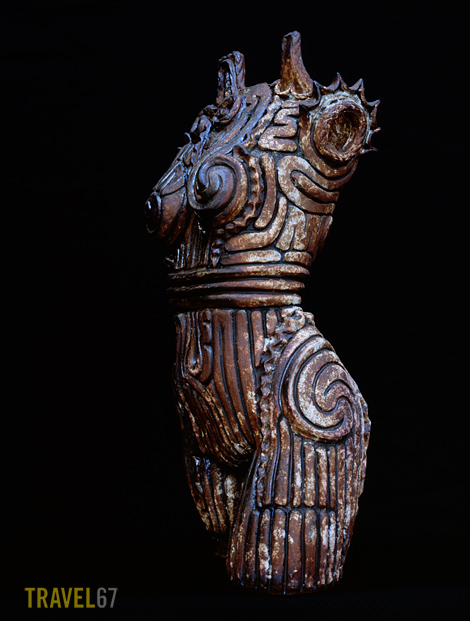
Some are based on natural forms while others are more abstract. Some see element of Picasso in my work with a mixture of angular and flowing shapes. For a long time, I’ve been influenced by the work of Rodin who produced sculptures of bodies in bronze. Recently I created a series of torsos similar to those of Rodin, but in clay. The human form never goes out of style.

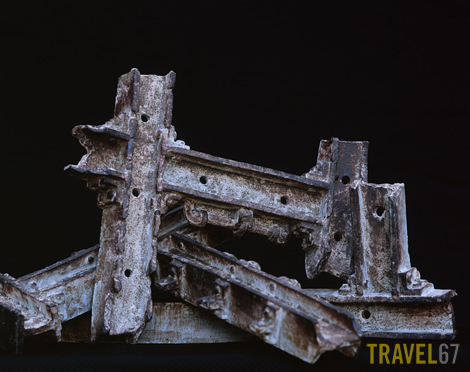
Some of your pieces have a futuristic or industrial feel to them. They look more like rusted metal than clay.
Yes my “iron works” in clay are popular. I’m currently working on a series of pieces that I call Modern Jomon, I’m blending a 3000 year old style of pottery with modern industrial shapes. Some Japanese visitors have said it reminds them of the airships in the anime Laputa: Castle in the Sky by Hayao Miyazaki.

Have you had any exhibitions of your work?
I showed some of my pieces in Kagoshima and since being back in Okinawa I’ve had exhibits at the Ryubo Department Store, the Foster Library, Urasoe Art Museum, the Okiten Annual Art Show, and Cotonoha Artspace + Café. In 2009, I exhibited my work at the Design Festa in Tokyo where I was able to showcase my creations to a new audience.

Nick’s workshop and kiln is located off route 84 between Nago City and Motobu Town. Directions and information about his work, the public workshop, and kiln can be found at www.sentorayaki.com

The Traveling Photographer #4

Now that nearly all computer related issues have been resolved, I’m able to do a bit of scanning and put up a few blog posts. Here’s the latest “The Traveling Photographer” from the December issue of Okinawa Living Magazine. This month it’s all about using natural framing.

The Traveling Photographer #4 by Chris Willson, Okinawa Living Magazine

The Traveling Photographer #4 by Chris Willson, Okinawa Living Magazine

See a larger, readable, scan of the page here.

Dealing with a petulant Snow Leopard

A follow up to Apple Mac by Kafka.

The Good

Applications bought on iTunes could be downloaded again. This was nice as I had just paid about 20 bucks for the Japanese Ap. that works as a great English/Japanese dictionary.

I easily reinstall the applications Soundslides, iVCD and Earthdesk via downloads from the web. Happily I still had all the license codes. To get Fetch again I needed to upgrade to the latest version for a few bucks, but that too is now up and running.

The Bad

Photoshop CS3 install disk doesn’t run. In a bizarre twist it looks like CS3 is compatible with Snow Leopard but it seems that the tiny little program that installs the program isn’t. Adobe doesn’t support CS3 anymore. Supposedly there are no problems with CS4. I bite the bullet and order a CS3 to CS4 upgrade from Adobe. (I realize this is rewarding bad behavior).

No longer have the CD or code for Word for Mac. Go out and buy copy of Microsoft Office for Mac 2008. Get home, put disc in machine. Machine spits it out. Need to finish writing a The Traveling Photographer article so download trial of iWork. “Pages” seems to be a pretty good word processor, just need to remember to save as  .doc before mailing anything to an editor.

The Ugly

CS4 upgrade pack arrives. Happily open box insert install DVD, computer whirrs then spits out DVD.

Deodeo phones to say my  external hard drive has returned from I-O Data fixed and clean (empty) as a whistle.

Connect external hard drive and let it backup about 500 GB of data.

Talk to Apple Care. They suggest to try the CS3, CS4, and Microsoft Office for Mac discs in another Mac to see if it was a problem with each disk. (I resist the urge to point out that if there is a one in a thousand chance of a particular install disc being faulty, for it to happen to all three discs would be one in a billion.) Drive over to house of fellow Mac Pro user, photographer Aviva Bowman, discs work fine on her computer.

Talk to Apple Care again. They say they’ll send a shipping box right away. Couriers will pick  up my computer tomorrow, take it back to Apple and they’ll sort out the problem.

The Good (I realize I’ve used this already, but it’s nice to end on a positive note)

Drink mug of tea and look on the bright side of life.

Didn’t lose any significant information, but learned a valuable lesson about backing up data.

I had purchased the extended 3 year Apple Care plan so if there are any faults with the Superdrive they’re covered.

Bear, my labrador, just peed outside on the grass rather than inside on the floor. Hoorah.

Zen and the Art of Photography Exhibitions

There seems to be an endless number of books, magazines and Internet forums discussing the latest camera equipment. There are fewer places to get information about actually taking photographs, even fewer with regards to printing those photos, and hardly any giving advice about putting on an exhibition.

Over the past two years I’ve had my first 4 exhibitions. It has been a real learning experience, from the initial stages of working out how I am going to produce the prints to finally sitting in a room watching other people stare at my photographs. There are many things I know now that I wish I had been aware of a couple of years ago. They may be obvious to some, but I thought I would share these little nuggets of wisdom.

Time

Do not underestimate the amount of time it will take. If you are putting on a solo show with numerous prints life is going to be busy!  For example, I thought it would be quite simple to frame all the prints by myself. It did, however, take an average of about 2 hours a picture and with 24 prints it became a huge job. Some galleries also expect you to be present during the entire show. And although it’s very enjoyable meeting interesting people, it involves a lot of days spent in a room when you might rather be out traveling or taking photographs.

Listen

If you are at the gallery the entire time it provides a fantastic opportunity for feedback. Some conversations were about what I could do better (see labels and height), others were advice on great places I should visit in the future. When I asked visitors which photograph was their favorite the results were fascinating and quite unexpected. The vast majority of Japanese men liked “Into the mist”, while the Japanese women were far more enamored with the photographs of either Fuji or the snow monkeys. The Geisha / Maiko photograph although very popular with western visitors was of far less interest to Japanese. I was pleased that this range of choices validated my decision to show a diverse selection of photographs. An entire exhibition of bridge photographs might have had a tighter artistic theme, but then I would have missed out on the conversation with the elderly lady who pointed at my print of a deserted Okinawan beach and explained how she had visited the exact same place sixty years earlier.

Labels

There should be clear labels that tell the visitor exactly where the photograph was taken, and even better a description of how you took the photograph. Labels should be printed large as a surprising number of the people who visit galleries are older and don’t want to be straining their eyes looking at small typeface.

Height

Hang the prints at the correct height for the average viewer, not yourself. Otherwise (if you are six foot foreigner in rural Japan) you may have people balancing on their toes trying to see them.

To sell or not to sell?

Some galleries are display only, others will happily sell your prints and take a commission, while others will vary the cost of renting the gallery space depending on whether you are displaying or selling. I chose to display only for three of the four exhibitions, but handed out business cards to anyone who enquired about prints.

Advertise

You may have the most amazing selection of photographs but if nobody knows about your exhibition you are only going to get a few random visitors who happened to be passing by. It is worth talking with the gallery to find out how much if any advertising they are willing to do for your exhibition. Of course tell family and friends, but also consider contacting local newspapers to let them now about the event. The key here is to do it in advance so that hopefully you will get mentioned in the paper on the first rather than the last day of the exhibition.

Guest books

Guest books are vital way of staying in touch with visitors who come to your exhibition. It is essential therefore that as well as a name and comment you get an email address or a full mail address. That way you can thank them for attending and / or let them know when your next exhibition will be held. (It will be a little tricky to do this if all they write is John Smith – Nevada.)

Portfolio

At my second exhibition I put out a small file with some tear sheets from various magazines that have used my photographs. It turned out to very popular, people could sit down and look through the pictures and spot which of the ones that had been in magazines were now up on the wall.

Real Art

Putting on an exhibition is a wonderful way to show everyone your work and hopefully most people will be full of praise. It is unlikely, if not impossible, however that praise will be universal. What surprised me was that there is still a certain snobbery by some gallery patrons that photography is not “real art,” or that real photographs are black and white, not color.

Once you embrace the fact that your can’t please everyone, (or that some can’t be pleased at all) it is much easier to concentrate on following your own artistic vision.

Watermarks

Just had an interesting email which shows the importance of watermarking your images.


Photograph by Chris Willson (not Youko Maeda!)

The webmaster of a model / photographer  website contacted me saying that he was suspicious of a new member’s application. The new member, a photographer named “Youko Maeda” from “Hawaii”, uploaded some examples of her photographs (including the one above)  all of which had  TRAVEL 67 watermarks on them. The webmaster decided to visit http://www.travel67.com found out the photographer was a Chris Willson and not a Youko Maeda and got in touch. The new member’s application has been denied, hopefully thwarting some dirtbags plans.

A simple watermark gives potential clients or customers the ability to find who the owner of the copyright is, and hopefully dissuades others from stealing your work.

Having said that people can still crop or photoshop watermarks away. This is one of the reasons why I don’t have huge images on the web.  I once got an “Okinwan Souvenir” on Facebook of some Taketomi Island star sand. Ironically the tiny gift image had been taken from my website by the application creator without my permission. I contacted the creator, Fernando Nakasone, but got no reply. Whether this was incompetence or maliciousness I don’t know but it is another reminder that photographers need to protect their work.