Latest Posts

Island Icons – Ceramic Artist Nick Centala

In the December issue of Okinawa Living magazine there’s an interview I did with ceramic artist Nick Centala. I’ve added the extended text and a few images below for people who can’t get hold of the magazine.
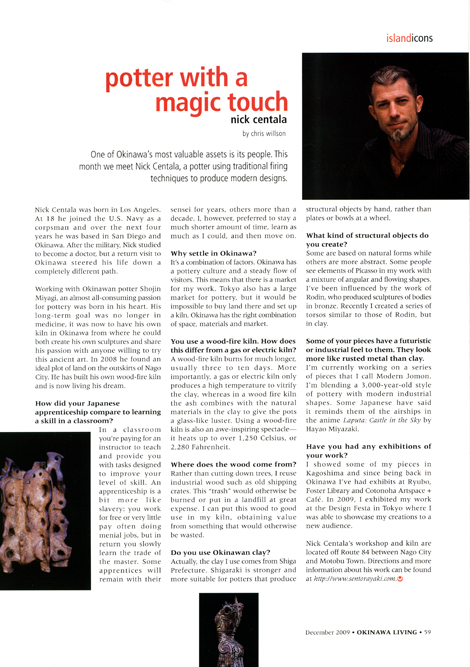
Nick Centala Interview by Chris Willson, Okinawa Living Magazine

Nick Centala Interview by Chris Willson, Okinawa Living Magazine

Potter with a Magic Touch

Okinawa’s most valuable asset is its people. This month we meet Nick Centala, a ceramic artist using traditional firing techniques to produce modern designs.

Nick Centala was born in Los Angeles. At 18 he joined the U.S. Navy as a corpsman and over the next 4 years he was based in San Diego and Okinawa. After the military, Nick studied pre-med to become a doctor, but a return visit to Okinawa steered his life down a different path.

In 2001, he spent five weeks learning about sculpting shîsâ with Okinawan potter Miyagi Shojin. A consuming passion for pottery grew from this experience. He switched his life goals from medicine to art, and became an apprentice to a potter in Kumamoto. After 3 months, he was offered a job managing a large wood-burning oven in Kagoshima, and it was there he spent 3 more years honing his craft. Nick still hoped to return to Okinawa, and when the opportunity arose to work for Okinawan potter Matsushima Choogi, he moved back to the Ryukyu Islands. His long-term goal, however, was to have his own kiln in Okinawa. From there he could create his own sculptures, but also make his knowledge and workshop available to others who have an interest in ceramics.
In 2008, Nick found the ideal plot of land on the outskirts of Nago City. He has since built his own 5-meter wood-fire kiln, and is finally living his dream.
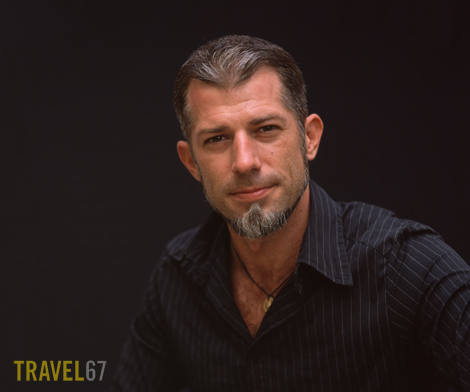
Potter Nick Centala

Potter Nick Centala

How did your Japanese apprenticeship compare to learning a skill in a classroom?
In a classroom, you’re paying for an instructor to teach and provide you with tasks designed to improve your level of skill. An apprenticeship is a bit more like slavery, you work for free or very little pay often doing menial jobs, but in return you slowly learn the trade of the master. Some apprentices will remain with their sensei for years, often more than a decade. I, however, preferred to stay a much shorter amount of time at a variety of different workshops. I’d learn as much as I could about a particular style then move on. Because of this, I could choose the kiln style that suited me the best.

Why base yourself in Okinawa?
It’s a combination of factors. Okinawa has a pottery culture and a steady flow of visitors, therefore a market for my work. Tokyo also has a large market for ceramic art, but it would be impossible to buy land and set up a kiln there. Okinawa has the right combination of space, materials and market.

You use a wood fire kiln, how does this differ to a gas or electric kiln?
A wood fire kiln burns for much longer, usually three to ten days. More importantly, a gas or an electric kiln only produces a high temperature to vitrify the clay. In a wood fire kiln the ash combines with the natural materials in the clay to give the pots a glass-like luster.
After cave painting, wood-fired pottery is the oldest art form in existence. Using a wood fire kiln is also an awe-inspiring spectacle. The kiln heats up to over 1250 Celsius or 2280 Fahrenheit. It burns white hot, an inferno contained within the walls of the kiln.

Where does the wood come from?
Rather than cutting down trees, I reuse industrial wood such as old shipping crates. This natural fuel would otherwise be burned or put in a landfill at great expense. I can put this wood to good use in my kiln, obtaining value from something that would otherwise be wasted.
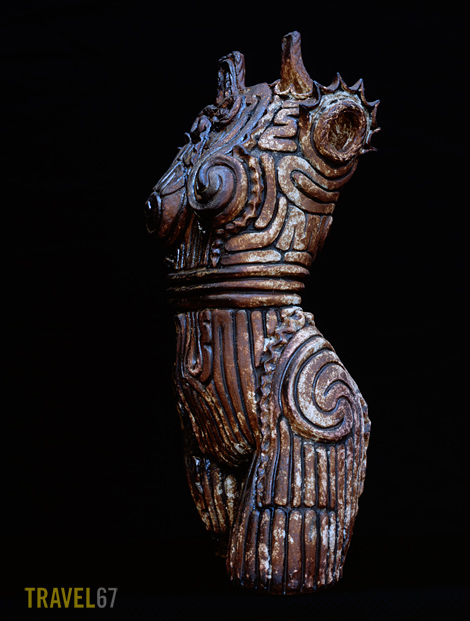
Potter Nick Centala

Do you use Okinawan clay?
Actually, the clay I use comes from Shiga prefecture. Shigaraki is stronger and more suitable for hand-built structural objects. Okinawan clay is nice, but a challenge to work with sometimes.

What kind of structural objects do you create?
Some are based on natural forms while others are more abstract. Some see element of Picasso in my work with a mixture of angular and flowing shapes. For a long time, I’ve been influenced by the work of Rodin who produced sculptures of bodies in bronze. Recently I created a series of torsos similar to those of Rodin, but in clay. The human form never goes out of style.

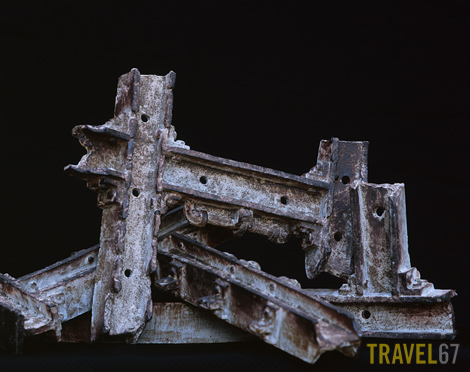
Some of your pieces have a futuristic or industrial feel to them. They look more like rusted metal than clay.
Yes my “iron works” in clay are popular. I’m currently working on a series of pieces that I call Modern Jomon, I’m blending a 3000 year old style of pottery with modern industrial shapes. Some Japanese visitors have said it reminds them of the airships in the anime Laputa: Castle in the Sky by Hayao Miyazaki.
Have you had any exhibitions of your work?
I showed some of my pieces in Kagoshima and since being back in Okinawa I’ve had exhibits at the Ryubo Department Store, the Foster Library, Urasoe Art Museum, the Okiten Annual Art Show, and Cotonoha Artspace + Café. In 2009, I exhibited my work at the Design Festa in Tokyo where I was able to showcase my creations to a new audience.

Nick’s workshop and kiln is located off route 84 between Nago City and Motobu Town. Directions and information about his work, the public workshop, and kiln can be found at www.sentorayaki.com

The Traveling Photographer #4

Now that nearly all computer related issues have been resolved, I’m able to do a bit of scanning and put up a few blog posts. Here’s the latest “The Traveling Photographer” from the December issue of Okinawa Living Magazine. This month it’s all about using natural framing.

The Traveling Photographer #4 by Chris Willson, Okinawa Living Magazine

The Traveling Photographer #4 by Chris Willson, Okinawa Living Magazine

See a larger, readable, scan of the page here.

Dealing with a petulant Snow Leopard

A follow up to Apple Mac by Kafka.

The Good

Applications bought on iTunes could be downloaded again. This was nice as I had just paid about 20 bucks for the Japanese Ap. that works as a great English/Japanese dictionary.

I easily reinstall the applications Soundslides, iVCD and Earthdesk via downloads from the web. Happily I still had all the license codes. To get Fetch again I needed to upgrade to the latest version for a few bucks, but that too is now up and running.

The Bad

Photoshop CS3 install disk doesn’t run. In a bizarre twist it looks like CS3 is compatible with Snow Leopard but it seems that the tiny little program that installs the program isn’t. Adobe doesn’t support CS3 anymore. Supposedly there are no problems with CS4. I bite the bullet and order a CS3 to CS4 upgrade from Adobe. (I realize this is rewarding bad behavior).

No longer have the CD or code for Word for Mac. Go out and buy copy of Microsoft Office for Mac 2008. Get home, put disc in machine. Machine spits it out. Need to finish writing a The Traveling Photographer article so download trial of iWork. “Pages” seems to be a pretty good word processor, just need to remember to save as  .doc before mailing anything to an editor.

The Ugly

CS4 upgrade pack arrives. Happily open box insert install DVD, computer whirrs then spits out DVD.

Deodeo phones to say my  external hard drive has returned from I-O Data fixed and clean (empty) as a whistle.

Connect external hard drive and let it backup about 500 GB of data.

Talk to Apple Care. They suggest to try the CS3, CS4, and Microsoft Office for Mac discs in another Mac to see if it was a problem with each disk. (I resist the urge to point out that if there is a one in a thousand chance of a particular install disc being faulty, for it to happen to all three discs would be one in a billion.) Drive over to house of fellow Mac Pro user, photographer Aviva Bowman, discs work fine on her computer.

Talk to Apple Care again. They say they’ll send a shipping box right away. Couriers will pick  up my computer tomorrow, take it back to Apple and they’ll sort out the problem.

The Good (I realize I’ve used this already, but it’s nice to end on a positive note)

Drink mug of tea and look on the bright side of life.

Didn’t lose any significant information, but learned a valuable lesson about backing up data.

I had purchased the extended 3 year Apple Care plan so if there are any faults with the Superdrive they’re covered.

Bear, my labrador, just peed outside on the grass rather than inside on the floor. Hoorah.

Zen and the Art of Photography Exhibitions

There seems to be an endless number of books, magazines and Internet forums discussing the latest camera equipment. There are fewer places to get information about actually taking photographs, even fewer with regards to printing those photos, and hardly any giving advice about putting on an exhibition.

Over the past two years I’ve had my first 4 exhibitions. It has been a real learning experience, from the initial stages of working out how I am going to produce the prints to finally sitting in a room watching other people stare at my photographs. There are many things I know now that I wish I had been aware of a couple of years ago. They may be obvious to some, but I thought I would share these little nuggets of wisdom.

Time

Do not underestimate the amount of time it will take. If you are putting on a solo show with numerous prints life is going to be busy!  For example, I thought it would be quite simple to frame all the prints by myself. It did, however, take an average of about 2 hours a picture and with 24 prints it became a huge job. Some galleries also expect you to be present during the entire show. And although it’s very enjoyable meeting interesting people, it involves a lot of days spent in a room when you might rather be out traveling or taking photographs.

Listen

If you are at the gallery the entire time it provides a fantastic opportunity for feedback. Some conversations were about what I could do better (see labels and height), others were advice on great places I should visit in the future. When I asked visitors which photograph was their favorite the results were fascinating and quite unexpected. The vast majority of Japanese men liked “Into the mist”, while the Japanese women were far more enamored with the photographs of either Fuji or the snow monkeys. The Geisha / Maiko photograph although very popular with western visitors was of far less interest to Japanese. I was pleased that this range of choices validated my decision to show a diverse selection of photographs. An entire exhibition of bridge photographs might have had a tighter artistic theme, but then I would have missed out on the conversation with the elderly lady who pointed at my print of a deserted Okinawan beach and explained how she had visited the exact same place sixty years earlier.

Labels

There should be clear labels that tell the visitor exactly where the photograph was taken, and even better a description of how you took the photograph. Labels should be printed large as a surprising number of the people who visit galleries are older and don’t want to be straining their eyes looking at small typeface.

Height

Hang the prints at the correct height for the average viewer, not yourself. Otherwise (if you are six foot foreigner in rural Japan) you may have people balancing on their toes trying to see them.

To sell or not to sell?

Some galleries are display only, others will happily sell your prints and take a commission, while others will vary the cost of renting the gallery space depending on whether you are displaying or selling. I chose to display only for three of the four exhibitions, but handed out business cards to anyone who enquired about prints.

Advertise

You may have the most amazing selection of photographs but if nobody knows about your exhibition you are only going to get a few random visitors who happened to be passing by. It is worth talking with the gallery to find out how much if any advertising they are willing to do for your exhibition. Of course tell family and friends, but also consider contacting local newspapers to let them now about the event. The key here is to do it in advance so that hopefully you will get mentioned in the paper on the first rather than the last day of the exhibition.

Guest books

Guest books are vital way of staying in touch with visitors who come to your exhibition. It is essential therefore that as well as a name and comment you get an email address or a full mail address. That way you can thank them for attending and / or let them know when your next exhibition will be held. (It will be a little tricky to do this if all they write is John Smith – Nevada.)

Portfolio

At my second exhibition I put out a small file with some tear sheets from various magazines that have used my photographs. It turned out to very popular, people could sit down and look through the pictures and spot which of the ones that had been in magazines were now up on the wall.

Real Art

Putting on an exhibition is a wonderful way to show everyone your work and hopefully most people will be full of praise. It is unlikely, if not impossible, however that praise will be universal. What surprised me was that there is still a certain snobbery by some gallery patrons that photography is not “real art,” or that real photographs are black and white, not color.

Once you embrace the fact that your can’t please everyone, (or that some can’t be pleased at all) it is much easier to concentrate on following your own artistic vision.

Watermarks

Just had an interesting email which shows the importance of watermarking your images.


Photograph by Chris Willson (not Youko Maeda!)

The webmaster of a model / photographer  website contacted me saying that he was suspicious of a new member’s application. The new member, a photographer named “Youko Maeda” from “Hawaii”, uploaded some examples of her photographs (including the one above)  all of which had  TRAVEL 67 watermarks on them. The webmaster decided to visit http://www.travel67.com found out the photographer was a Chris Willson and not a Youko Maeda and got in touch. The new member’s application has been denied, hopefully thwarting some dirtbags plans.

A simple watermark gives potential clients or customers the ability to find who the owner of the copyright is, and hopefully dissuades others from stealing your work.

Having said that people can still crop or photoshop watermarks away. This is one of the reasons why I don’t have huge images on the web.  I once got an “Okinwan Souvenir” on Facebook of some Taketomi Island star sand. Ironically the tiny gift image had been taken from my website by the application creator without my permission. I contacted the creator, Fernando Nakasone, but got no reply. Whether this was incompetence or maliciousness I don’t know but it is another reminder that photographers need to protect their work.


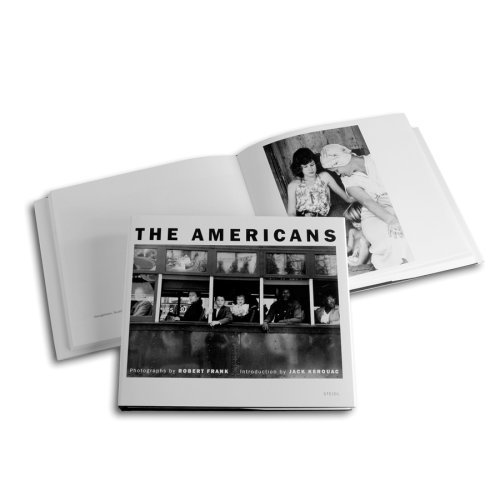
(Not yet) On the bookshelf: The Americans by Robert Frank

Over the last year I’ve talked about a few inspirational photography books on my bookshelf. This time, I thought I’d make my discovery of the photographic masters a little more interactive. Would it not be more interesting to read the book at the same time as others? Similar to a book club, but with less Oprah and more photographs.

I thought we could start with a book I’ve just ordered for Christmas The Americans by Robert Frank. So if you’re interested please beg, borrow or buy a copy and then I’d love to hear your comments. Exciting stuff.
The Americans by Robert Frank

Aerial Photographer Robert Cameron

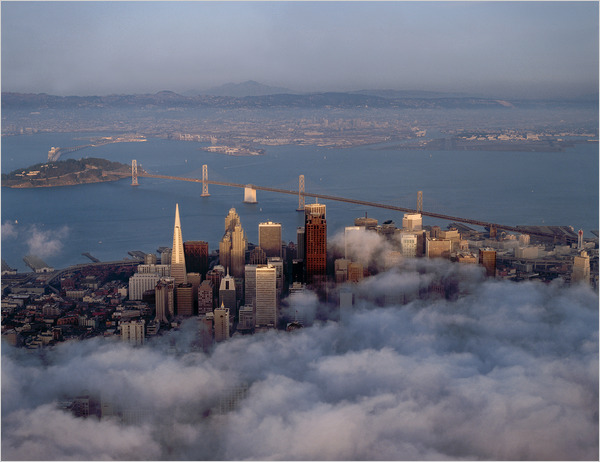
American photographer Robert Cameron died last week aged 98. He specialized in aerial photographs, most famously for his “Above” series of books.  Just three months ago he was up in a helicopter taking shots of the famously contorted Lombard Street in San Francisco.

What I hadn’t realized was that he took photos with a Pentax 67 attached to a gyroscope to minimize vibrations. Many of his photographs are  stunning.

Photograph by Robert Cameron

This has inspired me to do some aerial shots of Okinawa. All I need is a plane or a helicopter, and a pilot.

So if you or any of your friends happen to have a plane in Okinawa please get in touch!

Apple Mac by Kafka

10 days ago my 1TB external hard drive stopped working. This hard drive was running Time Machine continually making backups of all my data. I took it back to the store. They said they would send it back to the manufacturer IO DATA. IO DATA phoned a couple of days ago and said they would fix it but I would lose the data. No problems I said it’s only the backup, everything is safe on my very reliable Mac Pro computer….

This morning turn on my computer and all I get is the Apple logo and a little thinking symbol.

Call Apple support.  First question…

Is all your data saved?

AGGGGHHHHHHHHHH!!!!!!!!!!!

After an hour of trying various things. The lady on the phone says that I should reinstall Snow Leopard, but I will lose all information on the hard drive.  But there is hope…..

All my data is on my second “DATA” hard disk. Only applications are on the first “APPLICATIONS” hard disk. I figured I could reinstall on the first hard disk and all I will have to do is then reinstall photoshop etc which I have the disks for. (Because I was a good consumer and actually purchased the disk from Adobe!)

Lady on the phone talks me through the stages of clicking the Erase button followed by the various warnings saying are you really sure you want to do this…..

Snow Leopard is reinstalled. Computer springs back to life.

But….

Suddenly I begin to realize the consequences of my actions….

Anything saved to the desktop was on the now spotlessly clean hard disk 1. Images and articles I was currently working on have floated into the ether. The same goes for music, music videos, podcasts, ipod applications.

I connect the ipod to the computer. It says the ipod will only sync with the original computer, would I like to erase all the files on the ipod and sync with the empty folders on my spotlessly clean hard drive. I check the apple itunes store. It says please backup all music and videos as you can only download music and videos once. If you didn’t have a backup please purchase them again.

Insert Photoshop Cs3 disk to reinstall. Computer spits is out again.

Phone Adobe Japan. No English support. Explain situation in Japanese. I am told  that they no longer give free telephone support to CS3 customers.

Without CS3 I can’t edit or print. But then again the images I was currently working on have vanished.

Suddenly realize that I am happy to be still using film so at least I have a physical backup of everything. Just need to rescan the latest images. Scanner needs to be linked to photoshop. Aggghhhh.

The internet.  All my bookmarks have vanished. No problem, hopefully I will remember the address of anything important.

Go to WordPress.

Vent……

Feel better now.

Helena Christensen, Oxfam and a Pentax 67II

Pentax ceased production of the Pentax 67II camera this year. Maybe it was just too expensive to produce in small numbers, or maybe Pentax decided it was simpler to make the move to an all digital lineup of cameras.

There are some photographers however that are still use, and love, the Pentax 67II. It turns out that Helena Christensen, supermodel turned photographer, is one of them. I spotted this image of Helena with her Pentax 67 on the home page of the Guardian newspaper.

It links to a slideshow of her images documenting the effects climate change is having in Peru. You can see the slideshow here. Well worth checking out.


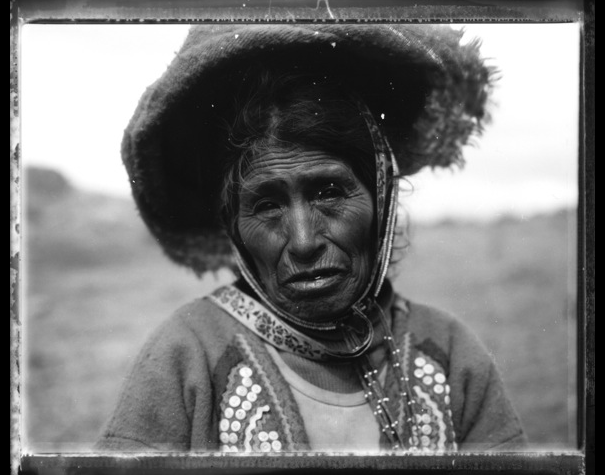
Peruvian Woman by Helena Christensen/Oxfam

Peruvian Woman by Helena Christensen/Oxfam