Latest Posts

The Lab Report – Bath time


Bath Time

Bath Time

Living on a subtropical island  has many advantages, one disadvantage however is that there are far more ants, termites, mosquitoes, cockroaches, spiders and other creatures that enjoy living on the island, and consequently in your home, and it seems on your dogs. One trick the vet told us was to buy a bottle of brown sulfurous liquid that turns your bath into your own personal onsen.  The dogs are quite happy to relax in the warm water, and the little critters that have been hiding in their coats are so disgusted by the noxious water they abandon ship (or dogs in this case) and are washed away down the plug hole to have new adventures in the sewage system.

You must remember to shampoo the dogs afterwards otherwise your faithful friends will wander around the house smelling of rotting eggs. Delightful.

On the bookshelf – Travel & Nature


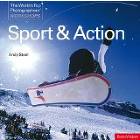
Travel & Nature by Andy Steel ( Rotovision )


Travel & Nature by Andy Steel ( Rotovision )


Rotovision is a British publisher that produces several really good books on photography. 


I just got one of the latest releases in their “The World’s Top Photographers’ Workshops” series titled Travel & Nature. The book is divided into ten sections each based around a particular photographer. Each section has an interview with the photographer, several pages of their best photographs and then a Tips for Success page where the photographer gives 10 nuggets of wisdom (or common sense). 
Travel photography is a bit like ecology  in that it is a blend of several different disciplines. This book therefore has interviews with a wide range of photographers including Steve Bloom (nature), David Doubliet (underwater) and Lee Frost (landscape). 

I have most of the titles in the series, some of which are better than others. Travel & Nature due to its diversity is a great book by itself, and if you like the informative style that delves more into the mindset of the photographer rather than the equipment he or she is using it deserves its space on the bookshelf.

Medium?

I do some freelance work for Okinawa Living magazine, a publication produced by M.C.C.S. which introduces Okinawan and Japanese culture to American military members and their families. I have a base pass so that I can drop off my work and meet with the editors, but it also allows me to use the fast food restaurants while I am on the base. This is not insignificant because it means I can get veggie burgers from Burger King. The only other fast food chain that does a veggie burger in Japan is the Hard Rock Cafe, but the closest one is in Fukuoka a thousand or so miles away.

I usually order the medium meal opting not to go large or king size. However on my last visit something interesting happened due to some clever/devious decision making on the part of Burger King.

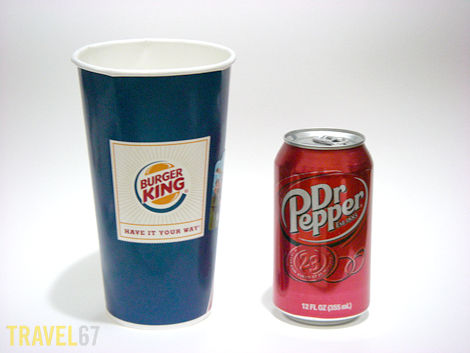
Burger King have decided to rename their sizes. King is now large. Large is now medium. Medium is now small. The portions however have not changed.

When I ordered my medium meal, I was given the veggie burger, the new medium sized fries and a new medium sized drink cup.

A medium sized drink?

A medium sized drink?

What they deem to be a medium-sized drink is now 22 fl.oz, almost double that in a regular can of soda.  I have less of a problem with Super-sized and King-sized amounts of food, the ridiculousness of the amount is referred to in their sizing. But to suggest, and possibly habituate your customers to the idea that drinking a liter of soda with a meal is a middle of the road option seems to be misleading.

Okinawa has one of the longest life expectancies in the world.  There’s an article about  Okinawan longevity , and interviews with Dr.  Andrew Weil and Dr. Makoto Suzuki, on my website, but to summarize it is clear that diet is a major factor. 

I have no problem with a company offering a range of sizes from the miniscule to the ridiculous. However, labeling those sizes correctly is a necessity. 

Misleading your customers isn’t.

Journalists, programmers and a robot

Tokyo’s weather may not have been cooperating, but fortuitous timing meant that I could catch up with several fellow ex-pats now living in the metropolis.

On the first night I was invited to The Foreign Correspondents Club of Japan in Ginza and met photographers Jeremy Sutton-Hibbert and Alfie Goodrich along with Justin McCurry the Tokyo correspondent for The Guardian, Julian Ryall the Tokyo correspondent for The Daily Telegraph and Chris Dunn an International Trade Consultant. Great guys living really interesting lives.

On the second night I met up with programmers Hector Garcia, Pietro Zuco and Ignacio Izquierdo and chatted about Flick’r and the ongoing computing revolution. Fascinating stuff and just in case you didn’t know…

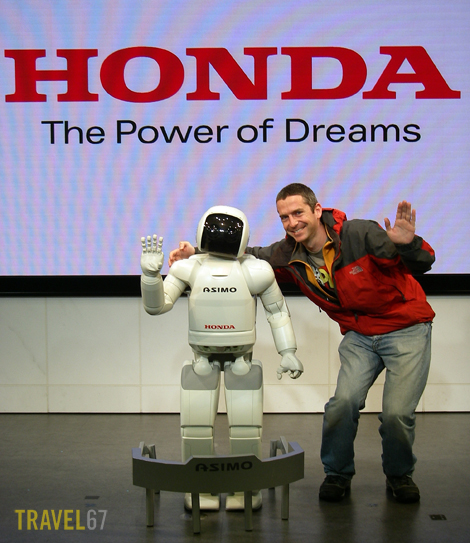
On my final morning Tokyo treated me to a special mix of sleet and wind, so I headed to Aoyama to meet ASIMO.

Honda's ASIMO robot

Honda's ASIMO robot

ASIMO didn’t say much, but was probably aware that in the near future his offspring will rule the world and we shall all tremble in their wake….

Rainy days in Tokyo

It was either cloudy, rainy or snowing the entire 3 days I was in Tokyo. This meant that the exterior architectural shots I wanted will have to wait for another visit. I did however visit the Tokyo International Forum to get some interior shots. The building was designed by architect Rafael Viñoly and completed in 1996. The glass and steel latticework (which looks a little like an upturned boat) fits the surrounding area far better than the similarly modern Kyoto train station.


Tokyo International Forum

Tokyo International Forum

Myoko Ski Area

I met up with my old friend Steve in Niigata, and after a day hanging out at his house we went to Myoko for a couple of days in the snow.

Myoko is a ski area close to the Niigata Nagano border. Mt Myoko is the mountain the region gets its name from, and there are several small ski areas on different parts of the peak. 

On the first day we went to Myoko Suginohara, the largest and busiest area. It was a Sunday and great weather so the slopes were quite crowded but it was good to be back on a snowboard again. After face planting off a jump, I also came to the grim realization that perhaps my skills have got a little rusty after a 7 year break.

We stayed at The Hawk and Hare Inn in Akakura which is run by an American ninjutsu falconer (I couldn’t make this stuff up.). It had a really relaxing atmosphere with a roaring fire, a constant supply of hot tea and a variety of boarding games. We played Risk, and I won (Steve will claim it was a draw).


Steve at Akakura Kanko (showing he's been in Japan too long by flashing the peace sign for photos)

Steve at Akakura Kanko (showing he's been in Japan too long by flashing the peace sign for photos)

The next day we went to Akakura Kanko. It was now a weekday, and snowing heavily so there were relatively few people out on the slopes. Much better snow conditions and for the first few hours there were even a few nice lines of untouched powder along the edges. We stopped for a break  at the Akakura Kanko Resort and Spa a large hotel complex located halfway down this small ski area. It was built in 1937, a collaborative effort between the Japanese and Germans, and perched on the side of the mountain. There is more than one reason why some locals gave it the nickname “the eagle’s nest.”  Steve and I  came in out of the cold, sat down in the very nice cafe and had cheese buns and coffee.


Akakura Kanko Resort & Spa (Spending most of my time behind a camera rather than in front of one has led to me forgetting to smile. I was having a good time, honest.)

Akakura Kanko Resort & Spa (Spending most of my time behind a camera rather than in front of one has led to me forgetting to smile. I was having a good time, honest.)

After another couple of days in Niigata, I headed south to Tokyo.

The joy and pain of rail travel in Japan.

From Aomori my next stop was to visit my friend Steve in Niigata. I checked on hyperdia.com and found that I could take a limited express train from Aomori to Akita, change, then get another limited express train from Akita to Niigata. I would leave Aomori at 13.45, get the 16.34 from Akita and arrive in Niigata at 20.07. The cost for the ticket was ¥12,290.

Things were going great, I spent the entire ride to Akita chatting to  Max a Japanese filmmaker  who now works in New York. At Akita station however, I was told that the train from Akita to Niigata was cancelled due to high winds.  The ticket office said that I would have to take an alternative route…


Akita to Niigata - routes A & B

Akita to Niigata - routes A & B

Rather than travel the 250km straight down the coast in three and a half hours (the green route), I would have to travel 900km from Akita all the way to Omiya near Tokyo and then up to Niigata (the red route). It would all be on bullet trains so if I got the 17.09 train from Akita I could get to Niigata just before eleven. They apologized that I would arrive nearly 3 hours later than I had expected and then….

charged me and extra ¥8430 because I would now be completing the journey by  bullet train,

I rolled my eyes, and then handed over my credit card. 


Shinkansen - perfect when you need to travel and extra 650km

Shinkansen - perfect when you need to travel an extra 650km

Pentax 645 digital

The Pentax 645 digital is a thing of legend, that is for years there have been rumors of it’s possible existence but time and again it has failed to materialize.

Back in 2005 it was going to be an 18.6 megapixel camera,

Pentax 645 digital prototype (photo from Amateur Photographer.co.uk)

Pentax 645 digital prototype (photo from Amateur Photographer.co.uk)

a year later it had changed shape.

Pentax 645 digital prototype (photo from Amateur Photographer.co.uk)

Pentax 645 digital prototype (photo from Amateur Photographer.co.uk)

By 2007, there were plans that the camera would now have a 32 megapixel sensor but it looked uncertain whether it would make production. By 2008 the general consensus of fellow Pentaxians seemed to be that the camera would never see the light of day.

Then yesterday a post appeared on the website Amateur Photographer.

PMA: PENTAX REVIVES MEDIUM FORMAT DIGITAL CAMERA PLAN (UPDATE)

If you will allow me to steal from Mark Twain…

It appears that  the rumors of its death have been greatly exaggerated.

Daibutsu – Giant Buddhas

After Hachinohe I went a little further north to the city of Aomori. Aomori is home to the Nebuta Festival in August, where huge colorful floats parade through the city. In mid-winter Aomori, like Hachinohe, is cold and gray with most of its residents either indoors or bundled up against the freezing conditions trying to commute to and from work on treacherous roads and sidewalks.

 One local attraction that interested me was the Showa Daibutsu a giant bronze statue of Buddha around 45 minutes by bus from the city center. Constructed in 1984 it is 21.35 meters high and weighs 220 tons.It was the largest Buddha in Japan until the construction of the Ushiku Daibutsu in Ibaraki Prefecture. 

It sits in a clearing among the trees and unlike the giant buddha at Nara is exposed to everything Mother Nature has to throw at it. 


Showa Daibutsu, Aomori

Showa Daibutsu, Aomori

Other giant Buddhas I have seen in Japan include the one at Nara,

Todai-ji Daibutsu, Nara

Todai-ji Daibutsu, Nara

and the one at Kamakura.


Daibutsu of Kamakura

Daibutsu of Kamakura

Haven’t been to the Ushiku Daibutsu, but if you have please post a picture in a response. In fact, if you’ve seen any giant Buddhas anywhere in the world, it would be great to see the photos.

Which scanner do you use?

Epson Perfection v750-M

Epson Perfection v750-M

I scan all my transparencies with an Epson Perfection V750-M scanner. It produces fine results, and is reasonably fast and reasonably priced for what it does. In Japan is has a different name the GT-X970, but much to my delight you could still select English rather than Japanese when installing the software. In the past when clients have requested, images have also been sent out for drum scanning. This has however was infrequent, and tended to be only when they wanted very large files.

Also essential to scanning is an air duster, to keep the scanner surface and transparency free of all the dust you can see, and then plenty of time, patience and the spot healing brush tool in Photoshop to remove all the tiny specks of dust which appear once you have enlarged the file.

Imacon flextight X5

Imacon flextight X5

Of course if money were not an issue I would run out and get an Imacon Flextight X5. It would do the job faster and produce better results if I was scanning images to very large sizes and needed to get every last detail out of the transparency. On the other hand if money was not an issue I would be in a hot air balloon cruising over the Masai Mara game reserve and someone else can do the scanning.