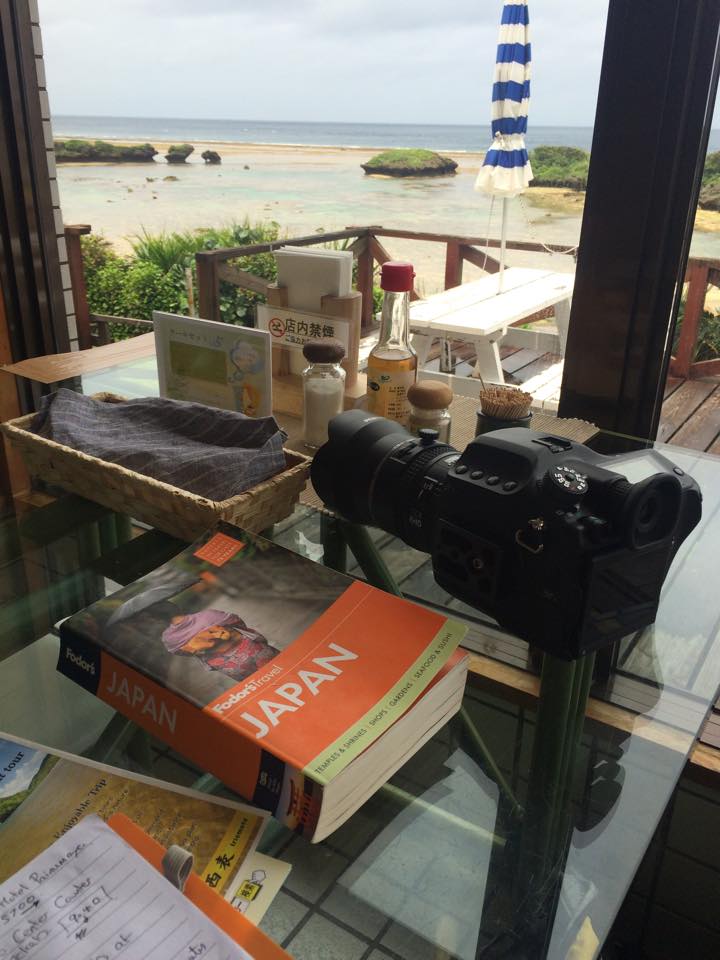
This is the third edition of the Fodor’s Japan guidebook that I’ve helped update. For the 22nd edition I travelled around Kyushu and Okinawa checking to see what changes there have been over the last couple of years. It’s great to be able to share amazing places with a worldwide audience.
The book is now available for pre-order at Amazon.
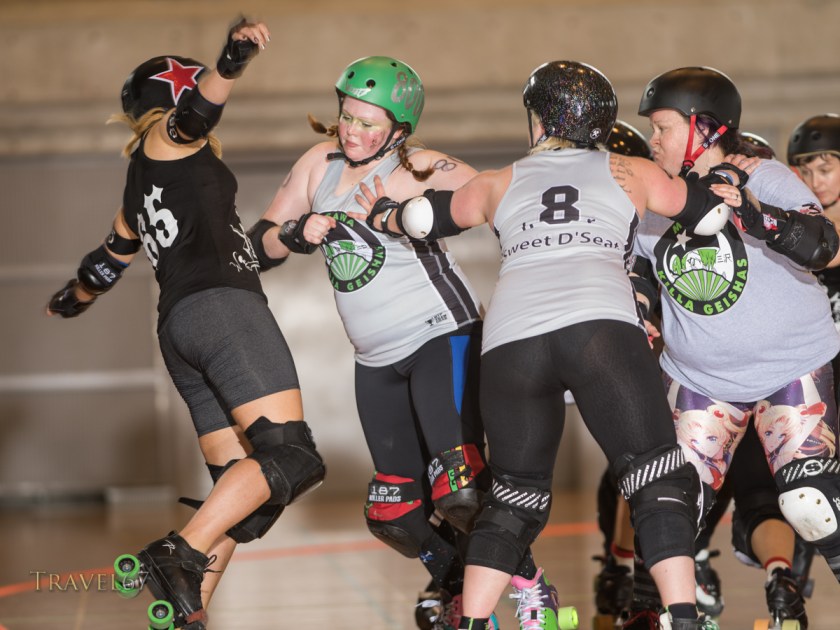
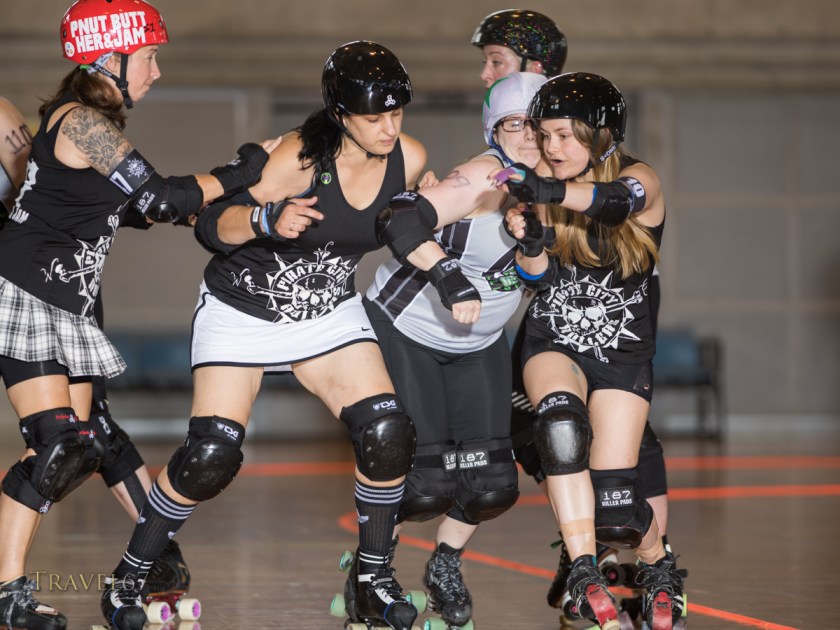
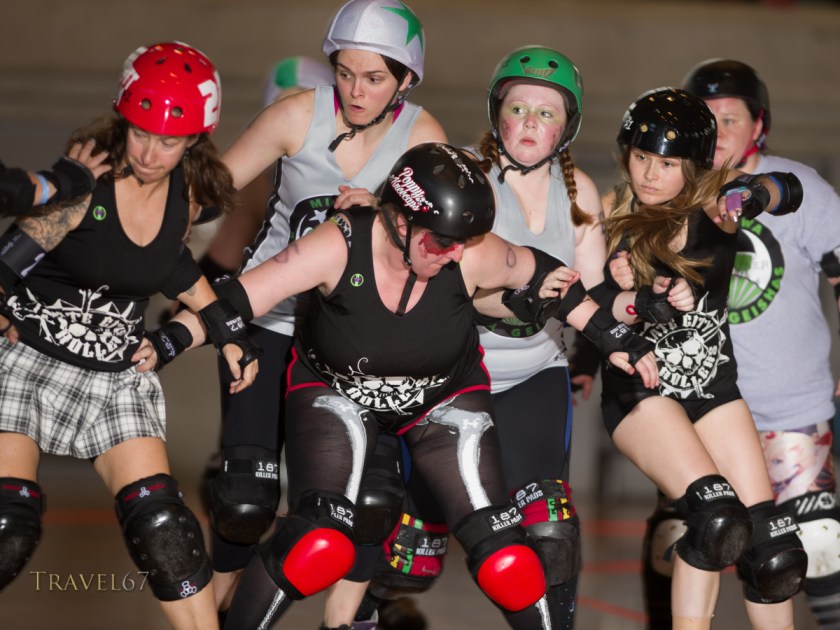
The Japan Open Roller Derby Tournament 2016 took place at Okinawa Comprehensive Park on March 25th and 26th. Here are a few pics from Saturday’s Pirate City v Misawa Killa Geishas.
This was the first time I’ve ever watched Roller Derby, so it took a little time before I could work out what was happening. Basically, the two teams of women on skates travel around a small flat oval track in the same direction. The teams get point by having their appointed “jammer” (wearing the star helmet cover) lap the oval. The rest of the team blocks the opponents jammer and assists their own jammer.
Player can’t use their hands, elbows or feet to block. So the teams often create a defensive wall , checking the jammer with their hips.
Contact, however, is fierce and the hits were hard. There are going to be a lot of sore and bruised players today.
Overall it was a great experience to watch and photograph. All the teams were great, but the Danish team Copenhagen dominated the matches I saw, and player 55 “Bay” seemed to be able to lap the track with the ease of a speed skater.
I shot using the Pentax 645Z, 300mm lens, Profoto B1 with the magnum reflector.
Huge thanks to Wendy and Andrea for inviting me to the event. Thanks also to the Roller Derby photographers Jonathan and Carlos for letting me shooting trackside with you.
Yoshitaka Taira, 10th dan World Matsubayashi-ryu (Shorin-ryu)
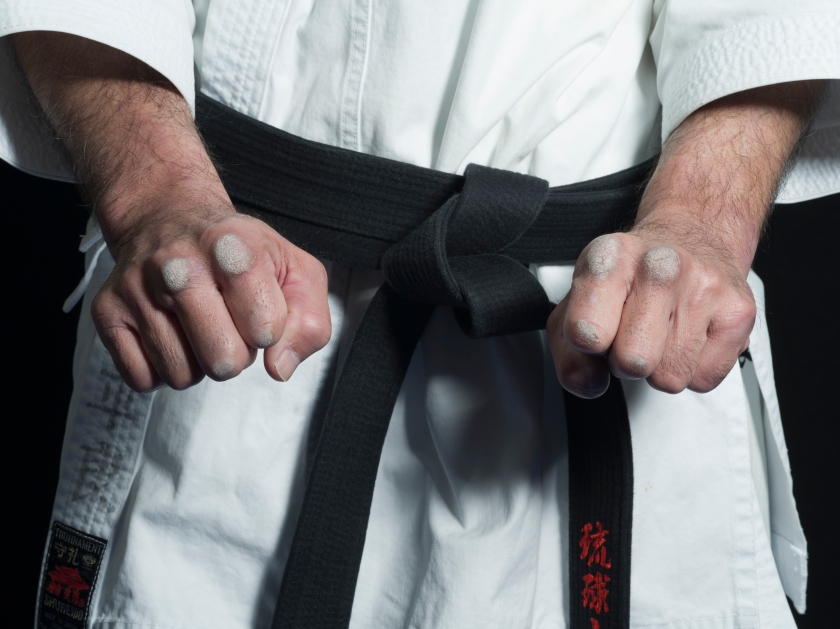
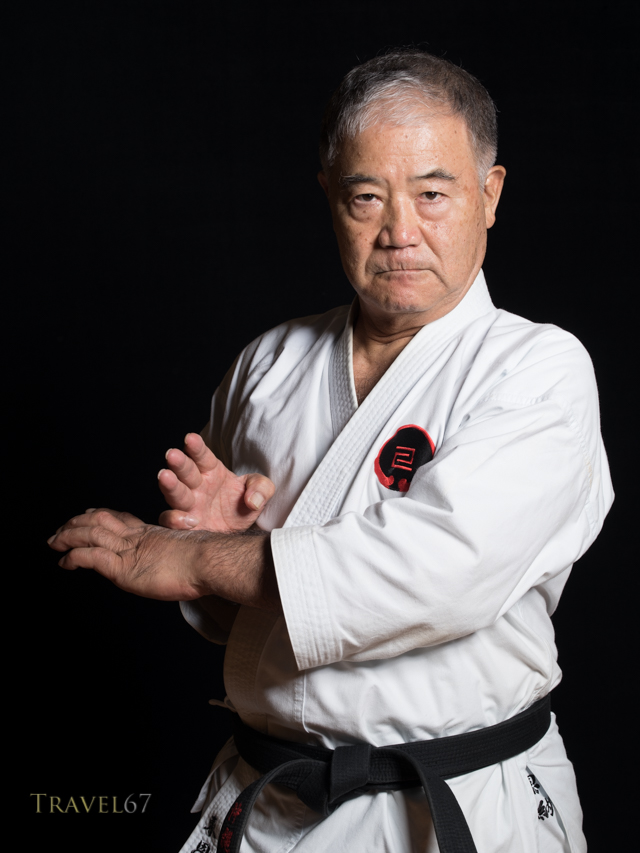
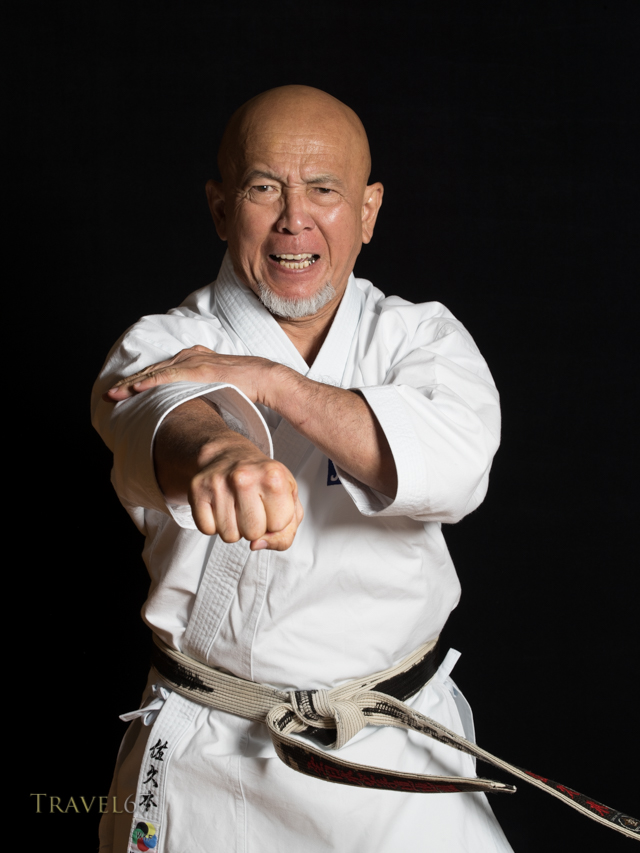
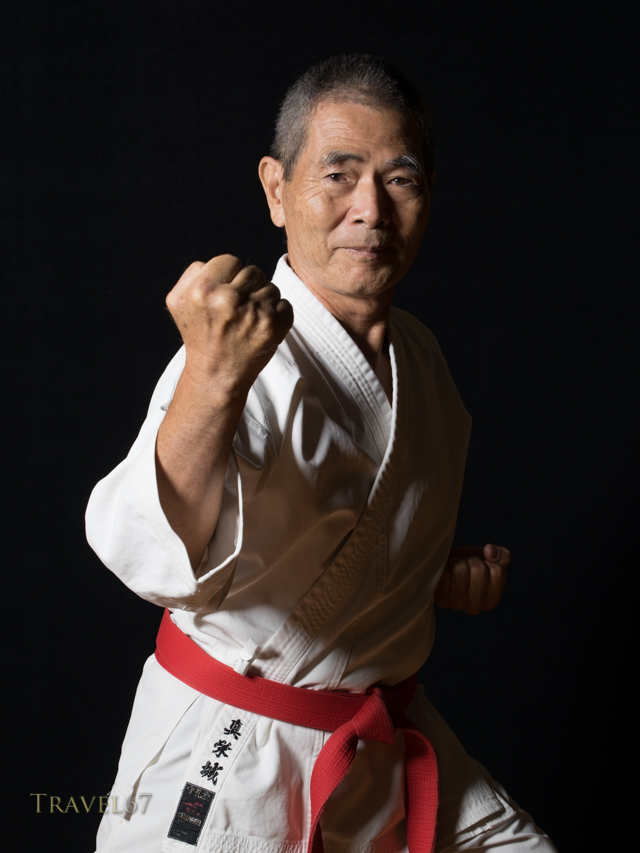
The Karate Masters Portrait Project began in March 2012. Its goal is to document karate and kobudo masters teaching in Okinawa at the start of the 21st Century. Their unparalleled knowledge of martial arts makes them of great cultural importance both in Japan and worldwide.
In 2012, James Pankiewicz, owner of the DOJO Bar in Naha, discussed with photographer Chris Willson how there were few, if any, good photos of certain karate masters. There was also little consistency in the images available. Many were blurry, low resolution, noisy, or simply snapped from a distance at a competition or demonstration.
2012年、那覇市内にある DOJO Bar のオーナー、ジェームズ・パンキュビッチは、フォトグラファーのクリス・ウィルソンと空手指導者の良い肖像はないかと話し合いました。
James and Chris began to take studio lighting, a black backdrop, and a high definition digital camera into the dojos of the karate masters. They hoped the portraits produced would become a historical record of the masters of Okinawan karate at the start of the 21st century.
The order in which they photographed the karate masters was not based on age, style or rank, but rather on slowly building up connections within the Okinawan karate community.
Images from the Karate Masters Portrait Project can be seen on the web at either Facebook or Flickr. However, Karate masters and their students around the world began to ask if we could produce a print book of the project. I decided to make the kind of book that I’d like to own myself. A large, high quality, coffee-table book with images of all 58 sensei that we’d photographed.
It quickly became clear that traditional publishers would want orders of several thousand books. Book production would simply be too expensive to undertake, and too risky if I couldn’t sell all of books. It might have even compromised the future of the project as I would have had to concentrate on being a bookseller rather than a photographer.
The solution was to use the U.S. print-on-demand publisher Blurb. I could create a large (11 inch x 13 inch) 122 page book and specify the use of high quality photo paper. Each of the 58 karate masters could have two pages of images along with their name, rank, and style in both English and Japanese.
2-page spread for Taira sensei.
I ordered a single test copy, it was shipped from the States to Okinawa. The test copy was then placed at the Dojo Bar where the karate masters were able to view it. A second test copy with higher quality paper was also ordered. This arrived and the “premium lustre” paper along with charcoal proline endpapers was a good improvement. Meanwhile James and I began contacting all the karate masters to double check the information in English and Japanese, and let them know about the progress we were making with the book.
Karate Masters Portrait Project Volume 1
After making the necessary changes to the text, I ordered another test copy. This arrived and a few more small changes were made along with the addition of a title page, copyright information etc. On November 29th the final version of the book was uploaded to Blurb, and it is now on sale!
After receiving your order Blurb will print your copy and can mail it worldwide. We do not plan to have a stock of books on sale in Okinawa.
The following page-by-page video allows you to check the exact photos in the book before purchase. You can also see a brief preview on the blurb website.
If a karate organization would like to gift a copy of the book to a particular master this is possible. We can order the copy, have it sent to Okinawa, sign it, and present it in person to the karate master from you. If you’d like to include a message with the book, then I can print out a message and place it inside the book. Please contact me at chris@travel67.com if this is something we can help you with.
—————————————————–
Each karate master photographed is given two prints for their own dojo as a thank you for taking part in the project. The pictures have been so gratefully received, and we’ve received many thanks from the karate masters and their families.
Handing out fine art prints as gifts to instructors at Naha’s budokan.
These prints of the karate masters are available to students and dojos around the world in two sizes.
11×16″ (A3) US$125 16X22″ (A2) US$175
Prints are created using archival quality Hahnemühle cotton rag photo paper and pigment inks. It is possible to make prints cheaper using generic papers and dye inks that quickly fade, but I only want to produce the best possible product. This may seem obsessive, but striving to achieve perfection is not just my goal, but is perhaps at the heart of every stance or kata. My hope is that they will take pride of place in dojos around the world.
Prints are shipped flat rather than rolled, and are mailed using insured and traceable international express airmail shipping. Images are usually dispatched within one week of ordering and delivery takes around 4 to 7 days. Shipping is US$25 dollars per order. Prints may also be collected from The DOJO Bar in Naha, Okinawa. Please email chris@travel67.com to discuss which prints you would like to purchase. Payment is via Paypal.
—————————————————–
At the request of some dojos, we now also offer the full resolution digital files of a single image or the best shots of a particular shoot. Purchase of the digital files gives you permission to make prints for personal usage. ( You can’t sell the digital files on to others, or use the images for purposes other than prints for yourself or your dojo. If you have questions regarding this please email and ask.) As the images are shot with medium format digital cameras (40MP & 53MP) it is possible to make very large prints.
Digital Download of Full Resolution Files
Single Image US $100
Set of Images of a Master US$500
Purchasing a print or digital files, not only helps fund the Karate Masters Portriat Project, but a portion of the fee will be given to the karate master in the purchased image(s) to help maintain their dojo.
—————————————————–
If you are a magazine or organization interested in licensing the images please contact me at chris@travel67.com with your questions. Permission to use an image for non-editorial purposes will not be given without the specific consent of the karate masters.
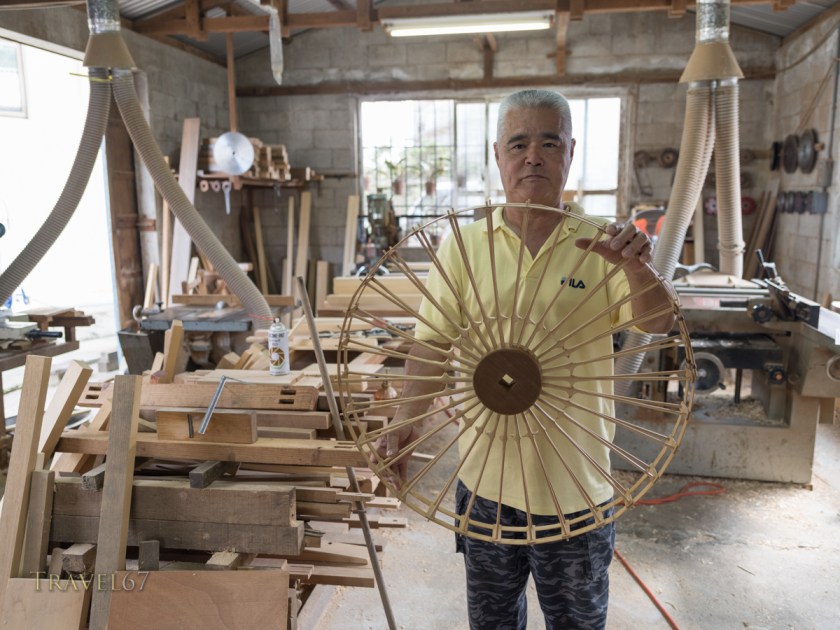
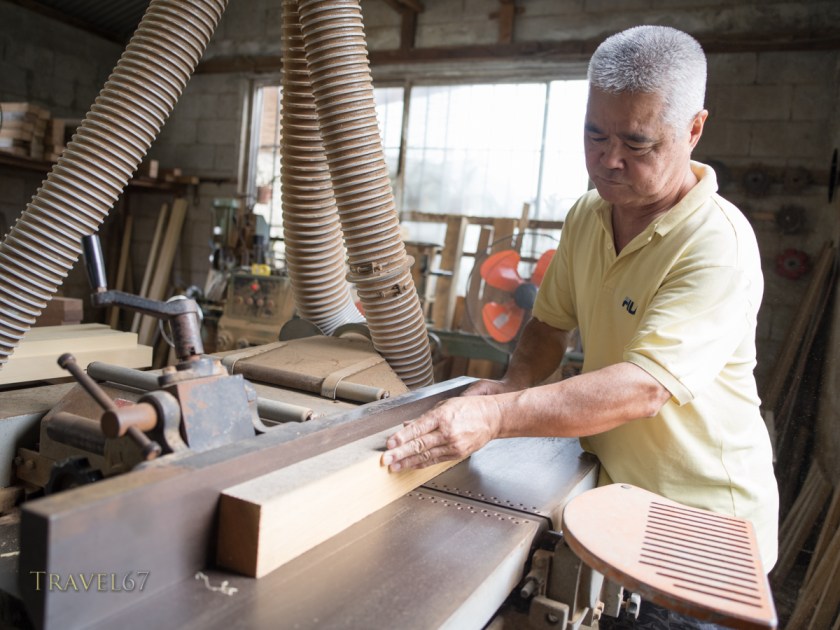
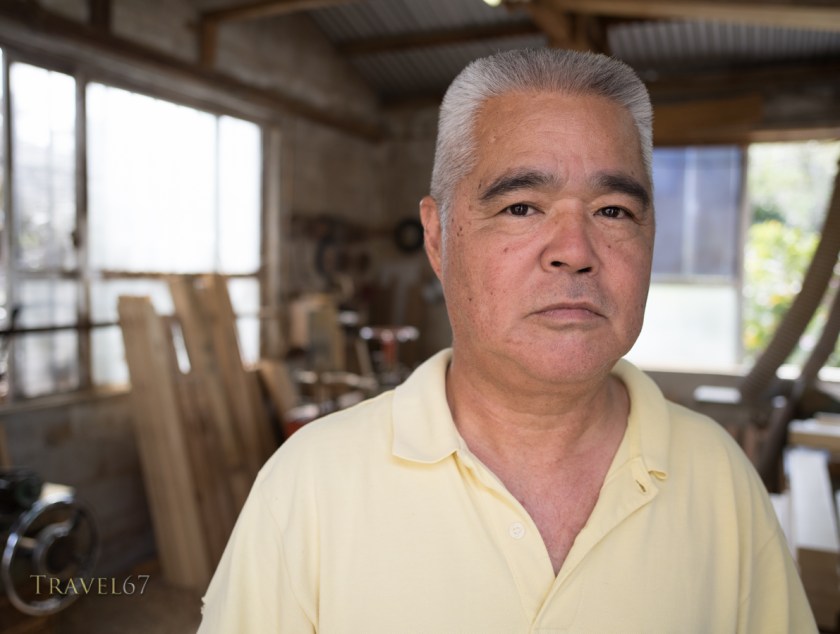
A new project I’m working on is documenting Okinawa’s traditional textile industry. Oshiro-san makes looms, shuttles, spinning wheels and other equipment from his workshop in Haebaru.
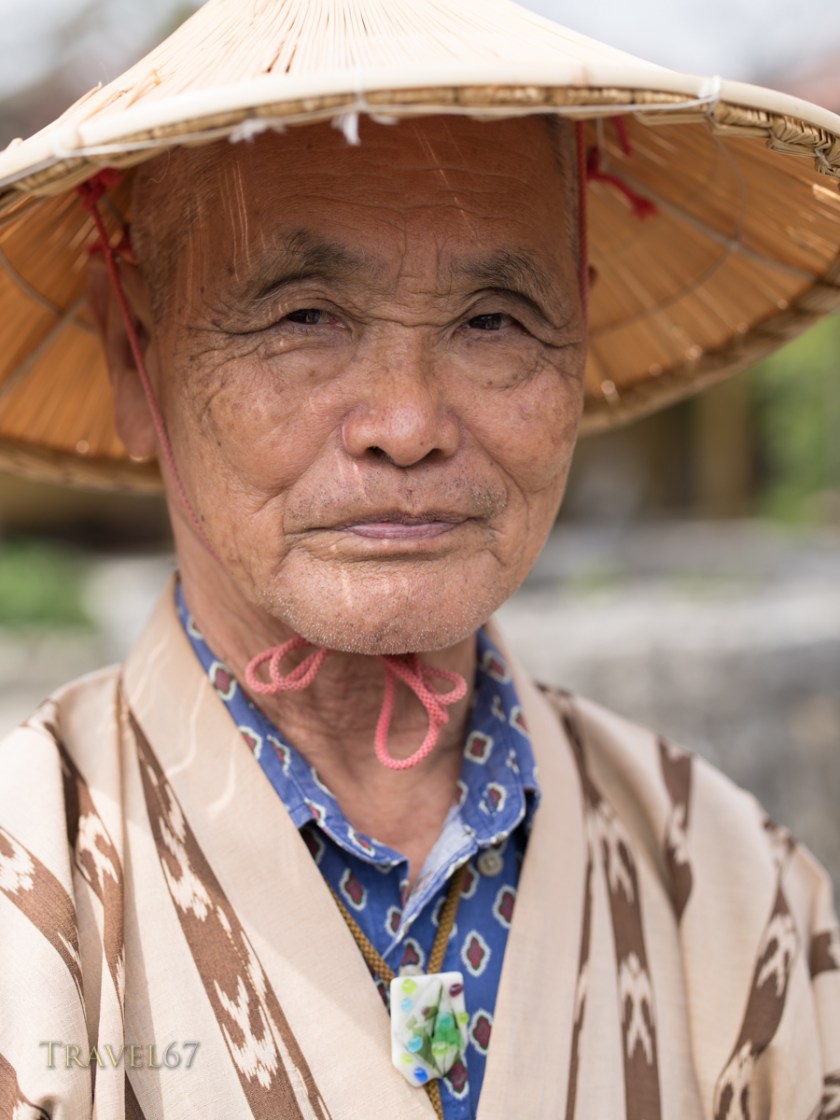
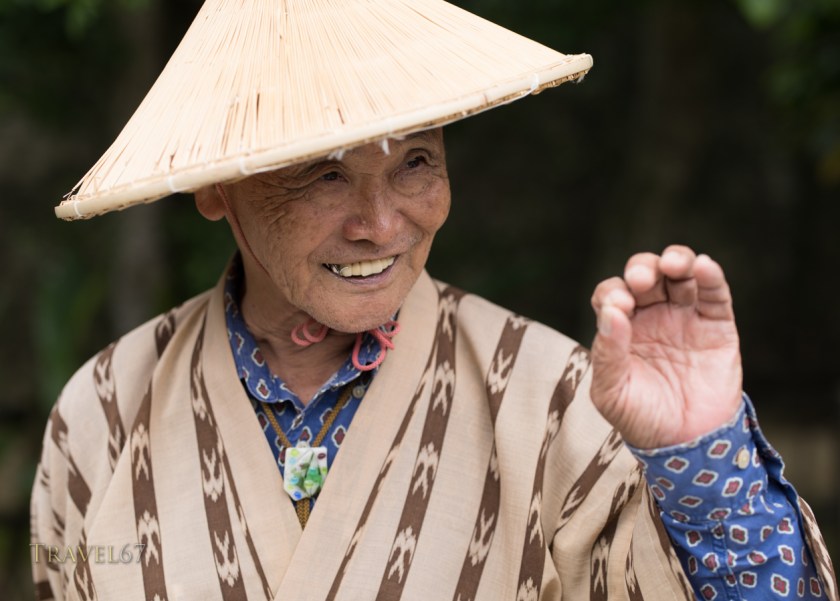
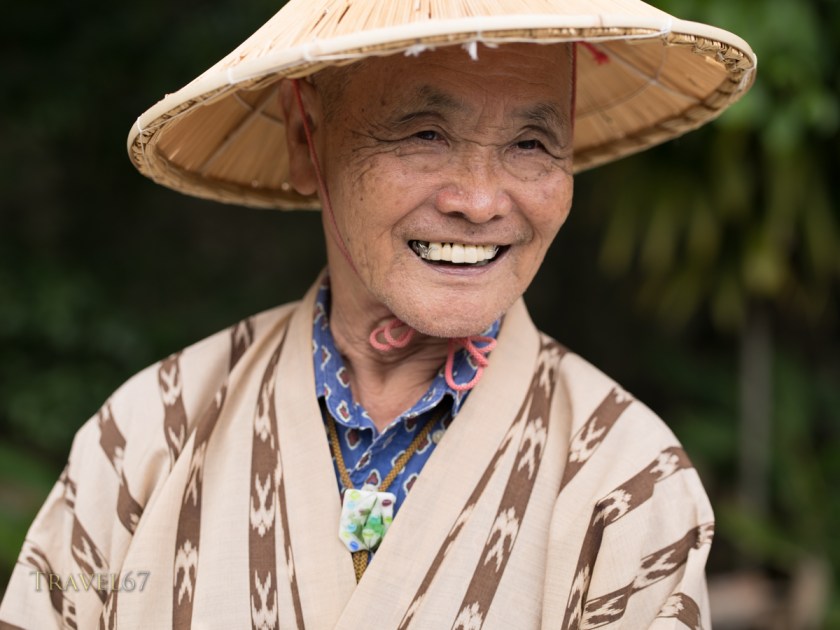
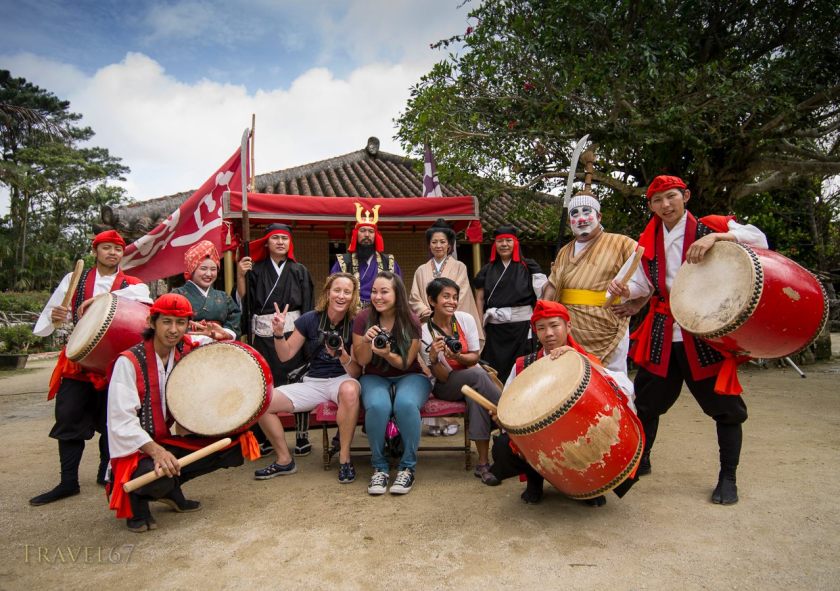
Today was the second day of the North & South intermediate level photography workshop. We shot at beaches, a waterfall, a cave, and a world heritage site, but the highlight was meeting Jahana-san.
Full of smiles, laughter, and information about how and why people used to poop into the pig pens, Jahana-san was a delight to chat with and photograph.
80 years young, he asked where all the members of our group were from and explained he’d visited Mexico last year, Cambodia last month, and hoped to go to Canada before his legs gave out. Legend 🙂
Thanks to Anna, Liesa, Kevin and Yuki for an awesome weekend.
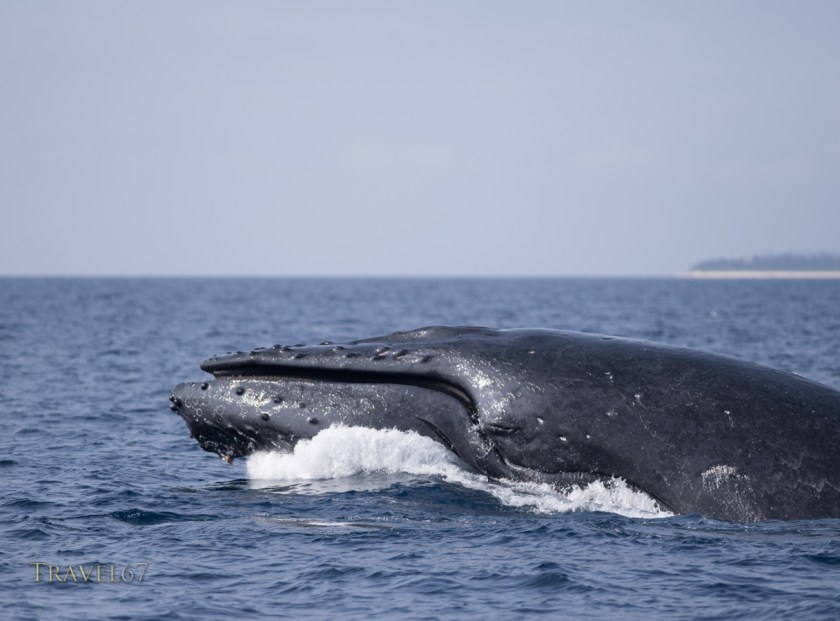
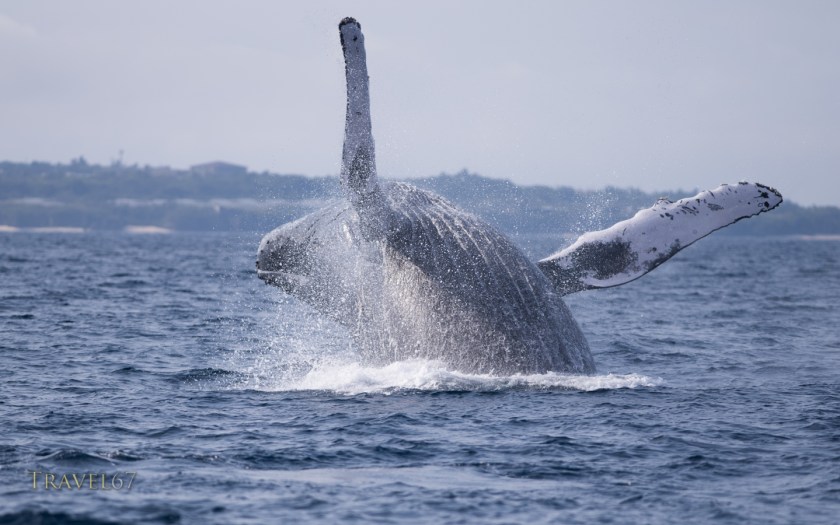
Out today with the Churashima Research Center taking pics from their research boat. A much happier occasion than photographing the carcass of a whale that had died and then washed up on the beach.
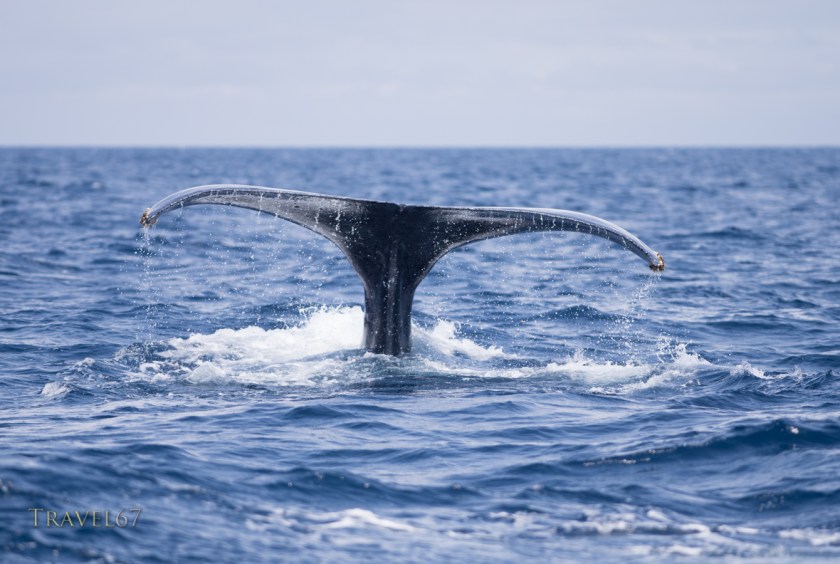
We were in the waters of the coast of Motobu not far from Sesoko Island. We saw around 20 whales in total, but it was the first mother and calf pair that were the star performers.
The whales slapped the surface with their long pectoral fins, and perform breaches before crashing back down onto the surface of the water.
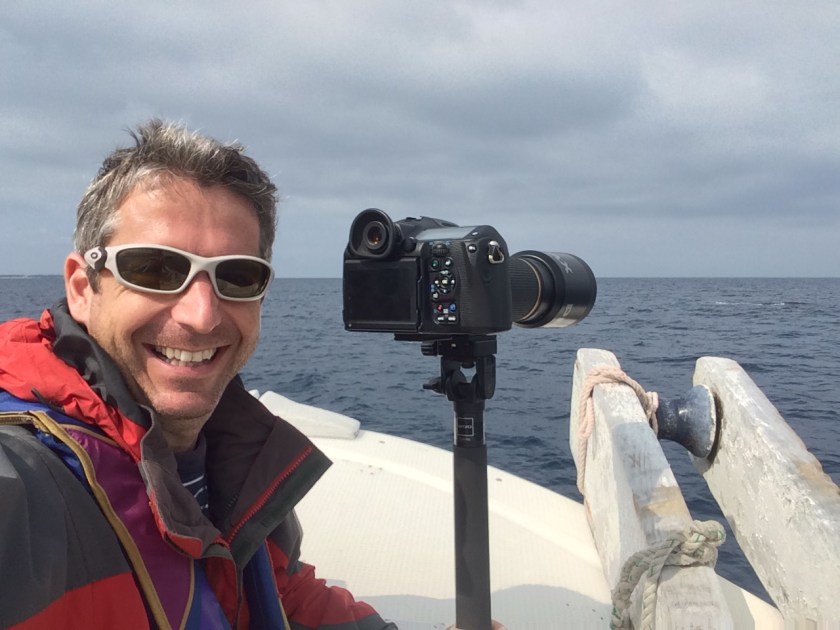
Pics shot with the Pentax 645Z and a 300m lens. Used a monopod to take the strain off my arms. Shot at ISO 400 so that I could use shutter speeds between 1/2000 and 1/4000 of a second.
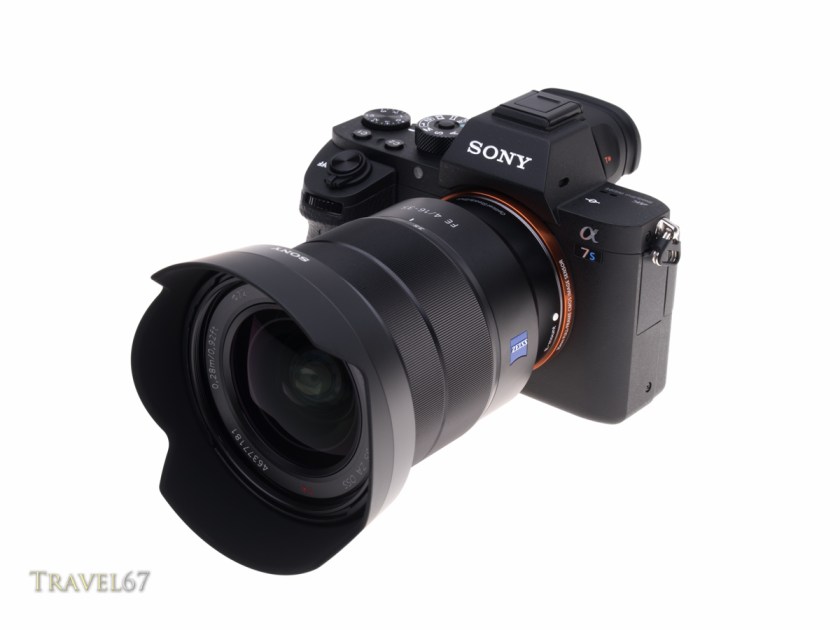
Although my current cameras can record HD 1080 video, if I’m specifically working with video on a project I want to be able to shoot footage at 4K. There are a wide range of cameras that can shoot 4K from a GoPro at a few hundred dollars to cinema cameras at a few hundred thousand. After looking at the options, and discussing things with my friend Jon Galione, I bought a Sony A7S II that will allow me to start shooting 4K internally and produce high quality footage.
Just in the testing phase at the moment, but here’s a few seconds shot with the A7S II and a Rokinon 85mm lens.
The March 12/13 Fundamentals workshop is now full. If you were hoping to take this class, but missed the chance don’t worry, and please join our May, June, July, or August workshop.
Pete Leong and I have scheduled an 1-day Off Camera Flash workshop for May 21, 2016. We’ll be showing you how to add a little magical light to your images using cheap and cheerful wireless speedlights. You don’t need to have a flash to join the class, in fact if you don’t have one already, I’d highly recommend waiting until you’ve taken the class.
The Facebook event page for the Off Camera Class is here:
Another shot from the Nakijin shoot this time using a simple reflector to bounce some light back onto Yuki. You still have clear shadows caused by the early afternoon sun, but the reflector is enough to keep them in check on the subject’s face. You don’t however get the clear catchlights that you would have got with the flash.
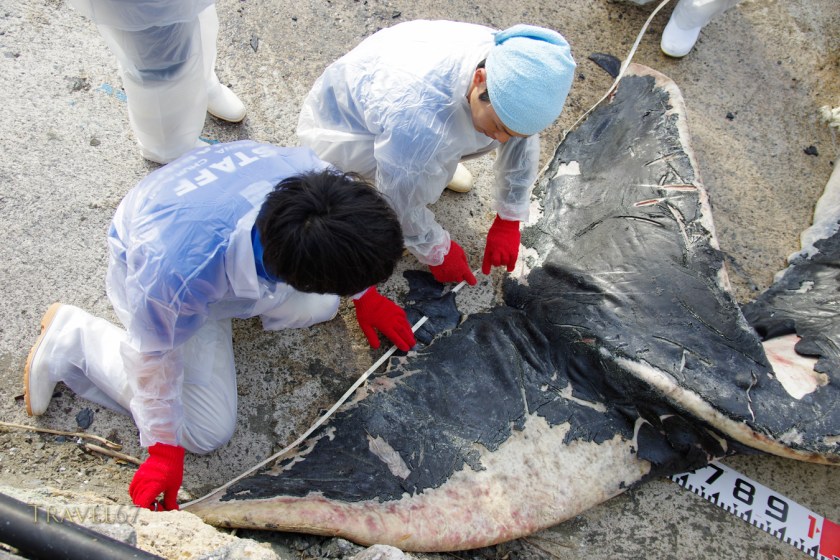
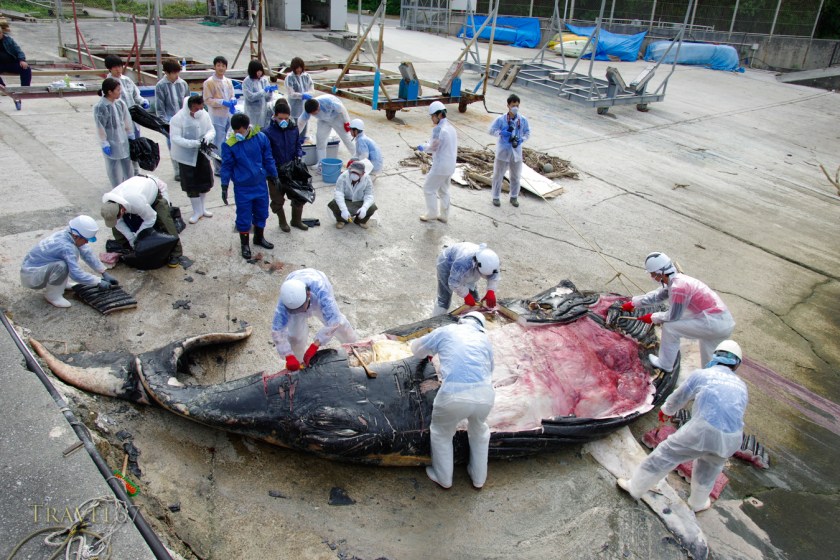
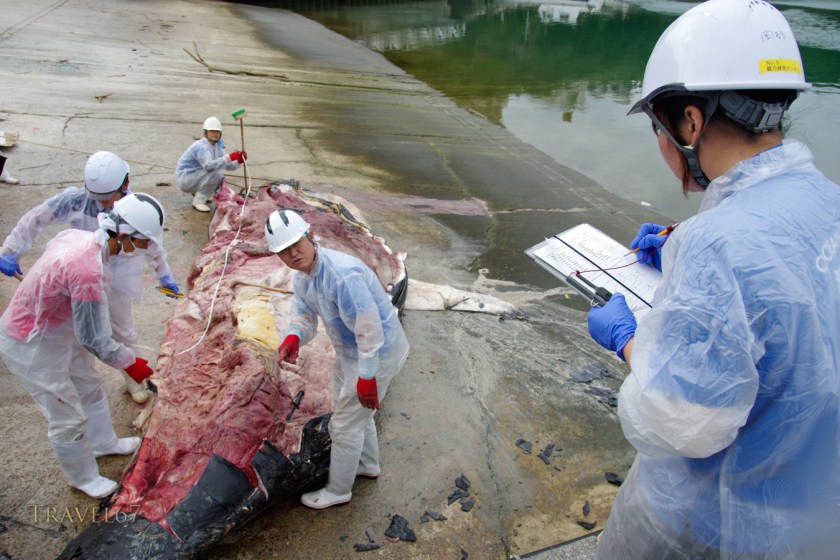
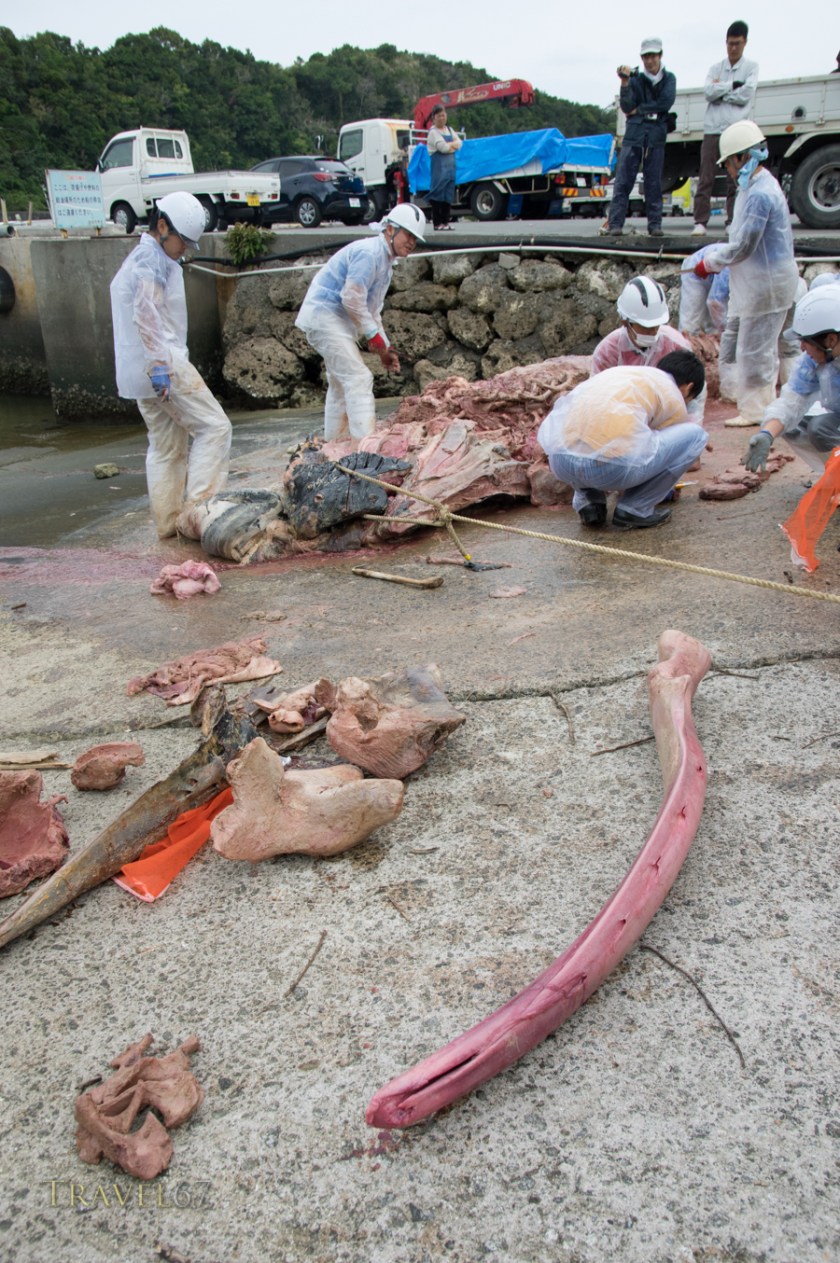
Dissection by Okinawa Churashima Research Center of young humpback whale that beached near Kadena, Okinawa, Japan. 19/02/2016
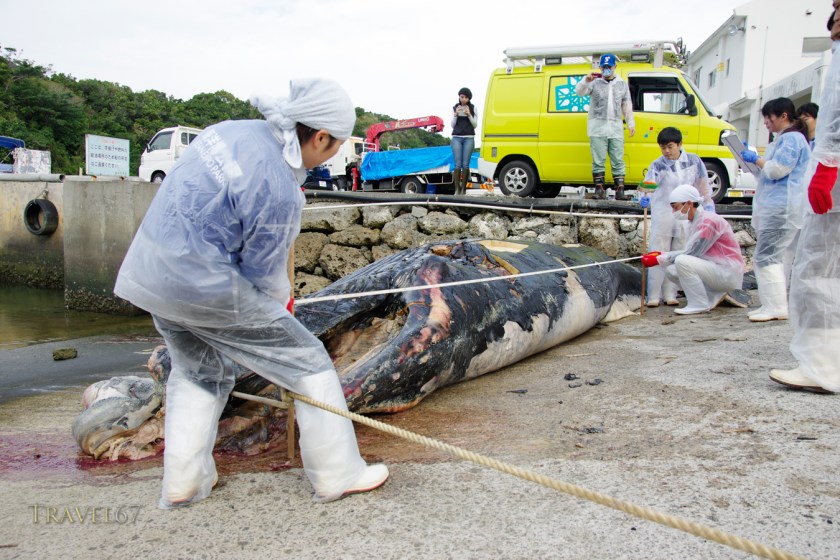
A dead humpback whale washed up near Kadena a few days ago. Humpbacks migrate from the arctic to Okinawa to breed and rear their young in winter. Unfortunately for this young whale its life ended early.
Dissection by Okinawa Churashima Research Center of young humpback whale that beached near Kadena, Okinawa, Japan. 19/02/2016
Okinawa Churashima Research Center monitors the migration of humpback whales and dolphins in the prefecture and also undertakes research to help with the preservation of endangered species such as the Hawksbill turtle and coconut crab. They also collect data from dead animals such as turtles killed by cars, bycatch from fishing nets, or beached whales.
Dissection by Okinawa Churashima Research Center of young humpback whale that beached near Kadena, Okinawa, Japan. 19/02/2016
This morning the researchers undertook an necropsy (animal autopsy) of the humpback whale. The length of the whale, flukes, and various others parts were measured.
Dissection by Okinawa Churashima Research Center of young humpback whale that beached near Kadena, Okinawa, Japan. 19/02/2016
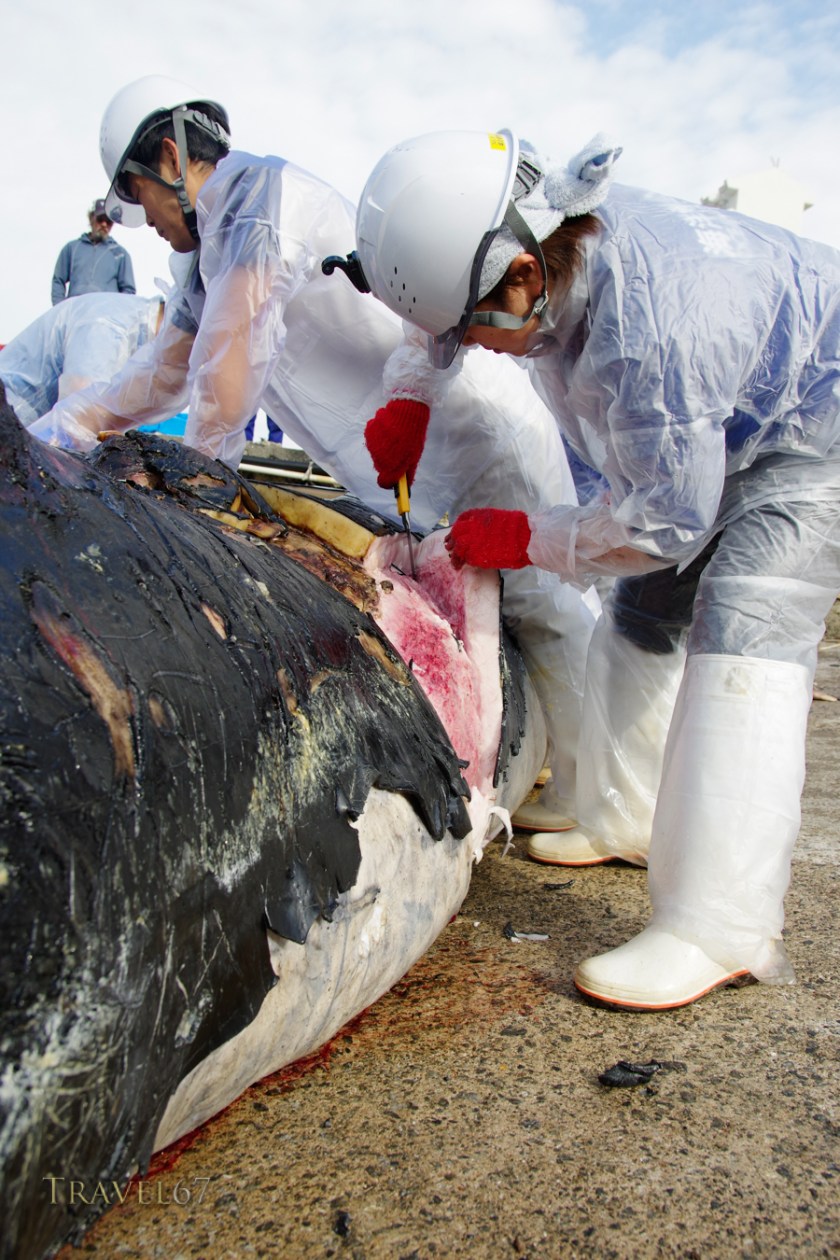
The outer layers of blubber were then cut away, measurements were taken, and the flesh was bagged for disposal.
Dissection by Okinawa Churashima Research Center of young humpback whale that beached near Kadena, Okinawa, Japan. 19/02/2016
The decomposing whale smelled badly especially downwind.
Dissection by Okinawa Churashima Research Center of young humpback whale that beached near Kadena, Okinawa, Japan. 19/02/2016
Dissection by Okinawa Churashima Research Center of young humpback whale that beached near Kadena, Okinawa, Japan. 19/02/2016
Dissection by Okinawa Churashima Research Center of young humpback whale that beached near Kadena, Okinawa, Japan. 19/02/2016
As more and more of the whale was removed and bagged, the bones were also measured, and collected separately. After analysis the data will hopefully give some insight into why the whale, which they estimated was around 1 year old, died.
Dissection by Okinawa Churashima Research Center of young humpback whale that beached near Kadena, Okinawa, Japan. 19/02/2016