This is a compilation of blog posts about my experience getting laser eye surgery in Japan.
Short Version:
I used glasses and contact lenses for 20 years. In 2013, I decided to get Laser Eye Surgery. I had iDesign iLASIK at the Kobe Kanagawa Clinic in Shinjuku, Tokyo. Procedure went great. I now have excellent vision, better than 20/20. Hoorah.
In 2020 the Kobe Kanagawa Clinic changed ownership and the clinic is now focused on other procedures. Richard, who helped me now works at the Shinagawa LASIK center which is a great option for English speakers in Japan.
Shinagawa LASIK Center
Richard set me up with a referral system for the Shinkawa LASIK Center so readers of my blog can get up to 50,000 yen off. Just message me and I’ll send you a referral discount coupon.
Long Version:
I got my first pair of glasses when I was about 13. At age 16, I started wearing contact lenses, and glasses became a last resort. For the next 20 years I used contact lenses pretty much everyday.
I’ve journeyed around the world with a wash kit containing vials of lens cleaner, saline, spare lenses and backup glasses. In the grand scheme of things, having to wear contact lenses is a mild inconvenience rather than a burden, but I really wished I could simply fix my eyes.
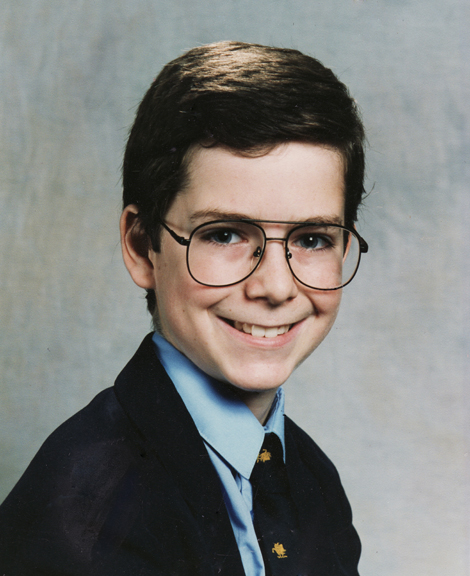
Glasses at age 13, attending The Manchester School of Witchcraft and Wizardry.
Laser eye surgery, LASIK, has been around since the 90s, but the cure seemed to come with too many possible side effects. Cases of patients no longer being able to drive at night due to haloing and glare sounded a little too common to be worth risking my own vision. For me to undergo LASIK it would have to give great results with minimal risk. I’d want the latest generation of equipment, used by a team that does enough procedures for it to be routine.
Over the past few years, several of my Japanese based friends have had LASIK. Some went overseas to the States, the UK or Thailand, a few had it done locally in Okinawa, while others travelled to mainland Japan. I decided to look into the various possibilities and one procedure, and one clinic, seemed the best option for me.

iDesign iLASIK as used by NASA
The latest version of LASIK is called iDesign iLASIK and the blurb sounded impressive. “iLASIK® is IntraLASIK + CustomVue Treatment, was based on the approval of Laser Vision Correction treatment by the United States Department of Defense and NASA-National Aeronautics and Space Administration and approved for use by their Air Force, Navy Pilots and Astronauts.” The procedure is customized to an individual’s eyes so the results in terms of clarity and recovery are better. It is more expensive than standard LASIK but I’d already made the decision that for me as a photographer the quality of the result was more important than the cost.
In 2013 the Kobe Kanagawa clinic had seven clinics in Japan, but only the Shinjuku and Kobe branches are able to perform the latest iDesign surgery. The Shinjuku clinic turned out to be just around the corner from the Pentax Forum in Tokyo where I’ve had several group and solo photo exhibitions so I knew the area well.
I contacted Richard Masuda who was in charge of international relations at the clinic. Richard’s a bilingual Canadian so was able to answer my questions and arrange an appointment for me. I requested to do the eye consultation and then surgery on the same day, and was booked in for December 27th, 2013. I had to stop wearing contact lenses at least 4 days before the operation, so I was back in glasses when I flew up to Tokyo on the 26th.

Now in the system!
At 11.30AM I arrived and was given my appointment card. I then filled out the forms (provided in English) for medical history, types of sporting activity, desired procedure etc.
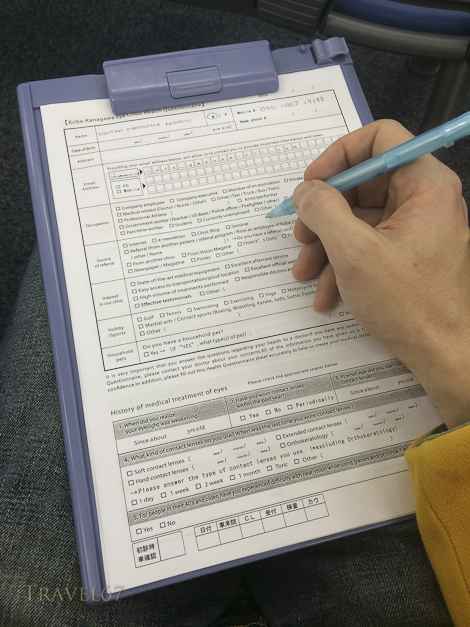
Medical History Check
Kitsunai-san the examiner then took me through a comprehensive series of eye tests. Along with the usual optometry tests to determine visual acuity, degree of myopia and astigmatism, they also tested radius and curvature of the cornea, intraocular pressure, thickness of the cornea, the radius of the pupil, and using WaveScan technology the tiny aberrations in the eye.

Mr. Kitsunai the examiner
Next the staff put some drops in my eye to dilate the pupils. This took a few minutes to kick in, and when it did my distance vision went blurry and my eyes became more sensitive to light. Dr. Kubo checked my eyes, and said I was good to go.

Dr. Kubo the consultant
A staff member and Richard then ran through the iLASIK procedure with me, and the various eye drops I would need to used over the following days. I also paid for the treatment. Premium iDesign LASIK is 380,000 yen for both eyes, but I got a 10,000 yen discount as I travelled from outside of the local area, and a 30,000 yen discount for giving a friend’s referral number. Total cost 340,000 yen. It was now around 1pm and I was booked in for surgery at 3pm. I went and had some lunch while my eyes returned to normal after the dilation procedure. Just before 3pm I returned, had a final check, anesthetic drops were put in my eyes, I took a pain tablet that would kick in later, and I was ready to go.

Richard Masuda & I just before surgery.
I put a gown over my t-shirt, a hat over my hair, changed into slippers then went into the surgery part of the clinic. I took off my prescription glasses (for the final time) posed for a photo with Richard and then went into the operating room. Richard also came into the room to help translate.
The whole surgery took less than 5 minutes. The room was dimly lit, there was a recliner, various machines, and the surgical team led by Dr. Shiba. I lay down, they put a strap on my forehead to stop movement and a nurse rested her hand on mine. The surgeon put a speculum on one eye to hold back the eyelids then swung the iFS Femtosecond laser machine over my head. I stared at the dot and in a few seconds the laser cut a flap in my cornea. The first machine was swung away and the Excimer laser swung in. I stared straight ahead, and the surgeon lifted the flap in my eye. Things went a little dark for a second, then I was looking at a rather blurry red dot. The laser started, and for about 10 seconds the surgeon said something along the lines of that’s great, just look ahead, nearly done, perfect. The flap was replaced, the speculum switched to the other eye, and the procedure repeated. A couple of minutes later I’m done and walking out of the surgery. It was a little hazy, but I could already look around and see. I change out of the gown and hat, put on my shoes and walk back into the waiting room. I’m given a pair of glasses with clear lenses to protect my eyes from dust and fingers etc for the first week. Richard runs through the procedures with the eye drops and pain medication another time, gives me his personal phone number just in case, and I’m done!

Protective glasses after surgery
It’s a 15 minute walk from the clinic back to my hotel. On the way back my eyelids start to get really droopy and tears start to flow. There’s no pain, but I do feel like I’ve been hit by a tranquilizer dart. It’s clear why you shouldn’t drive on the same day as the procedure. I get back to the room, put in the three different eye drops and fall asleep still wearing my new protective glasses. I awake a couple of hours later, it’s now 7pm. I look out of the window and see the neon lights of Shinjuku. I burst out laughing. Everything is really sharp. I feel like the Six Million Dollar Man.

Eye Drops – Prevent Infection, Prevent inflammation, Prevent dry eye
Later that evening, an hour before going to sleep, I put in the eye drops again. I have some weird dreams. I keep waking up and staring at two tiny green lights on the smoke detector above the bed. I’d never noticed them before. I’d never been able to see them before.
At 11.40AM I am back at the clinic for my 1-day check. The day before without glasses I couldn’t see the chart, I got a score of 0.06. Now I could read the second to bottom row with each eye, and with both eyes open I could just about read the bottom row of comically small symbols. I now had 1.5 or slightly better in each eye. (20/20 vision is 1.0) I chat with Richard again, I have no pain and I can see great. The only worrying thing was that when I walked passed a mirror the new glasses made me look like the elderly guy from UP.
=====================
A week after my operation I flew up to Osaka for the 1 week check-up. I could have returned to the Shinjuku office in Tokyo, but as I could do this at any of the clinics, I thought I’d spend a couple of days in Kyoto and get my check in Umeda, Osaka.
At the clinic, with either eye open I could read the second to bottom line on the chart. With both eyes open I could just about make out all the symbols on the bottom line. Awesome.
I was back in the waiting room for a couple of minutes then in to see the eye doctor. He checked the health of my eyes, confirmed that the cornea had completely sealed and asked if I was having any problems. He explained about the new eye drops I would have for the next few weeks and that I had another checkup at the end of January. I picked up my new eye drops from reception (there are no fees for any post-op checks or medications) and I was done. Total time less than 15 minutes. Hoorah.

LASIK 1 week check
It’s now been about 2 weeks since I had the operation. Here are a few things I’ve noticed or realized.
– I’m saving a couple of minutes every morning and evening not having to put in or take out my contact lenses, rinse, fill the container with solution etc. That’s 4 minutes a day or 24 hours a year in extra time.
– When I wake in the night I still rummage around on the nightstand looking for glasses until I realize I can actually see.
– This led me to the conclusion that in the past if there had been a natural disaster at night, and I couldn’t find my glasses, I’d be trying to deal with the aftermath of a tsunami or earthquake while being partially blind. I hadn’t even considered this as a good reason to get LASIK but now it seems obvious.
– There is mold on the ceiling in my bedroom, tiny black specks all over the white paint. Hadn’t noticed it before. Must clean the house.
=====================
Last weekend I flew back up to Tokyo for my 1-month checkup.

New eyes, same silly faces.
As with my previous visits things went very smoothly. I filled out another questionnaire in English asking if I’d have any problems at all. I then met with an examiner who tested my vision. I could read the bottom line of the chart with both eyes open (2.0) and when using just one eye I could make out most of the tiniest symbols.

Final eye checks
After that Dr. Takahashi checked the health of my eyes and gave me the all clear. I can now start scuba diving again. I have some drops to use if my eyes feel dry at any point, but this was my final obligatory check.

Eye check by Dr. Takahashi
Finally Ogata-san gave me a quick interview about my experience at the clinic. Richard Masuda, the international relations staff member, was there to help translate, answer any questions, and in this case take photos.

Final interview with Ogata-san
=====================
It’s now been about six months since surgery. Back in March I was overseas photographing the temples and monks of Angkor Wat, most days I was up before the dawn so I could make use of the best light. Not having to put in contact lenses at 5AM while you’re half asleep was a delight.

Sunrise over the rice fields near Banteay Srei Temple, Cambodia
I’m also scuba diving again, and now don’t had to worry about the possibility that I’d lose my contact lenses when removing my mask underwater. Of course disposable lenses don’t cost much, but losing lenses and then having to make a shore exit through surf would be a real issue.

No contact lenses, no problem.
While in Tokyo in August, I’d stopped by the Kobe Kanagawa Eye Clinic in Shinjuku for my 6-month eye check after Lasik. ( 8 months after the op.)
First, I did a standard eye test. I could read the bottom line with my right eye, the second to bottom line with my left eye, and the bottom line clearly with both eyes open.
My eyes were then checked by the doctor, and I was given the all clear. Awesome.
I can go back to the clinic if I ever have any concerns, but that was the final regularly scheduled check-up.

Everything’s good. 6-month check
UPDATE: 1 year since the operation. No problems whatsoever!
I have been really pleased with the experience, and now recommend the procedure to friends and family. Lasik isn’t cheap, but it definitely feels like you are making a good investment in your health and quality of life. Of course there are many different procedures available and I’ve only had experience of iDesign iLasik, so if you’ve got general questions check out the website and send them an email.
UPDATE: 2 years since the opeartion. My eyes are great. Seems like a very long time ago since I wore contacts. Richard Masuda has left the Shinjuku branch of the clinic but they still take English speaking patients.
UPDATE: 3 years since the operation. No problems at all. Busy living life. Got married, bought a house in Okinawa. Happy.
UPDATE: 4 years and six months since I had Lasik. No problems at all. Yuki and I would like to introduce you to 4-month-old Jasmine. Having a baby is fantastic. It also means you have less time, less sleep, more colds, and more responsibilities. All the advantages of having had Lasik have now been magnified. So glad I don’t have to mess around finding glasses in the middle of the night, or dealing with contact lenses and poopy diapers while half-asleep.

UPDATE: Almost 5 years since LASIK. I was up in Shinjuku (Tokyo) for a meeting with Pentax so thought I’d pop around the corner to the Kobe Kanagawa Eye Clinic for a quick eye check. Still can make out the bottom row of the chart with both eyes open 🙂
UPDATE: Approaching 7 years since LASIK. Eyes are doing great. I’m 44 years old now so I’m probably going to be needing reading glasses in the next few years, but my distance vision is perfect. In 2020 the Kobe Kanagawa Clinic changed ownership and the clinic is now focused on other procedures. Richard, who helped me now works at the Shinagawa LASIK center which is a great option for English speakers in Japan.
Shinagawa LASIK Center
Richard set me up with a referral system for the Shinkawa LASIK Center so readers of my blog can get up to 50,000 yen off. Just message me and I’ll send you a referral discount coupon.
Want even more information? You can also check out my post
10 life changes since getting LASIK