Latest Posts

On the bookshelf – Travel Photography by Steve Davey

Travel Photography by Steve Davey

Travel Photography by Steve Davey

Travel Photography: Tread Your Own Path by Steve Davey is an excellent book. The photographs are good both by technical standard and subject matter. The book has a logical structure and the writer is able to make complicated subjects understandable and interesting. The start of the book is about choosing gear (camera bodies, lenses, bags) and some general advice on travel.  The “Execution” section covers the basics of how to take photographs (exposure, aperture, shutter speed, filters, flash) then the “Inspiration” section applies these techniques to situations you will find in the field (cities, festivals, markets, deserts). He then follows this with “Correction” a section on image processing, correction and manipulation (published in 2008 – this is still up to date). The final chapter is about working as a professional travel photographer and deals with issues such as copyright and marketing.
The amount of information covered by the book is both its greatest asset and its greatest weakness. If you’re already a Photoshop whiz then the correction section will be redundant, while experienced photographers will be well aware of most of the information in the execution section. I am sure however that even the most experienced photographer will find numerous interesting nuggets of wisdom, and for the beginner or intermediate photographer the book is well worth the price.

Extreme Close-Up

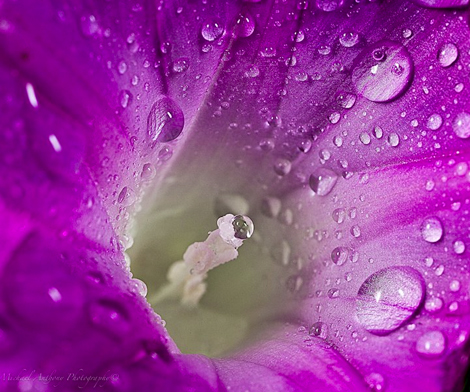
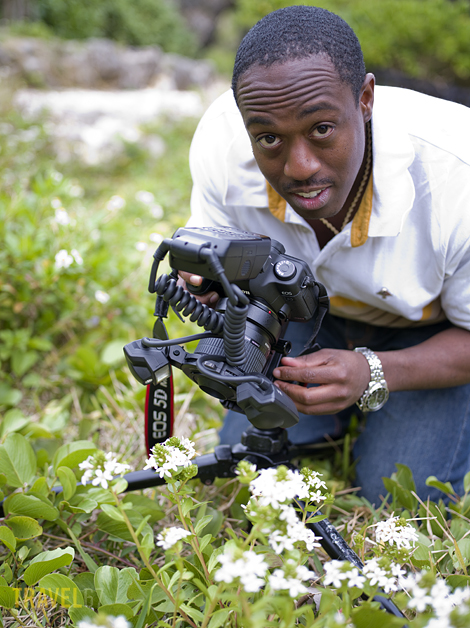
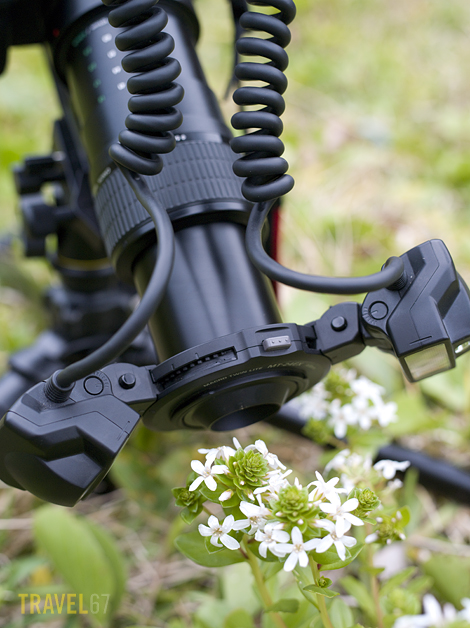
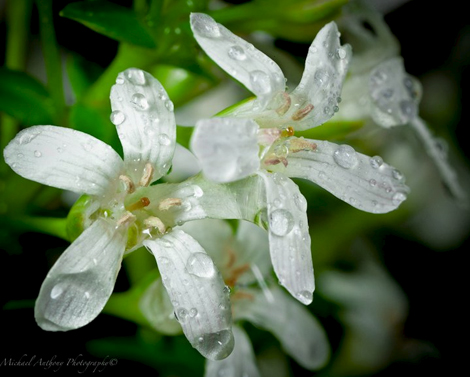
Met up with Pete Leong and Michael Anthony yesterday at the beach. I was really interested in the setup Michael used to get extreme close-up shots of flowers.  The images Michael was creating were fantastic. I’m going to follow some of his advice and ideas and try shooting some flower close-ups in the next few weeks.

Michael Anthony getting up close and personal

Canon 5D Mark II, MP-E 65mm Macro lens with macro twin flash.

Flower Macro by Michael Anthony (1)

Flower Macro by Michael Anthony (2)

Beware the Habu

Habu Snake warning sign

Beware the Habu Snake

Habu ( Trimeresurus flavoviridis ) are poisonous pit vipers found on Okinawa. As with most snakes they keep to themselves so you’re very unlikely to see a habu in the wild while on Okinawa. Unfortunately you are likely to see one sitting at the bottom of a bottle of Awamori (Okinawan Sake). Similar to the worm in a bottle of tequila the snake is thought to give the alcohol an extra kick.

Another interesting fact about the habu is that in 1910 someone made the decision to import Indian Mongooses into Okianawa to control the habu population. The mongoose has now become a serious pest on Okinawa, killing and eating virtually every native creature on Okinawa, except for… the habu.

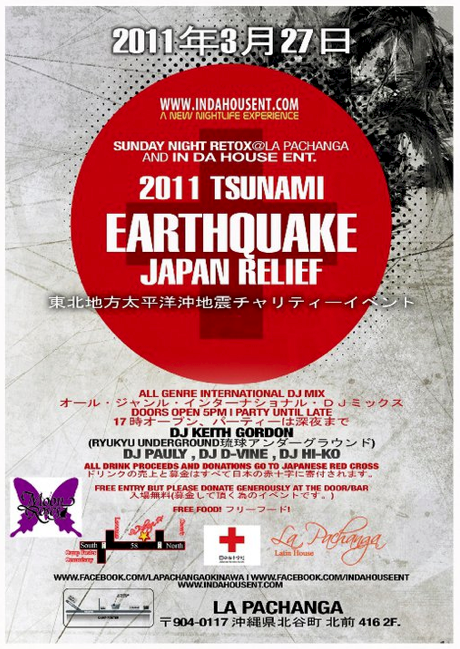
Donations to Japanese Red Cross

Some readers have been asking where they can make donations.

Information on making donations can be found at the website for the JAPANESE RED CROSS SOCIETY . Those in America will probably find it easier to make donations through the AMERICAN RED CROSS .

Not sure about the situation with regards to donations of clothes and blankets. For those in Okinawa I believe that they are making collections at some of the bases.

I’ve decided that during March and April I shall be giving 20% of the sale price from my prints of Japan to the Japanese Red Cross Society. This applies to any of my photographs sold through my website or through the Kadena Gift Corner on base.

As mentioned in previous posts, if you have relatives in Okinawa they are fine and well out of harms way. Thoughts should go out to those around Sendai. Radiation concerns seem to be getting all the attention in the news, but there are still thousands of people without homes or enough food and water.

Radiation on Okinawa

I’ve had a few emails and comments asking whether Okinawa is affected by the radiation leaks from the nuclear power plants in Fukushima.

Short Answer: NUCLEAR RADIATION LEAKS DO NOT AFFECT THOSE LIVING IN OKINAWA. PLEASE DO NOT WORRY.

Longer Answer: The “Fukushima Fifty”, Japanese engineers who are at the plant trying to control the nuclear reactors, are I imagine in very real danger. People within 13 miles of the plant have been told to leave the area. People between 13 and 19 miles have been told to stay indoors. People in cities not far from the plant may receive higher than background amounts of radiation, but nothing that is considered dangerous. Okinawa is over 1000 miles from the radiation leak and well out of harms way even in a worse case scenario.

Distance from Okinawa to Sendai

Updates / Lizard on a Leaf

Latest Update:

Things up in Tokyo seem to be even more stressful than normal. Worries about possible radiation or possible panic, along with rolling electrical blackouts mean than some are heading out of the city to stay with relatives in other parts of Japan.

One friend commented that the ice cream at the convenience stores was on sale, I guess the refrigerators don’t have backup generators.  I imagine that later tonight there will be some people  sitting around eating HäagenDazs in the dark.

I heard on the news that they had found several thousand people who were thought to be missing. Wonderful news, but many others will be still be spending a night out in the cold with limited food and water.

I’ll end with a snap of an Okinawan lizard I saw at Cape Teniya near Higashi Village. No idea of the species. It had a brown/black body with a vivid orange underside. Didn’t have a macro lens with me,  this is as close as I could go with the 55mm wide angle.

Okinawan Lizard


Progress

Things seem to be back to normal in Okinawa. Yesterday I went for a drive to the north of the island, and noticed this parking space at one of the convenience stores.

Electric Vehicle Parking / Charging Space in Okinawa

These E.V. (electric vehicle) charging stations are starting to appear across Okinawa. There are some at the expressway service areas , and I even spotted one all the way up in Higashi Village. This is a quite uplifting, a really positive sign for the future, especially following days of seeing catastrophic images on the news. I also saw my first Nissan Leaf electric car.

Nissan Leaf Electric Car

Nissan Leaf Electric Car (photo by Nissan)

Okinawa is pretty much perfect for electric vehicles. The islands compact size means that all journeys should be less than the official 100 mile range of the Leaf (and also less than the EPA’s  estimated range  for the Leaf of 73 miles). My hope is that the Leaf, and similar vehicles, will become the standard rental cars on the island. Great for the environment, great for the lungs of pedestrians and cyclists, great for the car companies to showcase their creations, and great for visitors who are indirectly test driving a possible next vehicle.